
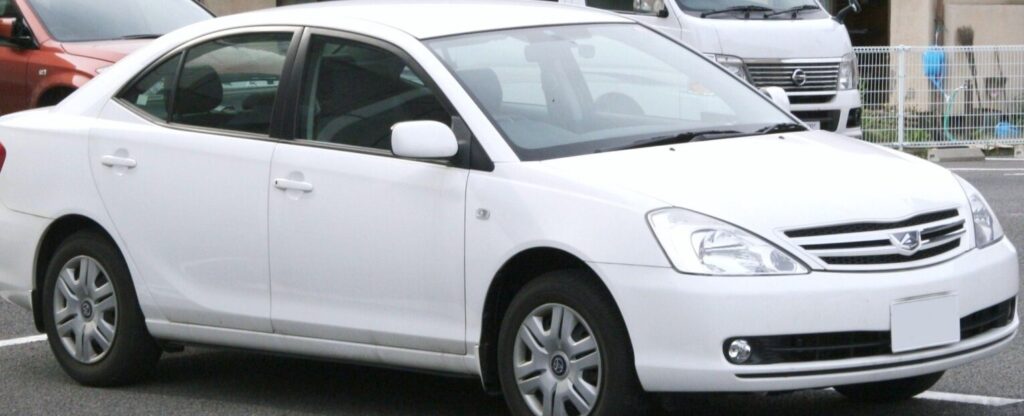
The Toyota Allion 2.0 i 16V D-4 (152 Hp) CVT, produced between 2001 and 2004, represents a significant iteration within the Allion lineage. Positioned as a mid-range offering in Toyota’s lineup, this variant aimed to balance performance, fuel efficiency, and comfort for the Japanese domestic market (JDM). The Allion, a compact sedan, was designed to appeal to buyers seeking a practical and reliable vehicle with a touch of refinement. This specific 2.0-liter configuration, paired with a Continuously Variable Transmission (CVT), offered a smooth driving experience and was a popular choice for those prioritizing ease of use over outright sporty handling.
Technical Specifications
| Brand | Toyota |
| Model | Allion |
| Type | 2.0 i 16V D-4 (152 Hp) CVT |
| Start of production | 2001 |
| End of production | 2004 |
| Powertrain Architecture | Internal Combustion engine |
| Body type | Sedan |
| Seats | 5 |
| Doors | 4 |
| Fuel consumption (urban) | 10 l/100 km (23.5 US mpg) |
| Fuel consumption (extra urban) | 6 l/100 km (39.2 US mpg) |
| Fuel Type | Petrol (Gasoline) |
| Maximum speed | 200 km/h (124.27 mph) |
| Weight-to-power ratio | 8.2 kg/Hp |
| Weight-to-torque ratio | 6.2 kg/Nm |
| Power | 152 Hp @ 6000 rpm |
| Power per litre | 76.1 Hp/l |
| Torque | 200 Nm @ 4000 rpm (147.51 lb.-ft. @ 4000 rpm) |
| Engine layout | Front, Transverse |
| Engine Model/Code | 1AZ-FSE |
| Engine displacement | 1998 cm3 (121.93 cu. in.) |
| Number of cylinders | 4 |
| Engine configuration | Inline |
| Cylinder Bore | 86 mm (3.39 in.) |
| Piston Stroke | 86 mm (3.39 in.) |
| Compression ratio | 9.8:1 |
| Number of valves per cylinder | 4 |
| Fuel injection system | Direct injection |
| Engine aspiration | Naturally aspirated |
| Valvetrain | DOHC |
| Engine oil capacity | 4.2 l (4.44 US qt | 3.7 UK qt) |
| Coolant capacity | 7 l (7.4 US qt | 6.16 UK qt) |
| Kerb Weight | 1240 kg (2733.73 lbs.) |
| Max. weight | 1515 kg (3340 lbs.) |
| Max load | 275 kg (606.27 lbs.) |
| Fuel tank capacity | 60 l (15.85 US gal | 13.2 UK gal) |
| Length | 4600 mm (181.1 in.) |
| Width | 1695 mm (66.73 in.) |
| Height | 1470 mm (57.87 in.) |
| Wheelbase | 2700 mm (106.3 in.) |
| Front track | 1480 mm (58.27 in.) |
| Rear track | 1460 mm (57.48 in.) |
| Ride height (ground clearance) | 160 mm (6.3 in.) |
| Minimum turning circle | 10.6 m (34.78 ft.) |
| Drivetrain | Front wheel drive |
| Number of gears/gearbox type | 1 gear, automatic transmission CVT |
| Front suspension | Spring Strut |
| Rear suspension | Suspension with traction connecting levers |
| Front brakes | Ventilated discs |
| Rear brakes | Drum |
| Assisting systems | ABS (Anti-lock braking system) |
| Steering type | Steering rack and pinion |
| Power steering | Hydraulic |
| Tires size | 185/70 R14 |
| Wheel rims size | 6J x 14 |
Powertrain & Engine Architecture
At the heart of the Allion 2.0 i D-4 CVT lies the 1AZ-FSE engine, a 1.998-liter inline-four cylinder powerplant. This engine is notable for its direct fuel injection (D-4 technology), which improves combustion efficiency and contributes to better fuel economy and reduced emissions. The 1AZ-FSE utilizes a double overhead camshaft (DOHC) valvetrain, optimizing airflow into and out of the cylinders for increased power output. The engine produces 152 horsepower at 6000 rpm and 200 Nm (147.51 lb-ft) of torque at 4000 rpm. The CVT transmission, a key feature of this variant, provides a seamless and continuously variable gear ratio, enhancing fuel efficiency and offering a smooth driving experience. Unlike traditional automatic transmissions with fixed gear steps, the CVT adjusts the gear ratio continuously to keep the engine operating at its most efficient point.
Driving Characteristics
The 2.0-liter engine and CVT combination in the Allion delivers a comfortable and refined driving experience. While not designed for outright performance, the engine provides adequate power for everyday driving situations, including highway merging and overtaking. The CVT transmission contributes to a smooth and linear acceleration feel, although some drivers may find it lacks the responsiveness of a traditional automatic or manual transmission. Compared to the base 1.5-liter models, the 2.0-liter Allion offers noticeably more power and torque, resulting in quicker acceleration and improved performance when fully loaded. The CVT’s gear ratios are optimized for fuel efficiency, but can be programmed for more aggressive shifting in “sport” mode (if equipped), providing a more engaging driving experience.
Equipment & Trim Levels
The Allion 2.0 i D-4 CVT typically came equipped with a range of standard features, including air conditioning, power windows, power door locks, and a basic audio system. Higher trim levels offered additional features such as alloy wheels, a more sophisticated audio system with CD player, and optional extras like a sunroof and leather upholstery. Interior appointments generally featured cloth seats and a functional, if somewhat understated, dashboard design. The focus was on practicality and durability rather than luxurious materials.
Chassis & Braking
The Allion’s chassis utilizes a front strut suspension and a rear torsion beam suspension. This setup provides a comfortable ride quality, suitable for everyday commuting. The front brakes are ventilated discs, offering good stopping power, while the rear brakes are drums, a cost-saving measure common in this class of vehicle. Anti-lock Braking System (ABS) was standard, enhancing safety by preventing wheel lockup during hard braking. The steering is a rack and pinion system with hydraulic power assistance, providing light and easy steering feel.
Market Reception & Comparison
The Toyota Allion 2.0 i D-4 CVT was generally well-received in the Japanese market. Critics praised its fuel efficiency, smooth ride, and reliable powertrain. Compared to other compact sedans in its class, such as the Nissan Sentra and Honda Civic, the Allion offered a competitive combination of features and value. The CVT transmission was a selling point for many buyers, offering a unique driving experience and improved fuel economy. However, some reviewers noted that the engine lacked the sporty character of some competitors.
Legacy
The 1AZ-FSE engine, found in the Allion 2.0 i, is known for its overall reliability, provided it receives regular maintenance. The CVT transmission, while generally durable, can require specialized servicing. In the used car market, these Allions are often sought after for their affordability, fuel efficiency, and Toyota’s reputation for dependability. Common issues, if any, tend to be related to age and mileage, such as wear and tear on suspension components and potential CVT fluid degradation. Overall, the Allion 2.0 i D-4 CVT remains a practical and reliable choice for buyers seeking a well-maintained and affordable compact sedan.
