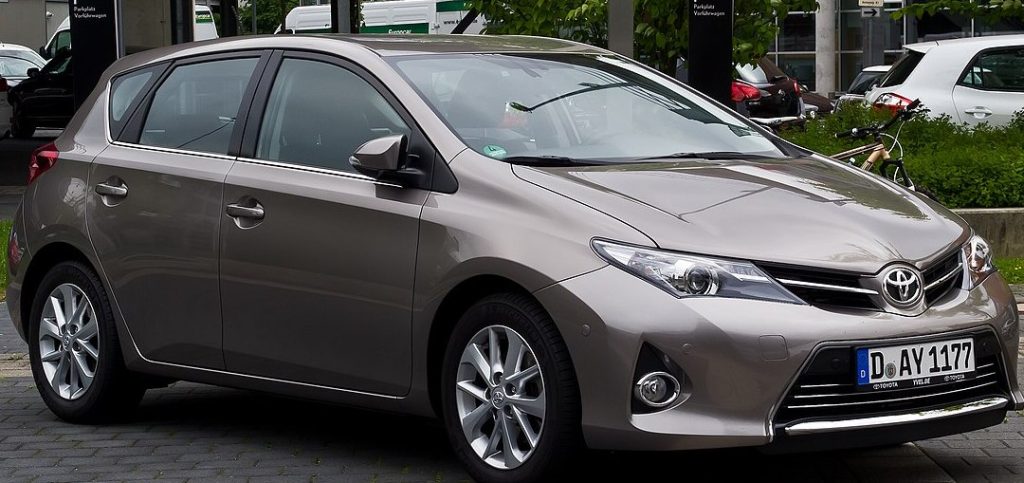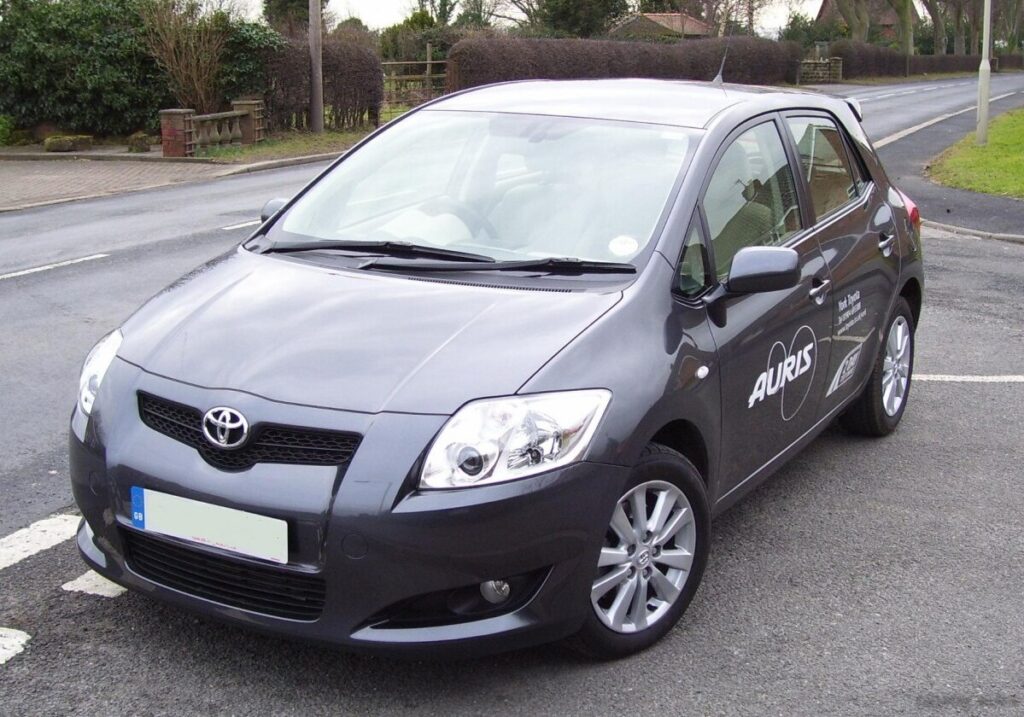
The Toyota Auris I 1.6i 16V VVT-i, produced between 2006 and 2010, represented Toyota’s entry into the competitive European compact hatchback segment. Positioned as a replacement for the Corolla Hatchback in Europe, the Auris aimed to offer a more modern and stylish alternative while retaining Toyota’s reputation for reliability. This specific 1.6-liter variant, producing 124 horsepower, served as a core model within the Auris range, offering a balance between affordability, fuel efficiency, and everyday usability. It was a key component of the first-generation Auris (E150 series), built on the Toyota New MC platform, shared with the Corolla.
Technical Specifications
| Brand | Toyota |
| Model | Auris |
| Generation | Auris I |
| Type (Engine) | 1.6i 16V VVT-i (124 Hp) |
| Start of production | 2006 |
| End of production | 2010 |
| Powertrain Architecture | Internal Combustion engine |
| Body type | Hatchback |
| Seats | 5 |
| Doors | 5 |
| Fuel consumption (urban) | 9 l/100 km (26.1 US mpg, 31.4 UK mpg, 11.1 km/l) |
| Fuel consumption (extra urban) | 5.9 l/100 km (39.9 US mpg, 47.9 UK mpg, 16.9 km/l) |
| Fuel consumption (combined) | 7.1 l/100 km (33.1 US mpg, 39.8 UK mpg, 14.1 km/l) |
| Fuel Type | Petrol (Gasoline) |
| Acceleration 0 – 100 km/h | 10.4 sec |
| Acceleration 0 – 62 mph | 10.4 sec |
| Acceleration 0 – 60 mph | 9.9 sec |
| Maximum speed | 190 km/h (118.06 mph) |
| Emission standard | Euro 4 |
| Weight-to-power ratio | 9.9 kg/Hp |
| Weight-to-torque ratio | 7.8 kg/Nm |
| Power | 124 Hp @ 6000 rpm |
| Power per litre | 77.6 Hp/l |
| Torque | 157 Nm @ 5200 rpm (115.8 lb.-ft. @ 5200 rpm) |
| Engine layout | Front, Transverse |
| Engine Model/Code | 1ZR-FE |
| Engine displacement | 1598 cm3 (97.52 cu. in.) |
| Number of cylinders | 4 |
| Engine configuration | Inline |
| Cylinder Bore | 80.5 mm (3.17 in.) |
| Piston Stroke | 78.5 mm (3.09 in.) |
| Compression ratio | 10.2:1 |
| Number of valves per cylinder | 4 |
| Fuel injection system | Multi-port manifold injection |
| Engine aspiration | Naturally aspirated engine |
| Valvetrain | DOHC |
| Engine oil capacity | 4.2 l (4.44 US qt | 3.7 UK qt) |
| Coolant | 5.5 l (5.81 US qt | 4.84 UK qt) |
| Kerb Weight | 1230 kg (2711.69 lbs.) |
| Max. weight | 1750 kg (3858.09 lbs.) |
| Max load | 520 kg (1146.4 lbs.) |
| Trunk (boot) space – minimum | 354 l (12.5 cu. ft.) |
| Trunk (boot) space – maximum | 761 l (26.87 cu. ft.) |
| Fuel tank capacity | 55 l (14.53 US gal | 12.1 UK gal) |
| Length | 4220 mm (166.14 in.) |
| Width | 1760 mm (69.29 in.) |
| Height | 1515 mm (59.65 in.) |
| Wheelbase | 2600 mm (102.36 in.) |
| Front track | 1524 mm (60 in.) |
| Rear (Back) track | 1522 mm (59.92 in.) |
| Minimum turning circle | 10.2 m (33.46 ft.) |
| Drivetrain Architecture | Front wheel drive |
| Drive wheel | Front wheel drive |
| Number of gears | 5 gears, manual transmission |
| Front suspension | Independent type McPherson |
| Rear suspension | Torsion |
| Front brakes | Ventilated discs |
| Rear brakes | Disc |
| Assisting systems | ABS (Anti-lock braking system) |
| Steering type | Steering rack and pinion |
| Tires size | 205/55 R16 |
Powertrain & Engine Architecture
The heart of the Auris 1.6i was the 1ZR-FE engine, a 1.6-liter inline-four cylinder gasoline engine. This engine was part of Toyota’s ZR engine family, known for its reliability and relatively simple design. The 1ZR-FE featured a dual overhead camshaft (DOHC) valvetrain with four valves per cylinder, and Toyota’s Variable Valve Timing-intelligent (VVT-i) system. VVT-i adjusted the timing of both intake and exhaust valves based on engine speed and load, optimizing performance and fuel efficiency. Fuel delivery was handled by a multi-port fuel injection system. The engine produced 124 horsepower at 6000 rpm and 157 Nm (115.8 lb-ft) of torque at 5200 rpm. The Auris 1.6i was typically paired with a five-speed manual transmission, but a four-speed automatic transmission was also available, impacting acceleration and fuel economy.
Driving Characteristics
The 1.6i engine, when coupled with the five-speed manual transmission, provided adequate performance for everyday driving. Acceleration from 0-60 mph took around 9.9 seconds, and top speed was approximately 118 mph. The engine felt responsive enough for city driving and highway cruising, although it lacked the outright punch of the higher-powered 1.8-liter or diesel variants. The automatic transmission, while offering convenience, noticeably dulled acceleration and increased fuel consumption. Gear ratios were tuned for fuel efficiency rather than sporty performance. The Auris 1.6i prioritized comfort and ease of use over dynamic handling, offering a smooth and predictable driving experience.
Equipment & Trim Levels
The Auris 1.6i typically came with a reasonable level of standard equipment. Base models included power steering, central locking, electric front windows, and an audio system. Higher trim levels, such as the ‘TR’ and ‘SR’ models, added features like alloy wheels, air conditioning, a multi-function steering wheel, and upgraded interior trim. Interior upholstery was typically cloth, with options for different colors and patterns. Optional extras included a sunroof, rear parking sensors, and a navigation system. The dashboard layout was functional and straightforward, prioritizing ergonomics and ease of use.
Chassis & Braking
The Auris I utilized a McPherson strut front suspension and a torsion beam rear suspension. This setup provided a comfortable ride quality, absorbing bumps and imperfections in the road effectively. The front brakes were ventilated discs, while the rear brakes were solid discs. Anti-lock Braking System (ABS) was standard, enhancing safety and control during emergency braking. The steering was a rack and pinion system, providing precise and responsive steering feel. The Auris 1.6i’s suspension was tuned for comfort rather than sporty handling, resulting in a slight degree of body roll during cornering.
Market Reception & Comparison
The Auris 1.6i was generally well-received by automotive critics as a practical and reliable family hatchback. It was praised for its comfortable ride, spacious interior, and fuel efficiency. However, some critics found the engine to be somewhat underpowered, particularly when compared to competitors like the Ford Focus or Volkswagen Golf. The 1.8-liter Auris offered significantly more performance, while the diesel variants provided superior fuel economy. The 1.6i was positioned as the entry-level model, appealing to buyers who prioritized affordability and practicality over outright performance. Its fuel economy figures of around 33.1 US mpg combined were competitive for its class.
Legacy
The Toyota Auris I 1.6i 16V VVT-i has proven to be a remarkably reliable vehicle. The 1ZR-FE engine is known for its durability and longevity, and with regular maintenance, it can easily exceed 150,000 miles. In the used car market, the Auris 1.6i remains a popular choice for buyers seeking an affordable and dependable compact hatchback. While it may not offer the most exciting driving experience, its reputation for reliability and low running costs makes it a sensible and practical option. Parts availability is generally good, and maintenance costs are relatively low, contributing to its continued appeal.