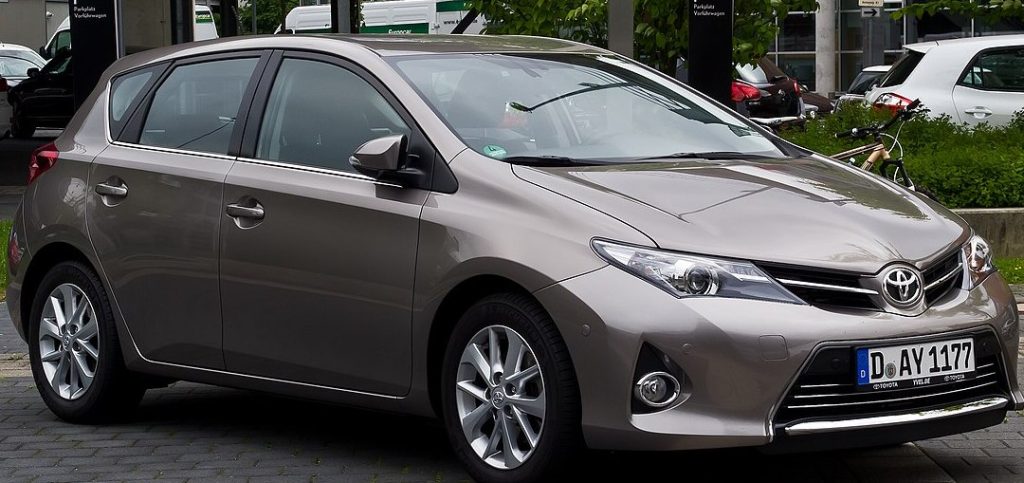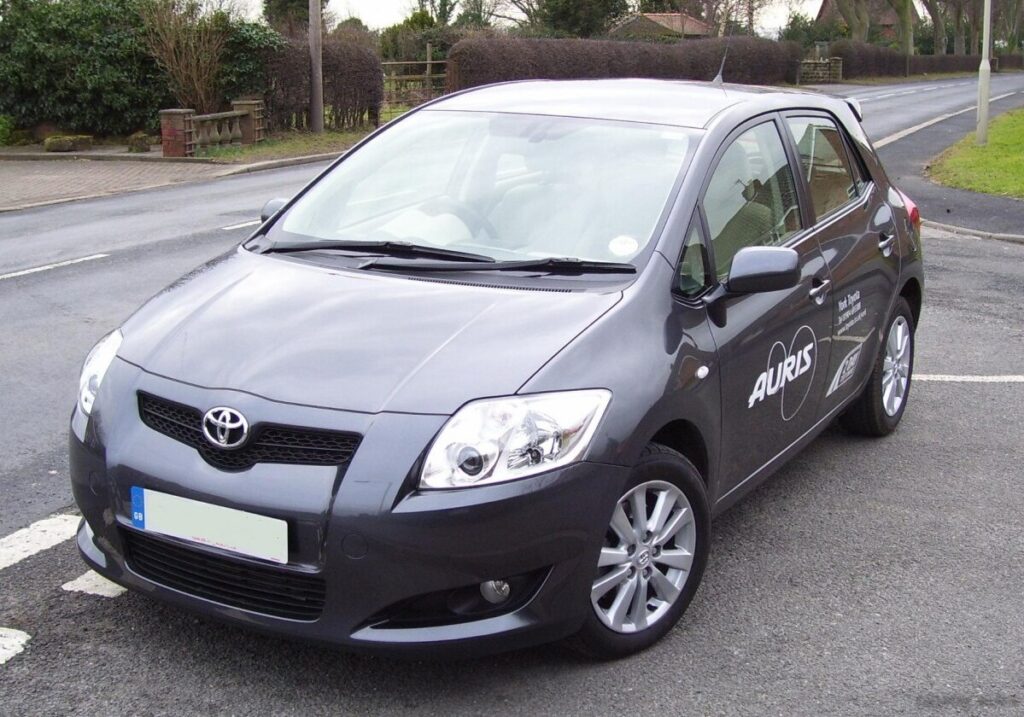
The Toyota Auris I 1.6i 16V VVT-i Automatic, produced between 2006 and 2010, represented a key offering in Toyota’s European C-segment hatchback lineup. Positioned as a mainstream, practical choice, this variant aimed to provide a balance of fuel efficiency, affordability, and ease of use. It was part of the first generation Auris (code name E150/NDE150), which was designed specifically for the European market to replace the Corolla Hatchback, offering a more modern and stylish alternative. This model competed directly with vehicles like the Volkswagen Golf, Ford Focus, and Opel/Vauxhall Astra.
Technical Specifications
| Brand | Toyota |
| Model | Auris |
| Generation | Auris I |
| Type (Engine) | 1.6i 16V VVT-i (124 Hp) Automatic |
| Start of production | 2006 |
| End of production | 2010 |
| Powertrain Architecture | Internal Combustion engine |
| Body type | Hatchback |
| Seats | 5 |
| Doors | 5 |
| Fuel consumption (urban) | 9 l/100 km (26.1 US mpg, 31.4 UK mpg, 11.1 km/l) |
| Fuel consumption (extra urban) | 5.9 l/100 km (39.9 US mpg, 47.9 UK mpg, 16.9 km/l) |
| Fuel consumption (combined) | 7.1 l/100 km (33.1 US mpg, 39.8 UK mpg, 14.1 km/l) |
| Fuel Type | Petrol (Gasoline) |
| Acceleration 0 – 100 km/h | 10.4 sec |
| Acceleration 0 – 62 mph | 10.4 sec |
| Acceleration 0 – 60 mph | 9.9 sec |
| Maximum speed | 190 km/h (118.06 mph) |
| Emission standard | Euro 4 |
| Weight-to-power ratio | 9.9 kg/Hp |
| Weight-to-torque ratio | 7.8 kg/Nm |
| Power | 124 Hp @ 6000 rpm |
| Torque | 157 Nm @ 5200 rpm (115.8 lb.-ft. @ 5200 rpm) |
| Engine layout | Front, Transverse |
| Engine Model/Code | 1ZR-FE |
| Engine displacement | 1598 cm3 (97.52 cu. in.) |
| Number of cylinders | 4 |
| Engine configuration | Inline |
| Cylinder Bore | 80.5 mm (3.17 in.) |
| Piston Stroke | 78.5 mm (3.09 in.) |
| Compression ratio | 10.2:1 |
| Number of valves per cylinder | 4 |
| Fuel injection system | Multi-port manifold injection |
| Engine aspiration | Naturally aspirated engine |
| Valvetrain | DOHC |
| Engine oil capacity | 4.2 l (4.44 US qt | 3.7 UK qt) |
| Coolant capacity | 5.6 l (5.92 US qt | 4.93 UK qt) |
| Kerb Weight | 1230 kg (2711.69 lbs.) |
| Max. weight | 1750 kg (3858.09 lbs.) |
| Max load | 520 kg (1146.4 lbs.) |
| Trunk (boot) space – minimum | 354 l (12.5 cu. ft.) |
| Trunk (boot) space – maximum | 761 l (26.87 cu. ft.) |
| Fuel tank capacity | 55 l (14.53 US gal | 12.1 UK gal) |
| Length | 4220 mm (166.14 in.) |
| Width | 1760 mm (69.29 in.) |
| Height | 1515 mm (59.65 in.) |
| Wheelbase | 2600 mm (102.36 in.) |
| Front track | 1524 mm (60 in.) |
| Rear track | 1522 mm (59.92 in.) |
| Minimum turning circle | 10.2 m (33.46 ft.) |
| Drivetrain Architecture | Front wheel drive |
| Number of gears | 5 |
| Gearbox type | Automatic transmission |
| Front suspension | Independent type McPherson |
| Rear suspension | Torsion |
| Front brakes | Ventilated discs |
| Rear brakes | Disc |
| Assisting systems | ABS (Anti-lock braking system) |
| Steering type | Steering rack and pinion |
| Tires size | 205/55 R16 |
| Wheel rims size | 16 |
INTRODUCTION
The Toyota Auris I 1.6i 16V VVT-i Automatic, launched in 2006, was a crucial model for Toyota in Europe. Designed to appeal to a broad audience, it offered a practical and reliable hatchback option. The “1.6i” designation refers to the engine displacement, while “16V” indicates the four valves per cylinder. VVT-i (Variable Valve Timing-intelligent) was Toyota’s technology for improving engine efficiency and performance. The automatic transmission option provided convenience, particularly for urban driving, and broadened the car’s appeal to drivers who preferred not to operate a manual gearbox. This variant sat in the middle of the Auris range, offering a step up from the base 1.4L engine but remaining more affordable than the higher-specification 1.8L and diesel options.
Powertrain & Engine Architecture
The heart of this Auris variant is the 1ZR-FE engine, a 1.6-liter inline-four cylinder gasoline engine. This engine utilizes multi-port fuel injection and Toyota’s VVT-i system, which dynamically adjusts the timing of the intake and exhaust valves to optimize performance and fuel economy across the engine’s operating range. The 1ZR-FE is a naturally aspirated engine, meaning it doesn’t employ turbocharging or supercharging. The engine produces 124 horsepower at 6000 rpm and 157 Nm (115.8 lb-ft) of torque at 5200 rpm. Paired with this engine is a four-speed automatic transmission. While not the most modern transmission in terms of gear count, it was known for its reliability and smooth operation. The transmission’s gear ratios were tuned for comfortable cruising and adequate acceleration, prioritizing fuel efficiency over outright performance.
Driving Characteristics
The 1.6i Automatic Auris offered a comfortable and predictable driving experience. Acceleration from 0-60 mph took around 9.9 seconds, which was adequate for everyday driving but not particularly sporty. The automatic transmission, while smooth, could sometimes feel hesitant during quick acceleration or when attempting to overtake. Compared to the manual transmission version of the same engine, the automatic resulted in a slight performance decrease due to the transmission’s inherent efficiency losses. The gear ratios were spaced to provide reasonable fuel economy, but this came at the expense of responsiveness. The Auris’s suspension provided a comfortable ride, absorbing bumps and imperfections in the road well. However, it wasn’t particularly engaging for enthusiastic drivers, prioritizing comfort over handling precision.
Equipment & Trim Levels
The 1.6i Automatic Auris typically came equipped with a reasonable level of standard features. These included air conditioning, power windows, power door locks, central locking, and an audio system with CD player. Safety features such as ABS (Anti-lock Braking System) and multiple airbags were also standard. Higher trim levels, such as the ‘SR’ or ‘Style’ variants, added features like alloy wheels, fog lights, a multi-function steering wheel, and upgraded interior trim. Optional extras included a sunroof, satellite navigation, and parking sensors. Interior upholstery was typically cloth, with a relatively simple and functional dashboard layout.
Chassis & Braking
The Auris I utilized a front-wheel-drive layout with an independent McPherson strut suspension at the front and a torsion beam suspension at the rear. This suspension setup provided a good balance of ride comfort and handling. The braking system consisted of ventilated discs at the front and solid discs at the rear, providing adequate stopping power for the vehicle’s weight and performance. ABS was standard, enhancing braking performance and stability, particularly on slippery surfaces. The steering was a rack and pinion system, offering light and precise steering feel.
Market Reception & Comparison
The Toyota Auris I 1.6i Automatic was generally well-received by critics as a practical and reliable family hatchback. It was praised for its comfortable ride, fuel efficiency, and Toyota’s reputation for build quality. However, it was sometimes criticized for its uninspiring driving dynamics and the relatively dated four-speed automatic transmission compared to competitors offering five or six-speed automatics. Compared to the 1.4L engine, the 1.6i offered noticeably more power and a more relaxed driving experience. The 1.8L engine provided even more performance, but at a higher price point. The diesel variants (primarily the 1.4 D-4D and 2.0 D-4D) offered superior fuel economy but came with a higher initial cost and potentially higher maintenance expenses.
Legacy
The Toyota Auris I 1.6i Automatic has proven to be a reliable and durable vehicle. The 1ZR-FE engine is known for its longevity and relatively low maintenance requirements. In the used car market, these Auris models are often sought after for their affordability, practicality, and Toyota’s reputation for reliability. While not a particularly exciting car to drive, it remains a sensible and dependable choice for those seeking a comfortable and economical hatchback. Common issues are relatively minor, often relating to wear and tear on suspension components or routine maintenance items. The availability of spare parts is excellent, and the car’s relatively simple mechanical design makes it relatively easy and affordable to repair.