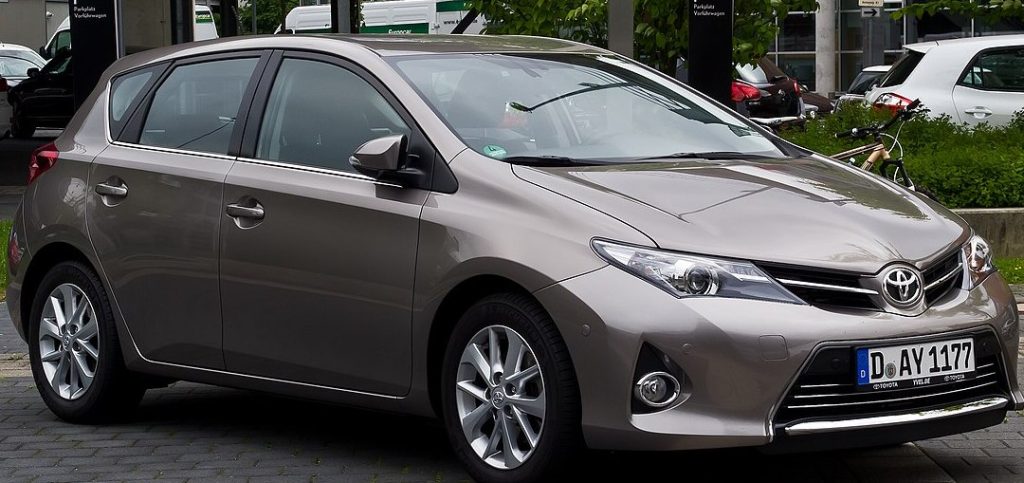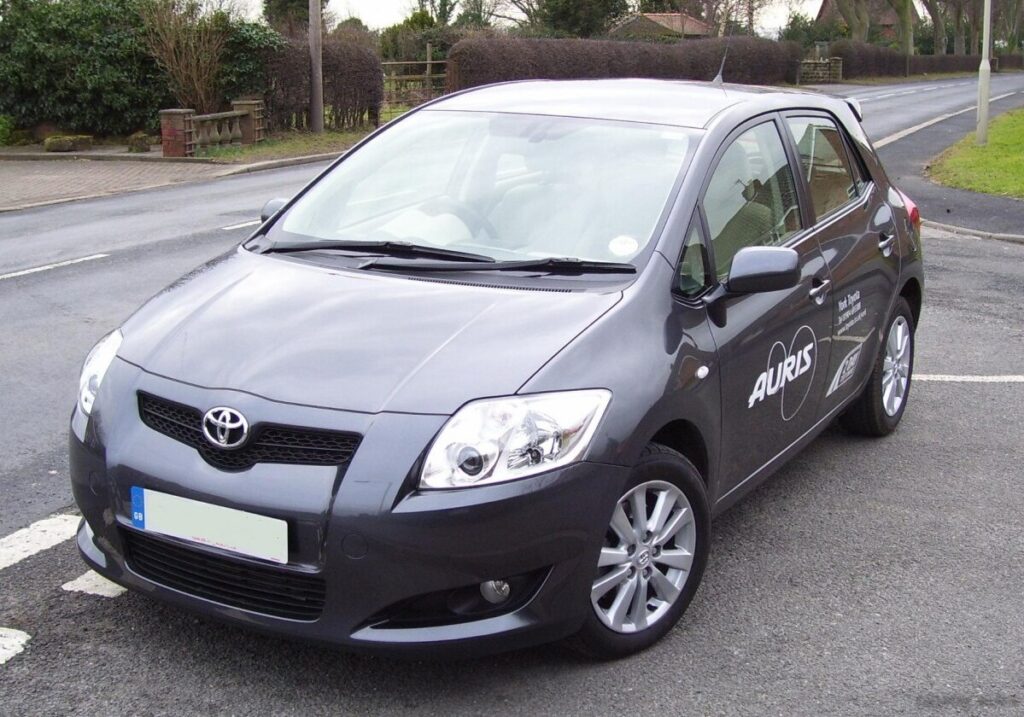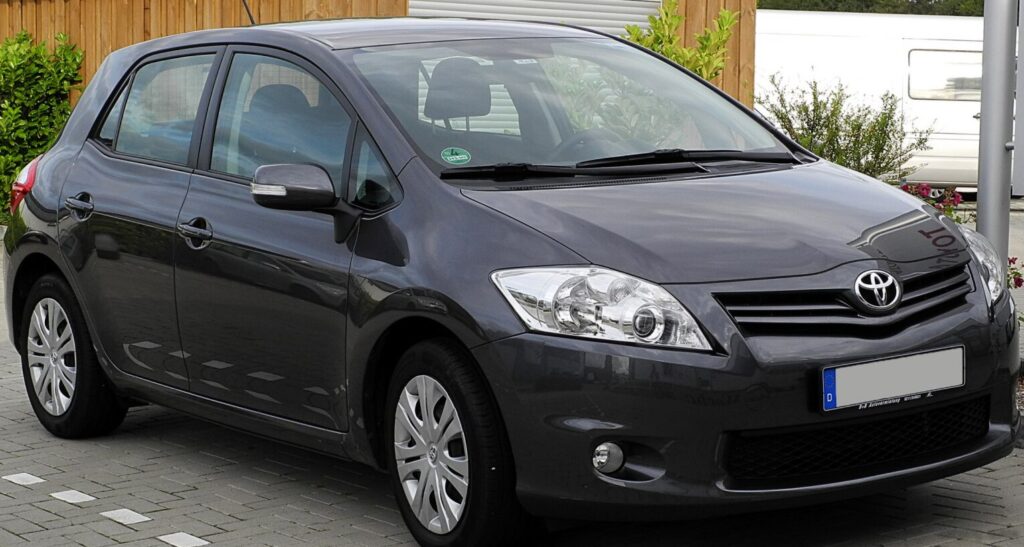
The Toyota Auris I (facelift, 2010-2012) 1.8 16V Valvematic, producing 147 horsepower, represented a significant step up in performance and technology for Toyota’s compact hatchback offering in the European market. Introduced as part of the Auris’ mid-life refresh, this variant aimed to appeal to drivers seeking a more engaging driving experience without sacrificing the practicality and reliability Toyota was known for. It sat in the mid-range of the Auris lineup, positioned above the 1.33 and 1.6 liter models, and below the later introduction of hybrid variants. This model was never officially sold in the United States, but represents a key evolution in Toyota’s global compact car strategy.
Technical Specifications
| Brand | Toyota |
| Model | Auris |
| Generation | Auris I (facelift 2010) |
| Type (Engine) | 1.8 16V Valvematic (147 Hp) |
| Start of production | 2010 |
| End of production | 2012 |
| Powertrain Architecture | Internal Combustion engine |
| Body type | Hatchback |
| Seats | 5 |
| Doors | 5 |
| Fuel consumption (urban) | 8.7 l/100 km (27 US mpg, 32.5 UK mpg, 11.5 km/l) |
| Fuel consumption (extra urban) | 5.5 l/100 km (42.8 US mpg, 51.4 UK mpg, 18.2 km/l) |
| Fuel consumption (combined) | 6.7 l/100 km (35.1 US mpg, 42.2 UK mpg, 14.9 km/l) |
| Fuel Type | Petrol (Gasoline) |
| Acceleration 0 – 100 km/h | 9.5 sec |
| Acceleration 0 – 62 mph | 9.5 sec |
| Acceleration 0 – 60 mph | 9 sec |
| Maximum speed | 200 km/h (124.27 mph) |
| Emission standard | Euro 5 |
| Weight-to-power ratio | 8.5 kg/Hp, 118.1 Hp/tonne |
| Weight-to-torque ratio | 6.9 kg/Nm, 144.6 Nm/tonne |
| Power | 147 Hp @ 6400 rpm |
| Power per litre | 81.8 Hp/l |
| Torque | 180 Nm @ 4000 rpm (132.76 lb.-ft. @ 4000 rpm) |
| Engine layout | Front, Transverse |
| Engine Model/Code | 2ZR-FAE |
| Engine displacement | 1798 cm3 (109.72 cu. in.) |
| Number of cylinders | 4 |
| Engine configuration | Inline |
| Number of valves per cylinder | 4 |
| Fuel injection system | Multi-port manifold injection |
| Engine aspiration | Naturally aspirated engine |
| Valvetrain | DOHC |
| Engine oil capacity | 4.2 l (4.44 US qt | 3.7 UK qt) |
| Coolant capacity | 5.6 l (5.92 US qt | 4.93 UK qt) |
| Kerb Weight | 1245 kg (2744.76 lbs.) |
| Max. weight | 1750 kg (3858.09 lbs.) |
| Max load | 505 kg (1113.33 lbs.) |
| Trunk (boot) space – minimum | 350 l (12.36 cu. ft.) |
| Trunk (boot) space – maximum | 750 l (26.49 cu. ft.) |
| Fuel tank capacity | 55 l (14.53 US gal | 12.1 UK gal) |
| Length | 4245 mm (167.13 in.) |
| Width | 1760 mm (69.29 in.) |
| Height | 1515 mm (59.65 in.) |
| Wheelbase | 2600 mm (102.36 in.) |
| Front track | 1525 mm (60.04 in.) |
| Rear track | 1525 mm (60.04 in.) |
| Minimum turning circle | 10.4 m (34.12 ft.) |
| Drivetrain Architecture | Front wheel drive |
| Drive wheel | Front wheel drive |
| Number of gears | 6 gears, manual transmission |
| Front suspension | Independent type McPherson |
| Rear suspension | Torsion |
| Front brakes | Ventilated discs |
| Rear brakes | Disc |
| Assisting systems | ABS (Anti-lock braking system) |
| Steering type | Steering rack and pinion |
| Tires size | 195/65 R15 |
| Wheel rims size | 15 |
INTRODUCTION
The Auris, launched in 2006, was Toyota’s attempt to create a more stylish and European-focused competitor in the compact hatchback segment, replacing the Corolla Hatchback in many markets. The 2010 facelift brought with it a revised front end, interior upgrades, and crucially, the introduction of the 1.8 16V Valvematic engine. This engine, part of Toyota’s ‘Valvematic’ family, offered improved efficiency and performance compared to the previous 1.6 liter engine. The 1.8L variant was aimed at buyers who wanted a more refined and capable driving experience, offering a balance between fuel economy and performance. It was a key model in Toyota’s strategy to appeal to a broader range of European consumers.
Powertrain & Engine Architecture
The heart of this Auris variant is the 2ZR-FAE 1.8-liter inline-four engine. This engine is notable for its Valvematic technology, a variable valve lift system that continuously adjusts the intake valve lift and timing based on driving conditions. Unlike traditional variable valve timing systems that only adjust valve *timing*, Valvematic alters the *amount* the valve opens, allowing for greater control over combustion and improved efficiency. The engine utilizes multi-port fuel injection and a double overhead camshaft (DOHC) configuration. The 180 Nm (132.76 lb-ft) of torque is delivered at 4000 rpm, providing a usable powerband for everyday driving. The engine is transversely mounted in the front of the vehicle, driving the front wheels. The six-speed manual transmission was the standard offering, providing precise gear changes and contributing to the car’s overall driving experience.
Driving Characteristics
The 1.8 16V Valvematic Auris offered a noticeable improvement in performance over the lower-displacement models. The 0-60 mph time of around 9 seconds was respectable for its class, and the engine felt responsive throughout the rev range. The six-speed manual transmission allowed drivers to keep the engine in its optimal powerband, enhancing acceleration. While not a sports car, the Auris 1.8 provided a more engaging driving experience than many of its competitors. Compared to the 1.6 liter version, the 1.8 felt more relaxed at highway speeds and offered more effortless overtaking capability. The gear ratios were well-chosen, providing a good balance between acceleration and fuel economy. The Valvematic system contributed to a smooth and linear power delivery, making the car easy to drive in a variety of conditions.
Equipment & Trim Levels
The 1.8 16V Valvematic Auris typically came with a good level of standard equipment. This included air conditioning, power windows, power mirrors, a CD player with auxiliary input, and ABS brakes. Higher trim levels added features such as alloy wheels, a multi-function steering wheel, cruise control, and automatic climate control. Interior upholstery was typically cloth, with options for upgraded materials on higher trims. The dashboard layout was functional and well-designed, with clear instrumentation and easy-to-use controls. Optional extras included a sunroof, parking sensors, and a navigation system.
Chassis & Braking
The Auris utilized a McPherson strut independent suspension at the front and a torsion beam suspension at the rear. This setup provided a comfortable ride quality while maintaining reasonable handling characteristics. The front brakes were ventilated discs, providing ample stopping power, while the rear brakes were solid discs. ABS (Anti-lock Braking System) was standard, enhancing safety in emergency braking situations. The steering was a rack and pinion system, offering precise and responsive steering feel. The 195/65 R15 tires provided a good balance between grip and ride comfort.
Market Reception & Comparison
The Auris 1.8 16V Valvematic was generally well-received by automotive critics. It was praised for its refined engine, comfortable ride, and good fuel economy. However, some critics noted that the interior styling was somewhat conservative and that the handling wasn’t as sporty as some of its rivals. Compared to the 1.6 liter Auris, the 1.8 offered significantly more performance and a more refined driving experience, but at a higher price point. The 1.8 also offered better fuel economy than some of its competitors, such as the Ford Focus 1.6 Ti-VCT. Reliability was a strong point, as expected from a Toyota, and the Auris generally proved to be a dependable and long-lasting vehicle.
Legacy
The 1.8 16V Valvematic engine proved to be a reliable and durable unit. Auris models equipped with this engine continue to be found on the used car market today, often with high mileage and a good service history. The Valvematic system, while complex, has proven to be relatively trouble-free. The Auris 1.8 represents a solid choice for buyers seeking a practical, reliable, and fuel-efficient compact hatchback. Its blend of performance, economy, and Toyota’s renowned build quality ensures its continued appeal in the used car market.