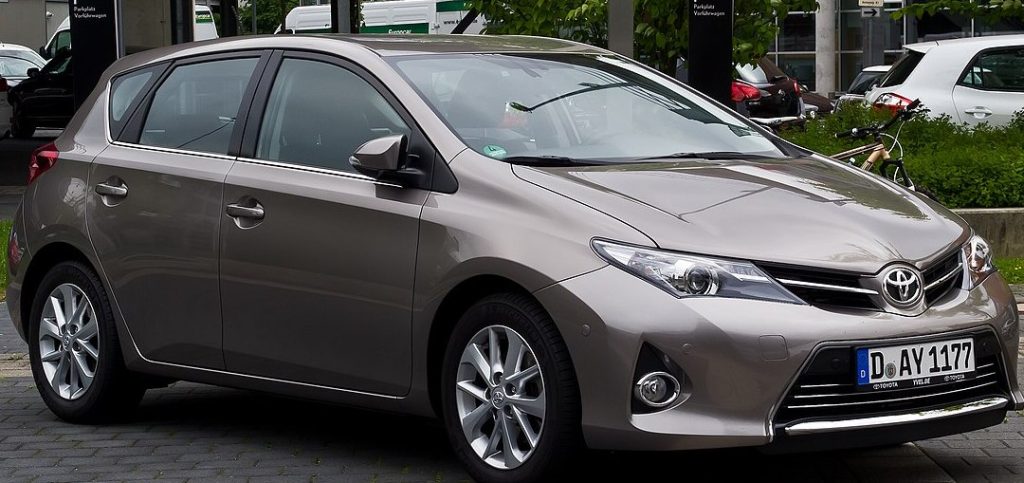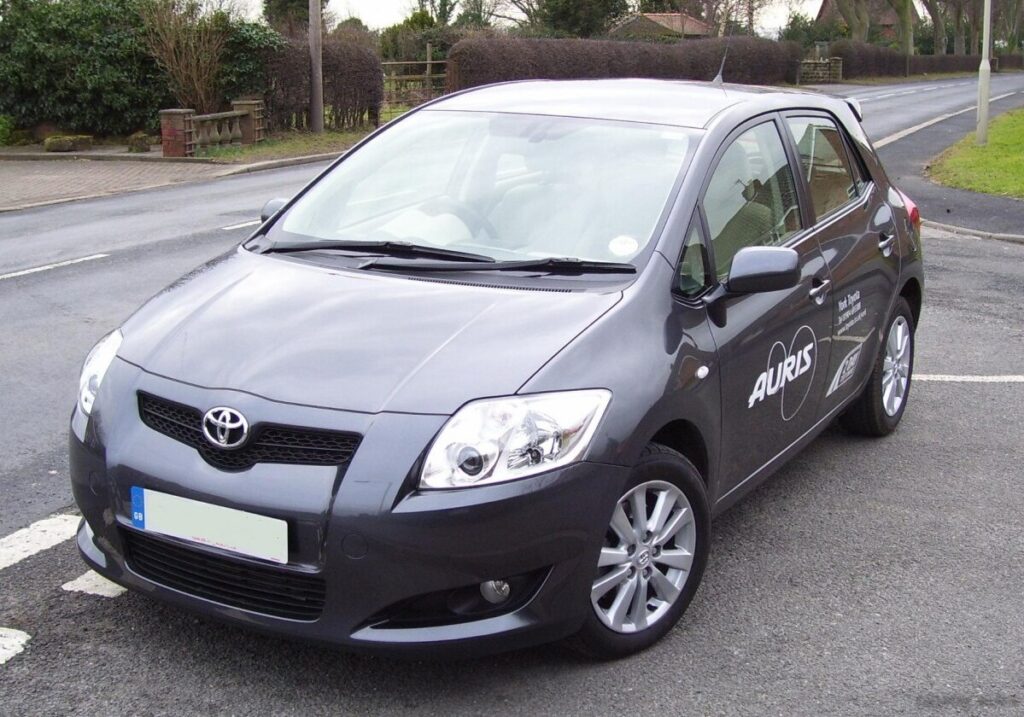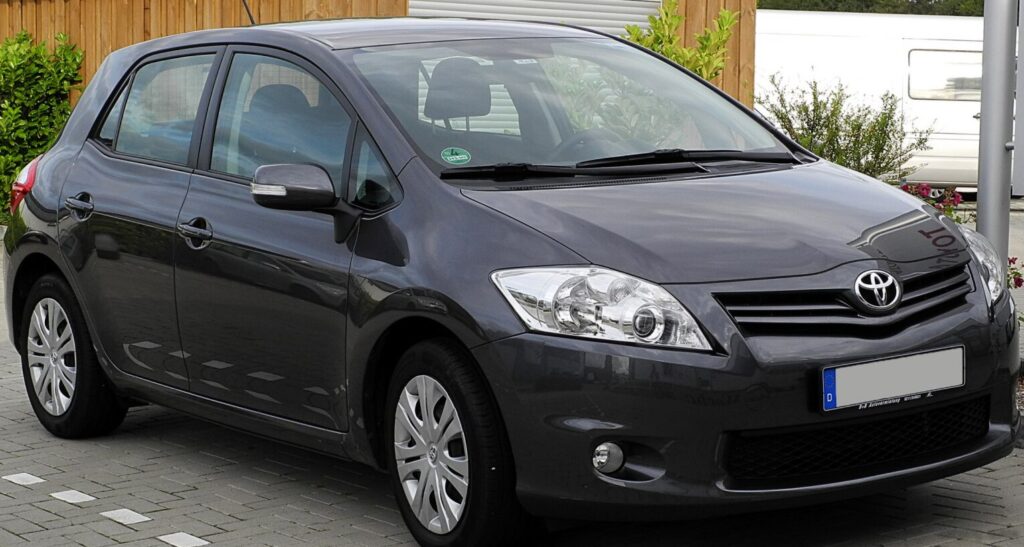
The Toyota Auris I (facelift, 2010-2012) 1.8 VVT-i Hybrid, equipped with the e-CVT transmission, represented a significant step forward in Toyota’s hybrid technology within the European compact hatchback market. Introduced as part of the Auris’s mid-life refresh, this variant combined a 1.8-liter gasoline engine with an electric motor, offering improved fuel economy and reduced emissions compared to traditional gasoline-powered Auris models. Positioned as a mid-range offering, it aimed to appeal to buyers seeking a practical, efficient, and technologically advanced vehicle. The Auris itself was Toyota’s challenger in the highly competitive C-segment, competing with vehicles like the Volkswagen Golf, Ford Focus, and Opel/Vauxhall Astra.
Technical Specifications
| Brand | Toyota |
| Model | Auris |
| Generation | Auris I (facelift 2010) |
| Type (Engine) | 1.8 VVT-i (136 Hp) Hybrid e-CVT |
| Start of production | 2010 |
| End of production | 2012 |
| Powertrain Architecture | FHEV (Full Hybrid Electric Vehicle) |
| Body type | Hatchback |
| Seats | 5 |
| Doors | 5 |
| Fuel consumption (urban) | 3.8-4 l/100 km (61.9 – 58.8 US mpg) |
| Fuel consumption (extra urban) | 3.8-4 l/100 km (61.9 – 58.8 US mpg) |
| Fuel consumption (combined) | 3.8-4 l/100 km (61.9 – 58.8 US mpg) |
| CO2 emissions | 89-93 g/km |
| Fuel Type | Petrol (Gasoline) |
| Acceleration 0 – 100 km/h | 11.4 sec |
| Acceleration 0 – 62 mph | 11.4 sec |
| Acceleration 0 – 60 mph | 10.8 sec |
| Maximum speed | 180 km/h (111.85 mph) |
| Emission standard | Euro 5 |
| Weight-to-power ratio | 10.1 kg/Hp |
| Weight-to-torque ratio | 9.7 kg/Nm |
| Battery voltage | 201.6 V |
| Battery technology | Nickel-metal hydride (NiMH) |
| All-electric range | 1.5 km (0.93 mi) |
| Max speed (electric) | 50 km/h (31.07 mph) |
| Electric motor power | 82 Hp |
| Electric motor Torque | 207 Nm (152.68 lb.-ft.) |
| System power | 136 Hp |
| Engine Power | 99 Hp @ 5200 rpm |
| Engine Torque | 142 Nm @ 4000 rpm (104.73 lb.-ft. @ 4000 rpm) |
| Engine displacement | 1798 cm3 (109.72 cu. in.) |
| Number of cylinders | 4 |
| Cylinder Bore | 80.5 mm (3.17 in.) |
| Piston Stroke | 88.3 mm (3.48 in.) |
| Fuel injection system | Multi-port manifold injection |
| Engine oil capacity | 4.2 l (4.44 US qt | 3.7 UK qt) |
| Coolant capacity | 6.5 l (6.87 US qt | 5.72 UK qt) |
| Kerb Weight | 1380-1420 kg (3042.38 – 3130.56 lbs.) |
| Max. weight | 1805 kg (3979.34 lbs.) |
| Max load | 385-425 kg (848.78 – 936.96 lbs.) |
| Trunk (boot) space (min) | 310 l (10.95 cu. ft.) |
| Trunk (boot) space (max) | 1290 l (45.56 cu. ft.) |
| Fuel tank capacity | 45 l (11.89 US gal | 9.9 UK gal) |
| Length | 4245 mm (167.13 in.) |
| Width | 1760 mm (69.29 in.) |
| Height | 1510 mm (59.45 in.) |
| Wheelbase | 2600 mm (102.36 in.) |
| Front track | 1515 mm (59.65 in.) |
| Rear track | 1515 mm (59.65 in.) |
| Front suspension | Independent type McPherson |
| Rear suspension | Torsion |
| Front brakes | Ventilated discs |
| Rear brakes | Disc |
| Gearbox | automatic transmission e-CVT |
Powertrain & Engine Architecture
The heart of the Auris Hybrid is the 2ZR-FXE 1.8-liter inline-four cylinder gasoline engine. This engine utilizes Toyota’s Valvematic technology, a continuously variable valve lift system, to optimize engine efficiency and power delivery. Valvematic allows for precise control of intake valve timing and lift, improving both fuel economy and responsiveness. The engine produces 99 horsepower at 5200 rpm and 142 Nm (104.73 lb-ft) of torque at 4000 rpm. Crucially, this engine is part of a full hybrid system, meaning it works in conjunction with an electric motor. The electric motor contributes an additional 82 horsepower and 207 Nm (152.68 lb-ft) of torque. The combined system output is 136 horsepower.
The e-CVT (electronically controlled continuously variable transmission) is a key component of the hybrid system. Unlike traditional CVTs that rely on belts and pulleys, Toyota’s e-CVT uses a planetary gearset to seamlessly blend the power from the gasoline engine and electric motor. This results in a smooth, linear acceleration feel without the stepped gear changes of a conventional automatic transmission. The e-CVT is integral to the Hybrid Synergy Drive system, allowing the vehicle to operate in electric-only mode at low speeds and under light loads, maximizing fuel efficiency.
Driving Characteristics
The 1.8 VVT-i Hybrid e-CVT Auris prioritizes fuel efficiency and smooth operation over outright performance. Acceleration from 0-60 mph takes approximately 10.8 seconds, and 0-100 km/h in 11.4 seconds, which is adequate for everyday driving but not particularly sporty. The e-CVT transmission contributes to a very refined driving experience, with seamless power delivery and minimal noise. The electric motor provides instant torque, which helps with initial acceleration and makes city driving particularly pleasant. However, under hard acceleration, the engine can become somewhat noisy as it works to maintain speed. Compared to the 1.6-liter gasoline Auris, the hybrid offers significantly better fuel economy, but slightly slower acceleration. Compared to a diesel Auris, the hybrid provides a quieter and more refined driving experience, but may not offer the same level of low-end torque.
Equipment & Trim Levels
The 1.8 VVT-i Hybrid typically came well-equipped, reflecting its position as a mid-range offering. Standard features often included air conditioning, power windows and mirrors, a CD/radio system with auxiliary input, and alloy wheels. Safety features such as ABS, traction control, and multiple airbags were also standard. Higher trim levels added features like automatic climate control, a touchscreen infotainment system, rear parking sensors, and cruise control. Interior upholstery was typically cloth, with options for partial leather trim. The dashboard layout was functional and modern, with a clear instrument cluster and logically arranged controls.
Chassis & Braking
The Auris Hybrid utilized a MacPherson strut front suspension and a torsion beam rear suspension. This setup provided a comfortable ride quality, suitable for everyday driving. The torsion beam rear suspension is a cost-effective solution that helps to minimize weight and complexity. The braking system consisted of ventilated discs on the front wheels and solid discs on the rear. ABS (Anti-lock Braking System) was standard, providing enhanced braking performance and stability. The steering was electrically assisted, offering light and precise control.
Market Reception & Comparison
The Toyota Auris Hybrid was generally well-received by critics, who praised its fuel efficiency, smooth ride, and refined driving experience. Its fuel economy of 3.8-4 l/100 km (61.9 – 58.8 US mpg) was a major selling point, particularly in Europe where fuel prices are high. However, some critics noted its relatively modest performance and the slightly higher price compared to non-hybrid Auris models. Compared to other hybrid vehicles in the C-segment, such as the Honda Civic Hybrid, the Auris offered a more conventional hatchback design and a more refined driving experience. Its reliability was also a strong point, consistent with Toyota’s reputation for building durable and dependable vehicles.
Legacy
The Toyota Auris Hybrid, particularly the 1.8 VVT-i e-CVT variant, has proven to be a reliable and durable vehicle. The Hybrid Synergy Drive system is known for its longevity, and many examples are still on the road today with high mileage. In the used car market, these Auris Hybrids hold their value relatively well, due to their fuel efficiency and reputation for reliability. The Auris Hybrid paved the way for Toyota’s continued success in the hybrid market, and its technology was later incorporated into other Toyota models, including the Prius and Corolla Hybrid.