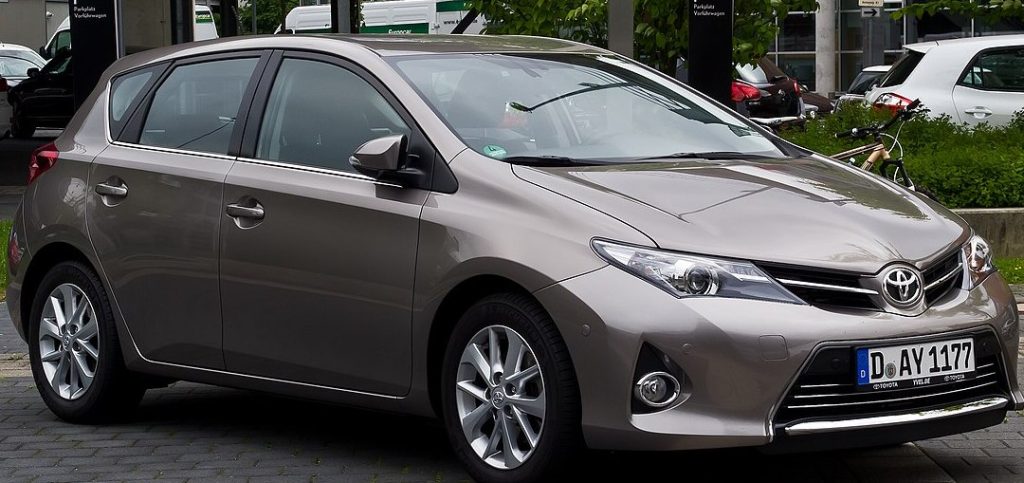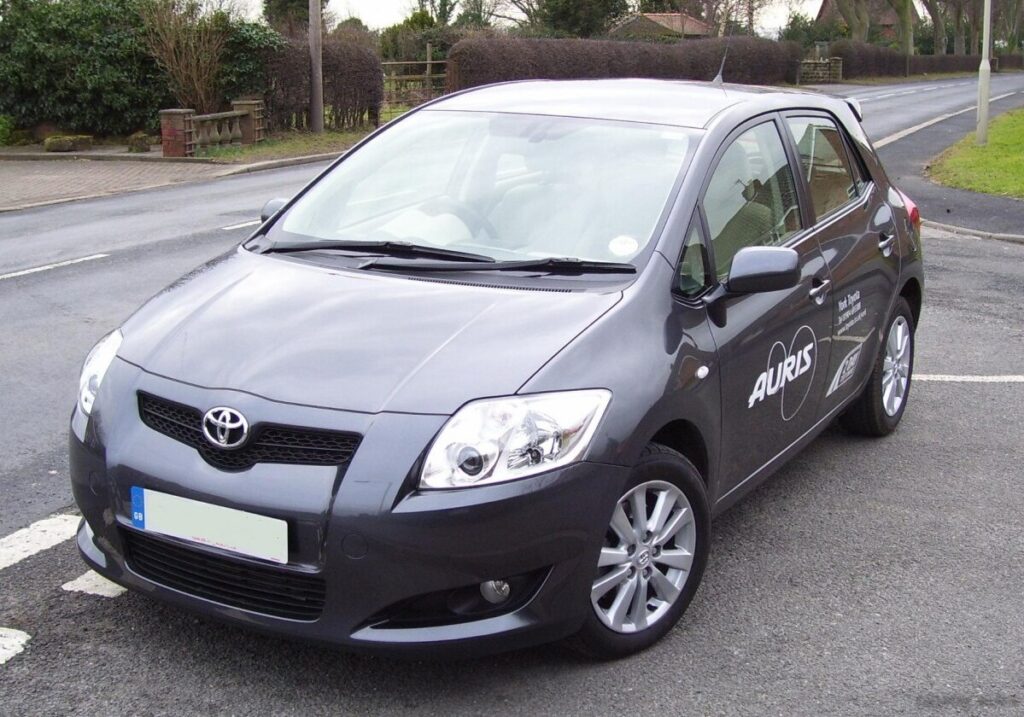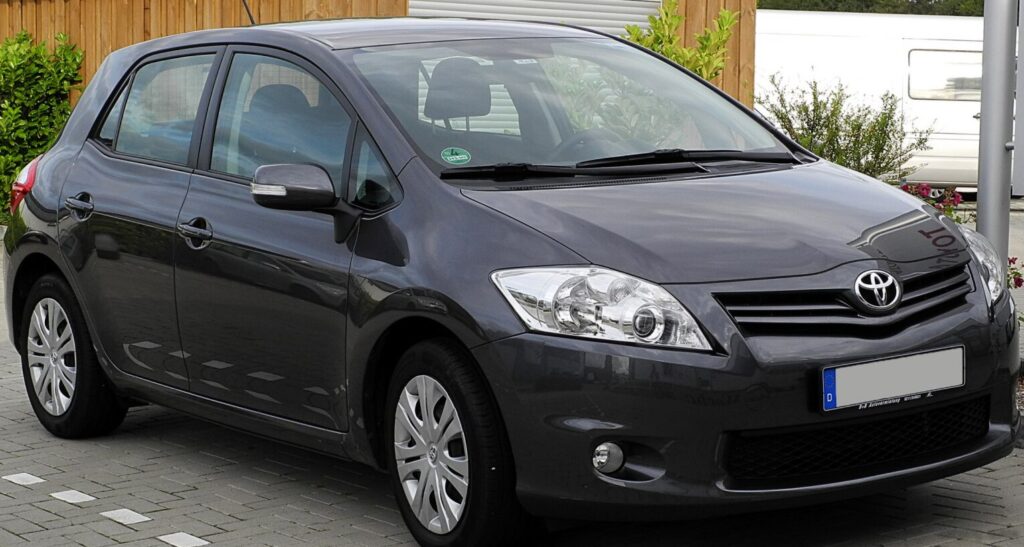
The Toyota Auris I (facelift, 2010-2012) 2.2 D-CAT, producing 177 horsepower, represented a significant offering in the European compact hatchback segment. Introduced as part of the Auris’ mid-life refresh, this variant aimed to provide a blend of fuel efficiency and performance, appealing to drivers seeking a more dynamic experience than the lower-powered petrol options. Positioned as a mid-to-upper trim level, it sat above the 1.6L petrol and 1.4L D-4D diesel models, but below any potential future performance-oriented trims. The Auris itself was Toyota’s attempt to create a more modern and European-focused competitor to established rivals like the Volkswagen Golf and Ford Focus, and the 2.2 D-CAT was a key component in that strategy.
Technical Specifications
| Brand | Toyota |
| Model | Auris |
| Generation | Auris I (facelift 2010) |
| Type (Engine) | 2.2 D-CAT (177 Hp) |
| Start of production | 2010 |
| End of production | 2012 |
| Powertrain Architecture | Internal Combustion engine |
| Body type | Hatchback |
| Seats | 5 |
| Doors | 5 |
| Fuel consumption (urban) | 7.3 l/100 km (32.2 US mpg, 38.7 UK mpg, 13.7 km/l) |
| Fuel consumption (extra urban) | 5 l/100 km (47 US mpg, 56.5 UK mpg, 20 km/l) |
| Fuel consumption (combined) | 5.9 l/100 km (39.9 US mpg, 47.9 UK mpg, 16.9 km/l) |
| CO2 emissions | 154 g/km |
| Fuel Type | Diesel |
| Acceleration 0 – 100 km/h | 8.1 sec |
| Acceleration 0 – 62 mph | 8.1 sec |
| Acceleration 0 – 60 mph | 7.7 sec |
| Maximum speed | 210 km/h (130.49 mph) |
| Emission standard | Euro 5 |
| Weight-to-power ratio | 8.1 kg/Hp, 123.8 Hp/tonne |
| Weight-to-torque ratio | 3.6 kg/Nm, 279.7 Nm/tonne |
| Power | 177 Hp @ 3600 rpm |
| Power per litre | 79.3 Hp/l |
| Torque | 400 Nm @ 2000-2800 rpm (295.02 lb.-ft. @ 2000-2800 rpm) |
| Engine layout | Front, Transverse |
| Engine Model/Code | 2AD-FHV |
| Engine displacement | 2231 cm3 (136.14 cu. in.) |
| Number of cylinders | 4 |
| Engine configuration | Inline |
| Cylinder Bore | 86 mm (3.39 in.) |
| Piston Stroke | 96 mm (3.78 in.) |
| Compression ratio | 15.7:1 |
| Number of valves per cylinder | 4 |
| Fuel injection system | Diesel Commonrail |
| Engine aspiration | Turbocharger, Intercooler |
| Valvetrain | DOHC |
| Engine oil capacity | 6.3 l (6.66 US qt | 5.54 UK qt) |
| Coolant capacity | 7.4 l (7.82 US qt | 6.51 UK qt) |
| Kerb Weight | 1430-1470 kg (3152.61 – 3240.8 lbs.) |
| Max. weight | 1920 kg (4232.88 lbs.) |
| Max load | 450-490 kg (992.08 – 1080.27 lbs.) |
| Trunk (boot) space – minimum | 354 l (12.5 cu. ft.) |
| Trunk (boot) space – maximum | 1335 l (47.15 cu. ft.) |
| Fuel tank capacity | 55 l (14.53 US gal | 12.1 UK gal) |
| Max. roof load | 75 kg (165.35 lbs.) |
| Permitted trailer load with brakes (12%) | 1500 kg (3306.93 lbs.) |
| Permitted trailer load without brakes | 450 kg (992.08 lbs.) |
| Permitted towbar download | 60 kg (132.28 lbs.) |
| Length | 4245 mm (167.13 in.) |
| Width | 1760 mm (69.29 in.) |
| Height | 1505 mm (59.25 in.) |
| Wheelbase | 2600 mm (102.36 in.) |
| Front track | 1515 mm (59.65 in.) |
| Rear track | 1515 mm (59.65 in.) |
| Front overhang | 905 mm (35.63 in.) |
| Rear overhang | 740 mm (29.13 in.) |
| Drag coefficient (Cd) | 0.292 |
| Minimum turning circle | 11 m (36.09 ft.) |
| Drivetrain Architecture | Front wheel drive |
| Drive wheel | Front wheel drive |
| Number of gears | 6 gears, manual transmission |
| Front suspension | Independent type McPherson |
| Rear suspension | Double wishbone |
| Front brakes | Ventilated discs, 295×26 mm |
| Rear brakes | Disc, 270×10 mm |
| Assisting systems | ABS (Anti-lock braking system) |
| Steering type | Steering rack and pinion |
| Power steering | Electric Steering |
| Tires size | 225/45 R17 |
| Wheel rims size | 7J x 17 |
Powertrain & Engine Architecture
The heart of the Auris 2.2 D-CAT was the 2AD-FHV engine, a 2.2-liter inline-four cylinder diesel. This engine was a key part of Toyota’s ‘D-CAT’ (Diesel Clean Advanced Technology) range, designed to meet increasingly stringent European emission standards. It featured a common-rail direct injection system, delivering fuel at extremely high pressure for improved combustion efficiency and reduced particulate matter. A turbocharger with an intercooler further enhanced performance, providing increased air intake for greater power output. The engine utilized a Double Overhead Camshaft (DOHC) valvetrain with four valves per cylinder, optimizing gas flow. The 2AD-FHV also incorporated a Diesel Particulate Filter (DPF) to trap soot, contributing to lower emissions. While a six-speed manual transmission was standard, an optional MultiMode transmission (Toyota’s automated manual) was also available, though less common.
Driving Characteristics
The 177 horsepower and 400 Nm (295 lb-ft) of torque provided by the 2.2 D-CAT engine gave the Auris a noticeably more spirited driving experience compared to the lower-powered variants. Acceleration from 0-60 mph was achieved in around 7.7-8.1 seconds, making it competitive within its class. The engine delivered strong low-end torque, making it easy to drive in urban environments and providing ample power for overtaking on the highway. The six-speed manual transmission offered precise shifts, while the optional MultiMode transmission, though offering convenience, was often criticized for its slower shift speeds and occasional jerkiness. Compared to the 1.6L petrol, the D-CAT offered significantly more torque and a broader powerband, but at the expense of some refinement and a slightly heavier engine note.
Equipment & Trim Levels
The 2.2 D-CAT Auris typically came equipped with a generous level of standard features. These included air conditioning, electric front and rear windows, a CD player with auxiliary input, and alloy wheels. Higher trim levels added features such as automatic climate control, a touchscreen infotainment system, rear parking sensors, and cruise control. Interior upholstery was typically cloth, with options for partial leather trim. The dashboard layout was functional and modern, though not particularly luxurious. Optional extras included a panoramic sunroof, satellite navigation, and upgraded audio systems.
Chassis & Braking
The Auris utilized a McPherson strut front suspension and a double wishbone rear suspension, providing a comfortable and controlled ride. The front brakes were ventilated discs, while the rear brakes were solid discs. Anti-lock Braking System (ABS) was standard. Stabilizer bars were fitted to both the front and rear axles to reduce body roll during cornering. The suspension was tuned to prioritize comfort over outright sportiness, but still offered decent handling characteristics. The weight of the diesel engine did contribute to a slightly higher curb weight compared to the petrol models, which could be noticeable during spirited driving.
Market Reception & Comparison
The Auris 2.2 D-CAT was generally well-received by automotive critics. It was praised for its fuel efficiency, strong performance, and comfortable ride. However, some reviewers noted that the engine could be a little noisy compared to some rivals, and the optional MultiMode transmission was not universally liked. Compared to the 1.6L petrol, the D-CAT offered superior fuel economy and significantly more torque. Against competitors like the Volkswagen Golf TDI and Ford Focus TDCi, the Auris offered a competitive package, though it often lacked the brand prestige of its German rivals.
Legacy
The 2.2 D-CAT engine proved to be relatively reliable, although, like all diesel engines, it required regular maintenance, including oil changes and DPF regeneration. The DPF could be a potential source of issues if the vehicle was primarily used for short journeys, as it needed to reach operating temperature to effectively burn off soot. Today, used examples of the Auris 2.2 D-CAT can be found at reasonable prices, offering a practical and fuel-efficient option for those seeking a compact hatchback. However, potential buyers should be aware of the potential maintenance costs associated with diesel engines, particularly the DPF and fuel injection system. The Auris, and specifically this engine variant, helped Toyota establish a stronger foothold in the European compact car market, paving the way for future models like the Corolla Hatchback.