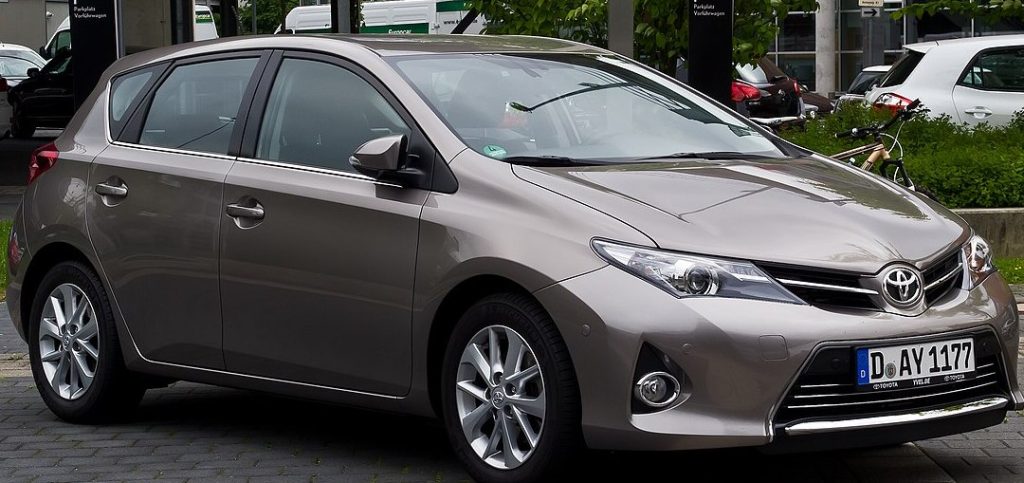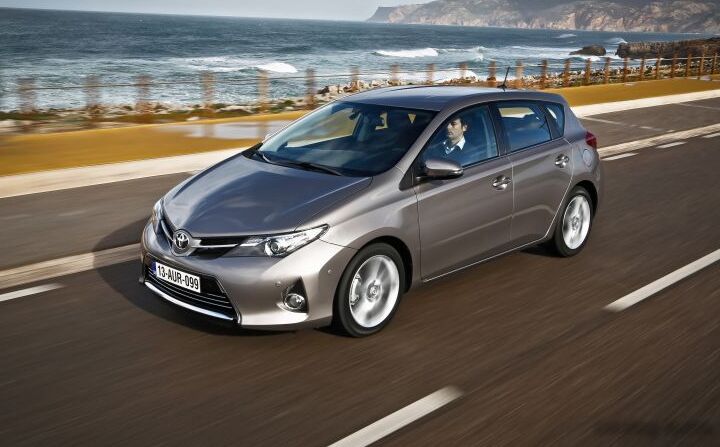
The Toyota Auris II 1.33 Dual VVT-i (99 horsepower) was a popular entry-level variant of Toyota’s compact hatchback, produced between 2012 and 2015. Positioned as an affordable and fuel-efficient option within the Auris II range (based on the E180 platform, sharing components with the Corolla E170), this model aimed to provide practical transportation for urban commuters and small families. It represented Toyota’s commitment to offering a diverse lineup catering to various customer needs, particularly in the European market where the Auris was primarily sold. This specific engine and transmission combination was designed to balance cost-effectiveness with acceptable performance and Toyota’s renowned reliability.
Technical Specifications
| Brand | Toyota |
| Model | Auris |
| Generation | Auris II |
| Type (Engine) | 1.33 Dual VVT-i (99 Hp) |
| Start of production | 2012 |
| End of production | 2015 |
| Powertrain Architecture | Internal Combustion engine |
| Body type | Hatchback |
| Seats | 5 |
| Doors | 5 |
| Fuel consumption (urban) | 7 l/100 km (33.6 US mpg, 40.4 UK mpg, 14.3 km/l) |
| Fuel consumption (extra urban) | 4.7 l/100 km (50 US mpg, 60.1 UK mpg, 21.3 km/l) |
| Fuel consumption (combined) | 5.5 l/100 km (42.8 US mpg, 51.4 UK mpg, 18.2 km/l) |
| Fuel Type | Petrol (Gasoline) |
| Acceleration 0 – 100 km/h | 12.6 sec |
| Acceleration 0 – 62 mph | 12.6 sec |
| Acceleration 0 – 60 mph | 12 sec |
| Maximum speed | 175 km/h (108.74 mph) |
| Emission standard | Euro 5 J |
| Weight-to-power ratio | 12.2 kg/Hp, 81.8 Hp/tonne |
| Weight-to-torque ratio | 9.5 kg/Nm, 105.8 Nm/tonne |
| Power | 99 Hp @ 6000 rpm |
| Power per litre | 74.5 Hp/l |
| Torque | 128 Nm @ 3800-3800 rpm (94.41 lb.-ft. @ 3800-3800 rpm) |
| Engine layout | Front, Transverse |
| Engine Model/Code | 1NR-FE |
| Engine displacement | 1329 cm3 (81.1 cu. in.) |
| Number of cylinders | 4 |
| Engine configuration | Inline |
| Cylinder Bore | 72.5 mm (2.85 in.) |
| Piston Stroke | 80.5 mm (3.17 in.) |
| Compression ratio | 11.5:1 |
| Number of valves per cylinder | 4 |
| Fuel injection system | Multi-port manifold injection |
| Engine aspiration | Naturally aspirated engine |
| Valvetrain | DOHC – Dual VVT-i |
| Engine oil capacity | 3.4 l (3.59 US qt | 2.99 UK qt) |
| Coolant | 5.7 l (6.02 US qt | 5.02 UK qt) |
| Kerb Weight | 1210 kg (2667.59 lbs.) |
| Max. weight | 1735 kg (3825.02 lbs.) |
| Max load | 525 kg (1157.43 lbs.) |
| Trunk (boot) space – minimum | 360 l (12.71 cu. ft.) |
| Fuel tank capacity | 50 l (13.21 US gal | 11 UK gal) |
| Length | 4275 mm (168.31 in.) |
| Width | 1760 mm (69.29 in.) |
| Height | 1460 mm (57.48 in.) |
| Wheelbase | 2600 mm (102.36 in.) |
| Front track | 1535 mm (60.43 in.) |
| Rear (Back) track | 1535 mm (60.43 in.) |
| Minimum turning circle | 10.4 m (34.12 ft.) |
| Drivetrain Architecture | Front wheel drive |
| Number of gears and type of gearbox | 6 gears, manual transmission |
| Front suspension | Independent, type McPherson with coil spring and anti-roll bar |
| Rear suspension | Torsion |
| Front brakes | Disc |
| Rear brakes | Disc |
| Assisting systems | ABS (Anti-lock braking system) |
| Steering type | Steering rack and pinion |
Powertrain & Engine Architecture
The heart of the Auris II 1.33 Dual VVT-i is the 1NR-FE engine, a 1.329-liter inline-four cylinder gasoline engine. This engine is part of Toyota’s NR engine family, known for its compact design and fuel efficiency. The “Dual VVT-i” designation refers to Toyota’s Variable Valve Timing-intelligent system, which controls both intake and exhaust valve timing to optimize engine performance and fuel economy across a wider range of engine speeds. The 1NR-FE utilizes multi-port fuel injection, delivering fuel directly into the intake ports. The engine produces 99 horsepower at 6000 rpm and 128 Nm (94.41 lb-ft) of torque between 3800 and 3800 rpm. The engine is transversely mounted in the front of the vehicle. The standard transmission for this variant was a six-speed manual gearbox, designed to maximize fuel efficiency and provide adequate acceleration. While an automatic transmission was available on other Auris II trims, it wasn’t typically paired with the 1.33 engine.
Driving Characteristics
The 1.33L engine, paired with the six-speed manual transmission, offered a relatively economical driving experience. Acceleration was modest, taking approximately 12.6 seconds to reach 62 mph (100 km/h). The engine felt most comfortable in the mid-range, providing sufficient power for everyday driving situations. The six-speed gearbox allowed for efficient cruising on highways, keeping engine speeds relatively low. Compared to the more powerful 1.6L or 1.8L engine options in the Auris II lineup, the 1.33 felt noticeably less responsive, particularly when fully loaded or tackling steep inclines. However, the lighter engine weight contributed to nimble handling and predictable cornering. The gear ratios were tuned for fuel economy, meaning the engine needed to be revved more to achieve quicker acceleration.
Equipment & Trim Levels
The 1.33 Dual VVT-i typically represented the entry-level trim for the Auris II. Standard equipment generally included air conditioning, power steering, electric front windows, a basic audio system with USB connectivity, and ABS brakes. Safety features such as multiple airbags were also standard. Interior upholstery was typically cloth, with a functional but basic dashboard layout. Optional extras included alloy wheels, a more advanced audio system, rear electric windows, and parking sensors. Higher trim levels, such as the Active, Icon, and Design, added features like automatic climate control, cruise control, and upgraded interior materials.
Chassis & Braking
The Auris II 1.33 utilized a McPherson strut front suspension with a coil spring and anti-roll bar, providing a comfortable ride and decent handling. The rear suspension employed a torsion beam setup, which was a cost-effective solution for maintaining ride quality. Brakes were disc brakes on all four wheels, providing adequate stopping power for the vehicle’s weight and performance. ABS (Anti-lock Braking System) was standard, enhancing safety during emergency braking situations. The steering system was a rack and pinion type, offering precise and responsive steering feel.
Market Reception & Comparison
The Auris II 1.33 Dual VVT-i was generally well-received as an affordable and reliable hatchback. Critics praised its fuel efficiency and comfortable ride, but noted its lack of outright performance. Compared to other trims in the Auris II lineup, the 1.33 offered the lowest running costs but sacrificed some driving enjoyment. Competitors in the same segment, such as the Volkswagen Golf, Ford Focus, and Opel Astra, offered similar levels of practicality and fuel efficiency, but often at a slightly higher price point. The Auris II 1.33’s strength lay in its value proposition – providing a dependable and economical vehicle for budget-conscious buyers.
Legacy
The 1NR-FE engine, used in the Auris II 1.33, has proven to be a remarkably reliable powertrain. Common issues are relatively rare, and the engine is known for its longevity with proper maintenance. In the used car market, the Auris II 1.33 remains a popular choice for first-time car buyers and those seeking a dependable and fuel-efficient vehicle. While not the most exciting car to drive, its practicality, reliability, and low running costs continue to make it a viable option for those prioritizing value and dependability over performance.