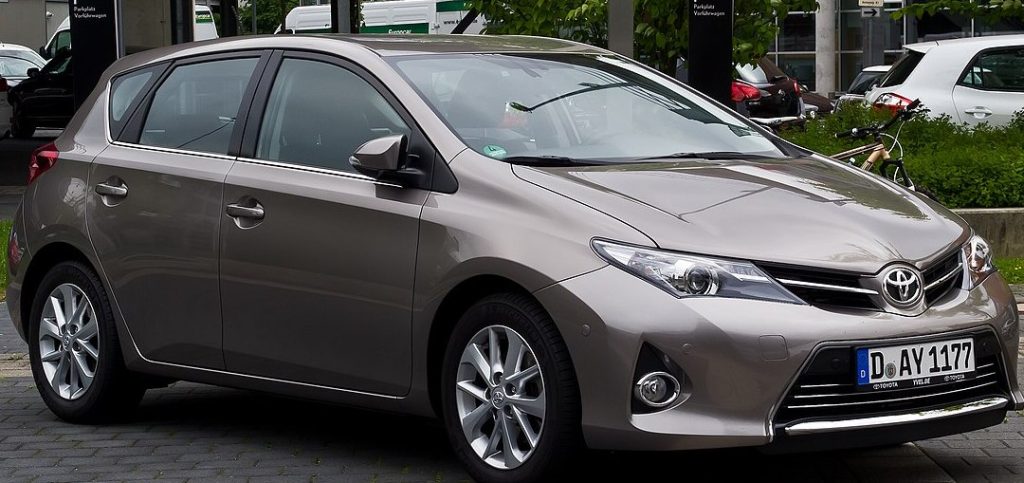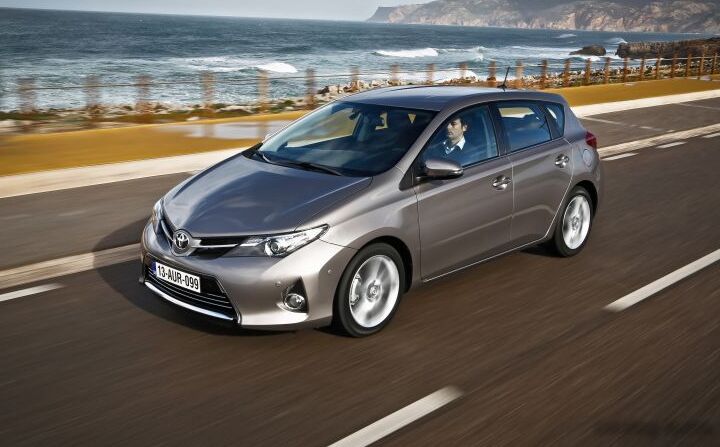
The Toyota Auris II 1.4 D-4D 90 hp Automatic, produced between 2012 and 2015, represented an entry-level offering within the second generation Auris (E180) lineup. Positioned as a fuel-efficient and practical hatchback, it catered to buyers prioritizing economy and ease of use over outright performance. This variant was primarily sold in the European market, where compact hatchbacks with diesel engines and automatic transmissions were popular choices. It sat below the 1.6L petrol and higher-powered diesel variants in terms of performance and price, offering a more accessible entry point into the Auris range.
Technical Specifications
| Brand | Toyota |
| Model | Auris |
| Generation | Auris II |
| Type (Engine) | 1.4 D-4D (90 Hp) Automatic |
| Start of production | 2012 |
| End of production | 2015 |
| Powertrain Architecture | Internal Combustion engine |
| Body type | Hatchback |
| Seats | 5 |
| Doors | 5 |
| Fuel consumption (urban) | 5 l/100 km (47 US mpg, 56.5 UK mpg, 20 km/l) |
| Fuel consumption (extra urban) | 3.9 l/100 km (60.3 US mpg, 72.4 UK mpg, 25.6 km/l) |
| Fuel consumption (combined) | 4.3 l/100 km (54.7 US mpg, 65.7 UK mpg, 23.3 km/l) |
| Fuel Type | Diesel |
| Acceleration 0 – 100 km/h | 14.7 sec |
| Acceleration 0 – 62 mph | 14.7 sec |
| Acceleration 0 – 60 mph | 14 sec |
| Maximum speed | 180 km/h (111.85 mph) |
| Emission standard | Euro 5 J |
| Weight-to-power ratio | 14.2 kg/Hp, 70.6 Hp/tonne |
| Weight-to-torque ratio | 6.2 kg/Nm, 160.8 Nm/tonne |
| Power | 90 Hp @ 3800 rpm |
| Power per litre | 66 Hp/l |
| Torque | 205 Nm @ 1800-2800 rpm (151.2 lb.-ft. @ 1800-2800 rpm) |
| Engine layout | Front, Transverse |
| Engine Model/Code | 1ND-TV |
| Engine displacement | 1364 cm3 (83.24 cu. in.) |
| Number of cylinders | 4 |
| Engine configuration | Inline |
| Cylinder Bore | 73 mm (2.87 in.) |
| Piston Stroke | 81.5 mm (3.21 in.) |
| Compression ratio | 16.5:1 |
| Number of valves per cylinder | 2 |
| Fuel injection system | Diesel Commonrail |
| Engine aspiration | Turbocharger, Intercooler |
| Valvetrain | SOHC |
| Engine oil capacity | 3.7 l (3.91 US qt | 3.26 UK qt) |
| Coolant capacity | 6 l (6.34 US qt | 5.28 UK qt) |
| Kerb Weight | 1275 kg (2810.89 lbs.) |
| Max. weight | 1815 kg (4001.39 lbs.) |
| Max load | 540 kg (1190.5 lbs.) |
| Trunk (boot) space – minimum | 360 l (12.71 cu. ft.) |
| Fuel tank capacity | 50 l (13.21 US gal | 11 UK gal) |
| Length | 4275 mm (168.31 in.) |
| Width | 1760 mm (69.29 in.) |
| Height | 1460 mm (57.48 in.) |
| Wheelbase | 2600 mm (102.36 in.) |
| Front track | 1535 mm (60.43 in.) |
| Rear track | 1535 mm (60.43 in.) |
| Minimum turning circle | 10.4 m (34.12 ft.) |
| Drivetrain Architecture | Front wheel drive |
| Number of gears | 6 |
| Gearbox type | Automatic transmission |
| Front suspension | Independent, type McPherson with coil spring and anti-roll bar |
| Rear suspension | Torsion |
| Front brakes | Disc |
| Rear brakes | Disc |
| Assisting systems | ABS (Anti-lock braking system) |
| Steering type | Steering rack and pinion |
INTRODUCTION
The Toyota Auris II, launched in 2012, was a significant redesign of Toyota’s compact hatchback, aimed at competing with established rivals like the Volkswagen Golf, Ford Focus, and Opel/Vauxhall Astra. The 1.4 D-4D Automatic variant was introduced as a fuel-conscious option, leveraging Toyota’s expertise in diesel engine technology. Built on the E180 platform (shared with other Toyota and Daihatsu models), the Auris II aimed for improved quality, refinement, and a more appealing design compared to its predecessor. This particular engine and transmission combination was targeted towards drivers seeking a comfortable and economical daily driver, particularly in urban environments.
Powertrain & Engine Architecture
At the heart of the Auris 1.4 D-4D Automatic lies the 1ND-TV engine, a 1.4-liter inline-four cylinder diesel. This engine utilizes a common rail direct injection system, delivering fuel directly into the combustion chamber at extremely high pressure for improved efficiency and reduced emissions. The engine is turbocharged and intercooled, enhancing power output and torque. The 1ND-TV engine is a SOHC (Single Overhead Camshaft) design, featuring two valves per cylinder. Paired with this engine is a six-speed automatic transmission, providing smooth gear changes and contributing to the car’s ease of driving. This transmission wasn’t known for being particularly sporty, prioritizing smooth operation and fuel efficiency over rapid shifts. The engine’s relatively low compression ratio of 16.5:1, while high for a gasoline engine, is typical for a diesel, contributing to its efficiency.
Driving Characteristics
The 90 hp output of the 1.4 D-4D, combined with the automatic transmission, resulted in a driving experience focused on practicality rather than performance. Acceleration from 0-60 mph took around 14 seconds, and top speed was limited to 180 km/h (112 mph). The automatic transmission, while convenient, did slightly diminish the engine’s responsiveness compared to the manual gearbox option. Gear ratios were optimized for fuel economy, meaning the engine often operated at lower RPMs during cruising. While adequate for everyday driving, overtaking maneuvers required careful planning. Compared to the 1.6L petrol version, the 1.4 D-4D offered significantly better fuel economy but less power. The higher-powered 2.0L D-4D models provided a more engaging driving experience but at the cost of increased fuel consumption and emissions.
Equipment & Trim Levels
The 1.4 D-4D Automatic typically came with a reasonable level of standard equipment. This included air conditioning, electric front windows, a CD player with auxiliary input, and ABS brakes. Higher trim levels, such as the ‘Icon’ or ‘Design’ variants, added features like alloy wheels, rear parking sensors, cruise control, and a touchscreen infotainment system. Interior upholstery was typically cloth, with a functional and durable design. Optional extras included satellite navigation, leather upholstery, and a panoramic sunroof. The dashboard layout was straightforward and user-friendly, prioritizing ease of use over stylistic flair.
Chassis & Braking
The Auris II utilized a McPherson strut front suspension and a torsion beam rear suspension. This setup provided a comfortable ride quality, well-suited for everyday driving. The front brakes were ventilated discs, while the rear brakes were solid discs. ABS (Anti-lock Braking System) was standard, enhancing safety. The steering was a rack and pinion system, providing adequate feedback and precision. Stabilizer bars were fitted to both the front and rear axles to reduce body roll during cornering. The suspension tuning was geared towards comfort rather than sporty handling.
Market Reception & Comparison
The Toyota Auris II 1.4 D-4D Automatic was generally well-received by critics for its fuel efficiency and comfortable ride. However, some reviewers noted its lack of outright performance and the somewhat unrefined nature of the diesel engine. Compared to the petrol-powered Auris models, the 1.4 D-4D offered significantly better fuel economy, making it a popular choice for high-mileage drivers. Against competitors like the Volkswagen Golf TDI, the Auris offered a competitive fuel economy figure but often lacked the Golf’s perceived build quality and driving dynamics. Reliability was a strong point, as expected from a Toyota product.
Legacy
The 1ND-TV engine, while not known for being a powerhouse, proved to be a reliable and durable unit. The six-speed automatic transmission, while not the most sophisticated, also demonstrated good longevity. In the used car market, the Auris II 1.4 D-4D Automatic remains a popular choice for buyers seeking an economical and practical hatchback. Maintenance costs are generally reasonable, and parts availability is good. However, potential buyers should be aware of the typical wear and tear associated with diesel engines, such as potential issues with the diesel particulate filter (DPF) and turbocharger. Overall, this variant represents a sensible and dependable option within the Auris II range.