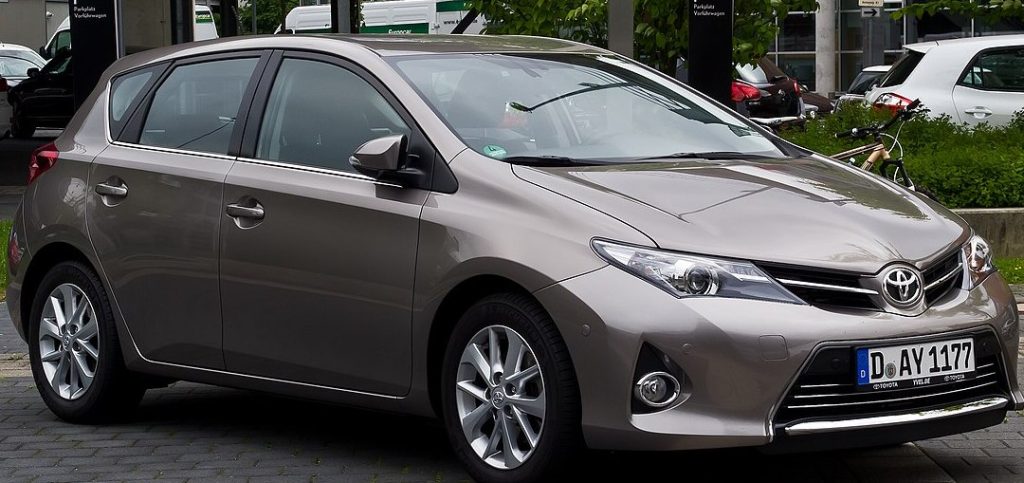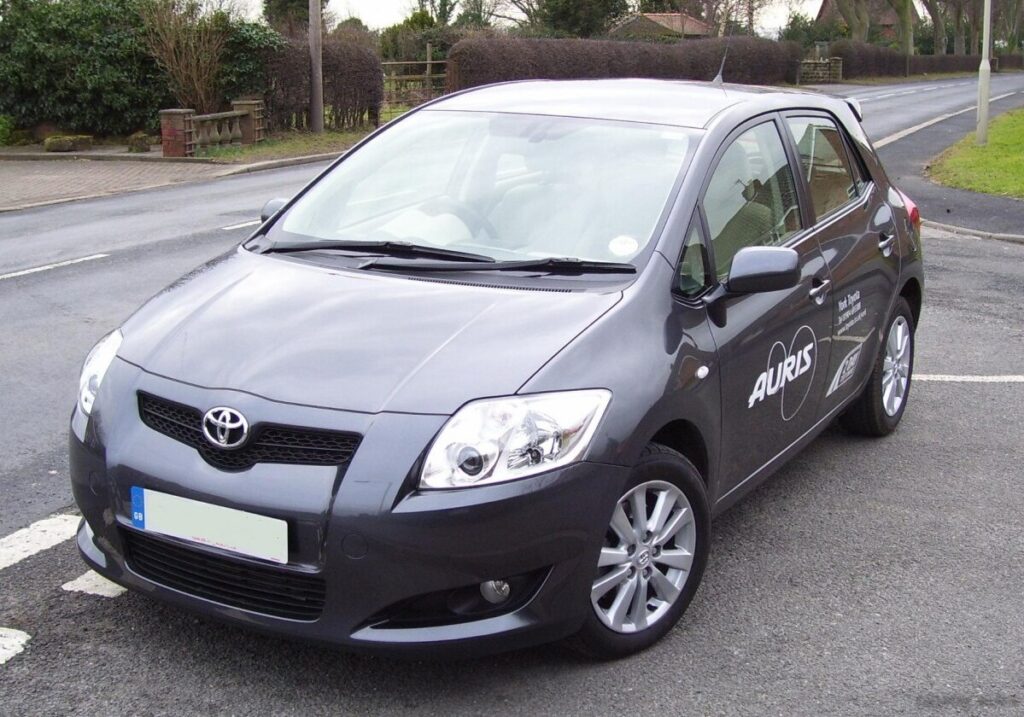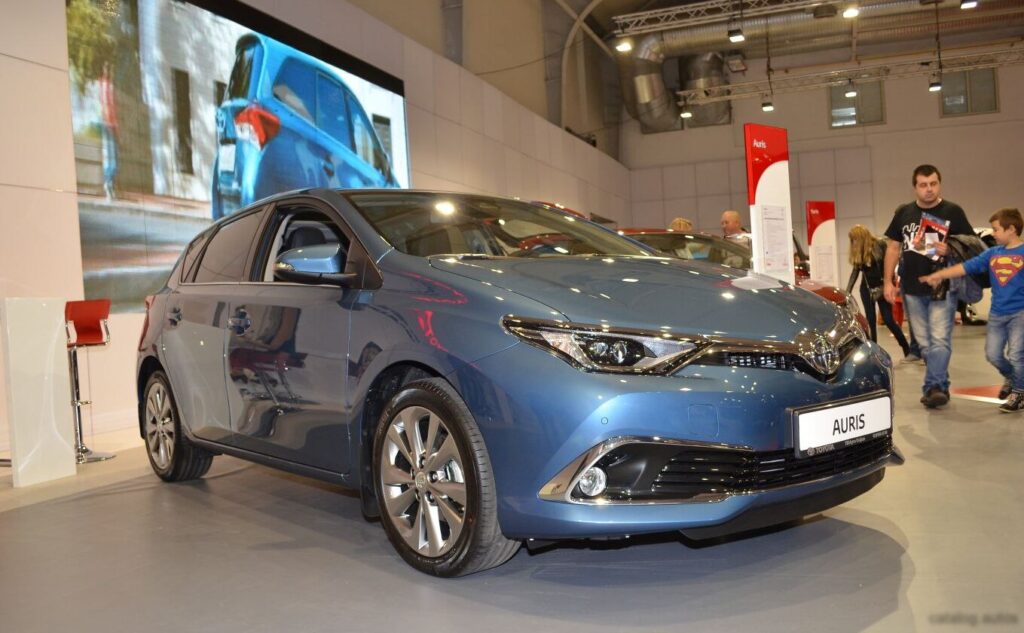
The Toyota Auris II, specifically the facelifted model produced from 2015 to 2018, represented a significant evolution of Toyota’s compact hatchback offering in the European market. The 1.8 (136 Hp) Hybrid e-CVT variant occupied a key position in the lineup, bridging the gap between the more affordable base models and the potentially more equipped trims. This version was designed to appeal to buyers prioritizing fuel efficiency and a smooth driving experience, leveraging Toyota’s established hybrid technology. It was built on the E180 platform, also known as the Auris II, and later served as the basis for the Corolla Hatchback that replaced the Auris in many markets.
Technical Specifications
| Brand | Toyota |
| Model | Auris |
| Generation | Auris II (facelift 2015) |
| Type (Engine) | 1.8 (136 Hp) Hybrid e-CVT |
| Start of production | 2015 |
| End of production | 2018 |
| Powertrain Architecture | FHEV (Full Hybrid Electric Vehicle) |
| Body type | Hatchback |
| Seats | 5 |
| Doors | 5 |
| Fuel consumption (urban) | 3.4-4.1 l/100 km (69.2 – 57.4 US mpg / 83.1 – 68.9 UK mpg / 29.4 – 24.4 km/l) |
| Fuel consumption (extra urban) | 3.4-4.1 l/100 km (69.2 – 57.4 US mpg / 83.1 – 68.9 UK mpg / 29.4 – 24.4 km/l) |
| Fuel consumption (combined) | 3.5-3.9 l/100 km (67.2 – 60.3 US mpg / 80.7 – 72.4 UK mpg / 28.6 – 25.6 km/l) |
| CO2 emissions | 79-91 g/km |
| Fuel Type | Petrol (Gasoline) |
| Acceleration 0 – 100 km/h | 10.9 sec |
| Acceleration 0 – 62 mph | 10.9 sec |
| Acceleration 0 – 60 mph | 10.4 sec |
| Maximum speed | 180 km/h (111.85 mph) |
| Emission standard | Euro 6 W |
| Weight-to-power ratio | 10.2 kg/Hp, 98.2 Hp/tonne |
| Weight-to-torque ratio | 9.8 kg/Nm, 102.5 Nm/tonne |
| Gross battery capacity | 1.31 kWh |
| Battery voltage | 201.6 V |
| Battery technology | Nickel-metal hydride (NiMH) |
| Battery location | Under the rear seats |
| Electric motor power | 82 Hp |
| Electric motor Torque | 207 Nm (152.68 lb.-ft.) |
| Electric motor location | Integrated into the transmission |
| System power | 136 Hp @ 5200 rpm |
| System torque | 142 Nm @ 4000 rpm (104.73 lb.-ft. @ 4000 rpm) |
| Engine Power | 99 Hp @ 5200 rpm |
| Engine Torque | 142 Nm @ 4000 rpm (104.73 lb.-ft. @ 4000 rpm) |
| Engine layout | Front, Transverse |
| Engine Model/Code | 2ZR-FXE |
| Engine displacement | 1798 cm3 (109.72 cu. in.) |
| Number of cylinders | 4 |
| Engine configuration | Inline |
| Cylinder Bore | 80.5 mm (3.17 in.) |
| Piston Stroke | 88.3 mm (3.48 in.) |
| Compression ratio | 13:1 |
| Number of valves per cylinder | 4 |
| Fuel injection system | Multi-port manifold injection |
| Engine aspiration | Naturally aspirated engine |
| Valvetrain | DOHC, VVT-i |
| Engine oil capacity | 4.2 l (4.44 US qt | 3.7 UK qt) |
| Coolant | 7 l (7.4 US qt | 6.16 UK qt) |
| Kerb Weight | 1385-1505 kg (3053.4 – 3317.96 lbs.) |
| Max. weight | 1815-1840 kg (4001.39 – 4056.51 lbs.) |
| Max load | 335-430 kg (738.55 – 947.99 lbs.) |
| Trunk (boot) space – minimum | 360 l (12.71 cu. ft.) |
| Trunk (boot) space – maximum | 1199 l (42.34 cu. ft.) |
| Fuel tank capacity | 45 l (11.89 US gal | 9.9 UK gal) |
| Max. roof load | 75 kg (165.35 lbs.) |
| Permitted trailer load with brakes (12%) | 385 kg (848.78 lbs.) |
| Permitted trailer load without brakes | 385 kg (848.78 lbs.) |
| Permitted towbar download | 55 kg (121.25 lbs.) |
| Length | 4330 mm (170.47 in.) |
| Width | 1760 mm (69.29 in.) |
| Height | 1475 mm (58.07 in.) |
| Wheelbase | 2600 mm (102.36 in.) |
| Front track | 1515-1535 mm (59.65 – 60.43 in.) |
| Rear (Back) track | 1505-1535 mm (59.25 – 60.43 in.) |
| Front overhang | 955 mm (37.6 in.) |
| Rear overhang | 775 mm (30.51 in.) |
| Ride height (ground clearance) | 140 mm (5.51 in.) |
| Drag coefficient (Cd) | 0.28 |
| Minimum turning circle (turning diameter) | 11.0 m (36.09 ft.) |
| Drivetrain Architecture | The Internal combustion engine (ICE) and electric motor drive the front wheels of the car with the ability to work in full electric or mixed mode. |
| Drive wheel | Front wheel drive |
| Number of gears and type of gearbox | automatic transmission e-CVT |
| Front suspension | Independent, type McPherson with coil spring and anti-roll bar |
| Rear suspension | Double wishbone |
| Front brakes | Ventilated discs, 277 mm |
| Rear brakes | Disc, 270 mm |
| Assisting systems | ABS (Anti-lock braking system) |
| Steering type | Steering rack and pinion |
| Power steering | Electric Steering |
| Tires size | 195/65 R15; 205/55 R16; 225/45 R17 |
| Wheel rims size | 6J x 15; 6.5J x 16; 7J x 17 |
INTRODUCTION
The Toyota Auris II facelift, launched in 2015, represented a mid-cycle refresh of the second-generation Auris, a compact hatchback designed primarily for the European market. The 1.8 Hybrid e-CVT model was a cornerstone of the range, offering a compelling blend of fuel economy and practicality. This variant utilized Toyota’s Hybrid Synergy Drive system, combining a 1.8-liter gasoline engine with an electric motor to deliver a combined output of 136 horsepower. Positioned as a mid-range offering, it aimed to attract buyers seeking a more efficient and refined driving experience than the base gasoline models, without the higher price tag of potentially more luxurious trims.
Powertrain & Engine Architecture
At the heart of the Auris 1.8 Hybrid is the 2ZR-FXE 1.8-liter inline-four cylinder gasoline engine. This engine employs Toyota’s Valvematic technology, a continuously variable valve lift system, to optimize efficiency and power delivery. It features multi-port fuel injection and a relatively high compression ratio of 13:1. The engine itself produces 99 horsepower and 142 Nm of torque. However, the system’s total output is 136 hp, thanks to the addition of the electric motor. The electric motor, powered by a nickel-metal hydride (NiMH) battery pack located under the rear seats, contributes 82 horsepower and 207 Nm of torque. The e-CVT (electronically controlled continuously variable transmission) doesn’t have fixed gears; instead, it utilizes a planetary gearset to seamlessly blend the power from the engine and electric motor. This system allows for smooth acceleration and optimized fuel efficiency. The ABS and ADZ engine codes were common for this generation.
Driving Characteristics
The Auris 1.8 Hybrid e-CVT delivers a distinctly different driving experience compared to its gasoline or diesel counterparts. The e-CVT provides smooth, linear acceleration, prioritizing efficiency over outright performance. While the 0-60 mph time of around 10.4 seconds isn’t particularly quick, the hybrid system provides ample torque for everyday driving situations. The car frequently operates in electric-only mode at lower speeds, resulting in near-silent operation and zero emissions. The transition between electric and gasoline power is generally seamless, although some drivers may notice a slight “rubber band” effect characteristic of CVTs under hard acceleration. Compared to the 1.6L gasoline engine, the hybrid offers significantly improved fuel economy and a more refined driving experience. It lacks the punch of the more powerful gasoline engines, but compensates with its efficiency and smoothness.
Equipment & Trim Levels
The 1.8 Hybrid e-CVT trim typically included a generous level of standard equipment. Features commonly included air conditioning, a touchscreen infotainment system with Bluetooth connectivity, alloy wheels, and a suite of safety features such as ABS, traction control, and multiple airbags. Interior upholstery was typically cloth, with options for upgraded materials available. Higher trim levels offered additional features such as automatic climate control, parking sensors, a rearview camera, and a more advanced infotainment system with navigation. Optional extras included a panoramic sunroof and premium audio systems.
Chassis & Braking
The Auris II utilized a McPherson strut front suspension and a double wishbone rear suspension, providing a comfortable and controlled ride. The front brakes were ventilated discs, while the rear brakes were solid discs. The suspension was tuned to prioritize comfort and stability, rather than sporty handling. Stabilizer bars were fitted to both the front and rear axles to reduce body roll. The steering was electrically assisted, providing light and precise control. The weight distribution was reasonably balanced, contributing to predictable handling characteristics.
Market Reception & Comparison
The Toyota Auris 1.8 Hybrid e-CVT was generally well-received by automotive critics. It was praised for its exceptional fuel economy, smooth ride, and refined driving experience. However, some critics noted its relatively modest performance and the somewhat uninspiring interior design. Compared to the 1.6L gasoline version, the hybrid offered significantly better fuel economy, but at a higher purchase price. Compared to the diesel models, the hybrid provided a quieter and more refined driving experience, but with slightly less torque. The Auris Hybrid competed with other compact hybrid hatchbacks, such as the Honda Civic Hybrid and the Hyundai Ioniq Hybrid.
Legacy
The Toyota Auris II 1.8 Hybrid e-CVT has proven to be a reliable and durable vehicle. The Hybrid Synergy Drive system is known for its longevity, and the 2ZR-FXE engine is generally considered to be a robust and dependable unit. In the used car market, these models continue to hold their value, particularly those with well-maintained service histories. The Auris Hybrid paved the way for the Corolla Hybrid, which has become a popular choice for buyers seeking a fuel-efficient and reliable compact car. The technology pioneered in the Auris Hybrid continues to be refined and improved in Toyota’s current generation of hybrid vehicles.