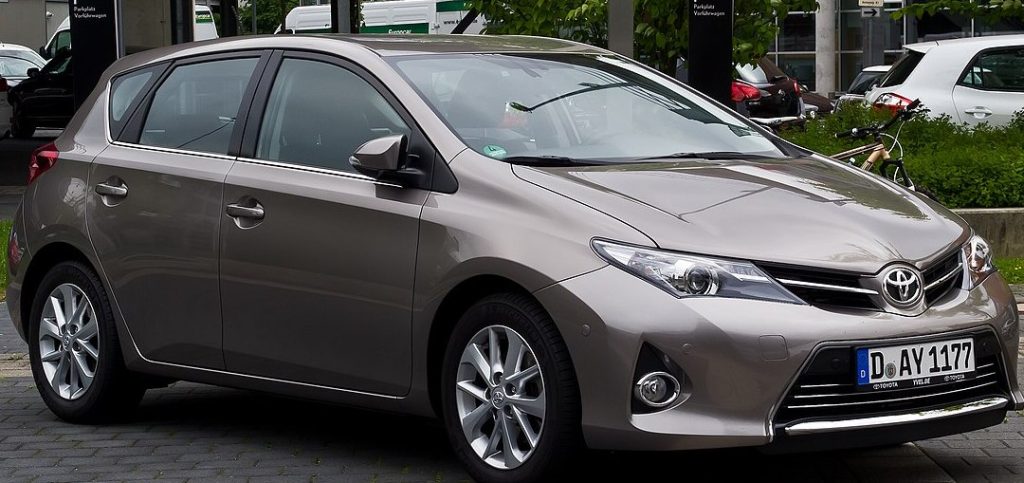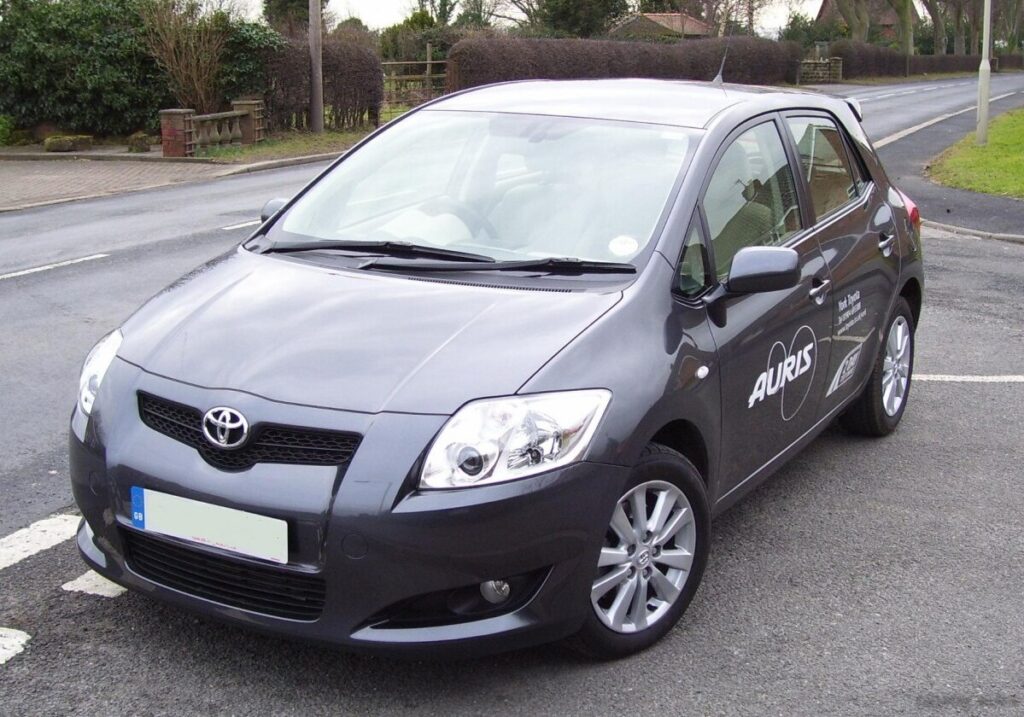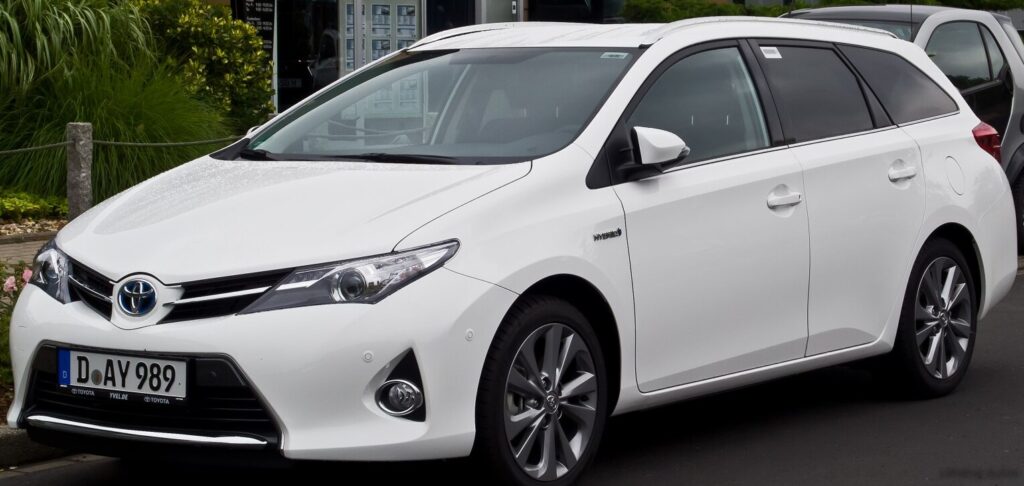
The Toyota Auris II Touring Sports 1.4 D-4D (90 hp) was a diesel-powered station wagon produced between 2012 and 2015. Positioned as an entry-level offering within the second-generation Auris Touring Sports range (based on the E180 platform, sharing components with the Corolla E170), it aimed to provide fuel efficiency and practicality for buyers seeking a compact, versatile vehicle. This variant was primarily sold in the European market, where demand for diesel-powered wagons remained strong. It represented Toyota’s attempt to cater to budget-conscious buyers while still offering the benefits of a modern, well-equipped vehicle.
Technical Specifications
| Brand | Toyota |
| Model | Auris |
| Generation | Auris II Touring Sports |
| Type (Engine) | 1.4 D-4D (90 Hp) |
| Start of production | 2012 |
| End of production | 2015 |
| Powertrain Architecture | Internal Combustion engine |
| Body type | Station wagon (estate) |
| Seats | 5 |
| Doors | 5 |
| Fuel consumption (urban) | 5.2 l/100 km (45.2 US mpg, 54.3 UK mpg, 19.2 km/l) |
| Fuel consumption (extra urban) | 3.8 l/100 km (61.9 US mpg, 74.3 UK mpg, 26.3 km/l) |
| Fuel consumption (combined) | 4.3 l/100 km (54.7 US mpg, 65.7 UK mpg, 23.3 km/l) |
| Fuel Type | Diesel |
| Acceleration 0 – 100 km/h | 13 sec |
| Acceleration 0 – 62 mph | 13 sec |
| Acceleration 0 – 60 mph | 12.4 sec |
| Maximum speed | 175 km/h (108.74 mph) |
| Emission standard | Euro 5 J |
| Weight-to-power ratio | 13.6 kg/Hp, 73.8 Hp/tonne |
| Weight-to-torque ratio | 6 kg/Nm, 168 Nm/tonne |
| Power | 90 Hp @ 3800 rpm |
| Power per litre | 66 Hp/l |
| Torque | 205 Nm @ 1800-2800 rpm (151.2 lb.-ft. @ 1800-2800 rpm) |
| Engine layout | Front, Transverse |
| Engine Model/Code | 1ND-TV |
| Engine displacement | 1364 cm3 (83.24 cu. in.) |
| Number of cylinders | 4 |
| Engine configuration | Inline |
| Cylinder Bore | 73 mm (2.87 in.) |
| Piston Stroke | 81.5 mm (3.21 in.) |
| Compression ratio | 16.5:1 |
| Number of valves per cylinder | 2 |
| Fuel injection system | Diesel Commonrail |
| Engine aspiration | Turbocharger, Intercooler |
| Valvetrain | SOHC |
| Engine oil capacity | 3.7 l (3.91 US qt | 3.26 UK qt) |
| Coolant | 6 l (6.34 US qt | 5.28 UK qt) |
| Kerb Weight | 1220 kg (2689.64 lbs.) |
| Max. weight | 1845 kg (4067.53 lbs.) |
| Max load | 625 kg (1377.89 lbs.) |
| Trunk (boot) space – minimum | 530 l (18.72 cu. ft.) |
| Trunk (boot) space – maximum | 1658 l (58.55 cu. ft.) |
| Fuel tank capacity | 50 l (13.21 US gal | 11 UK gal) |
| Length | 4560 mm (179.53 in.) |
| Width | 1760 mm (69.29 in.) |
| Height | 1460 mm (57.48 in.) |
| Wheelbase | 2600 mm (102.36 in.) |
| Front track | 1535 mm (60.43 in.) |
| Rear track | 1535 mm (60.43 in.) |
| Minimum turning circle | 10.4 m (34.12 ft.) |
| Drivetrain Architecture | Front wheel drive |
| Number of gears | 6 gears, manual transmission |
| Front suspension | Independent, type McPherson with coil spring and anti-roll bar |
| Rear suspension | Torsion |
| Front brakes | Ventilated discs |
| Rear brakes | Disc |
| Assisting systems | ABS (Anti-lock braking system) |
| Steering type | Steering rack and pinion |
Powertrain & Engine Architecture
The Auris 1.4 D-4D utilized the Toyota 1ND-TV engine, a 1.4-liter inline-four cylinder diesel. This engine was part of Toyota’s ‘D-4D’ family, known for its focus on fuel efficiency and low emissions. The 1ND-TV featured a turbocharger with an intercooler to boost power output, and a common-rail direct fuel injection system for precise fuel delivery. The engine employed a Single Overhead Camshaft (SOHC) valvetrain with two valves per cylinder. The engine’s relatively high compression ratio of 16.5:1 contributed to its efficiency, but also required high-quality diesel fuel. The engine was transversely mounted in the front of the vehicle. The 90 horsepower output was achieved at 3800 rpm, while peak torque of 205 Nm (151.2 lb-ft) was available between 1800 and 2800 rpm. This broad torque curve was designed to provide good drivability in everyday conditions. The engine was paired with a six-speed manual transmission, optimized for fuel economy rather than outright performance.
Driving Characteristics
The 1.4 D-4D with the manual transmission offered adequate, but not exhilarating, performance. Acceleration from 0-60 mph took around 12.4 seconds, and top speed was 175 km/h (108.74 mph). The focus was on fuel economy and relaxed cruising. The gear ratios were relatively long, prioritizing efficiency over rapid acceleration. Compared to higher-output versions of the Auris, such as those with the 1.6L petrol engine or the 2.0L D-4D, the 1.4 D-4D felt noticeably slower, particularly when fully loaded or tackling inclines. However, the plentiful low-end torque made it suitable for urban driving and highway cruising. The manual transmission provided a more engaging driving experience than an automatic would have, allowing drivers to better control the engine’s power band.
Equipment & Trim Levels
The 1.4 D-4D typically came with a reasonable level of standard equipment, though it was generally less lavish than higher-spec Auris models. Standard features often included air conditioning, power steering, electric front windows, a basic audio system with USB connectivity, and ABS brakes. Interior upholstery was typically cloth, and the dashboard featured a functional, if somewhat understated, design. Optional extras could include alloy wheels, a touchscreen infotainment system, rear parking sensors, and climate control. Trim levels varied slightly depending on the specific market, but the 1.4 D-4D generally represented the entry point to the Auris Touring Sports range.
Chassis & Braking
The Auris Touring Sports 1.4 D-4D utilized a McPherson strut front suspension with a coil spring and anti-roll bar, providing a comfortable ride and predictable handling. The rear suspension employed a torsion beam setup, which was a cost-effective solution that offered a good balance between comfort and stability. The front brakes were ventilated discs, while the rear brakes were solid discs. ABS (Anti-lock Braking System) was standard, enhancing safety during emergency braking. The suspension was tuned for comfort rather than sporty handling, reflecting the car’s intended role as a practical family vehicle.
Market Reception & Comparison
The Auris 1.4 D-4D was generally well-received by critics for its fuel efficiency and practicality. However, its performance was often criticized as being somewhat underwhelming. Compared to other diesel-powered estate cars in its class, such as the Volkswagen Golf Estate TDI or the Ford Focus Estate TDCi, the Auris 1.4 D-4D offered competitive fuel economy but lacked the same level of refinement or driving engagement. Its reliability was generally praised, consistent with Toyota’s reputation for building durable vehicles. The 1.4 D-4D was often seen as a sensible choice for buyers prioritizing economy and practicality over performance.
Legacy
The 1ND-TV engine, while not known for being particularly powerful, proved to be a reliable unit when properly maintained. The Auris 1.4 D-4D Touring Sports has become a popular choice on the used car market, particularly for buyers seeking an affordable and fuel-efficient estate car. Common issues are relatively minor, often related to diesel particulate filter (DPF) clogging if the vehicle is primarily used for short journeys. Overall, the 1.4 D-4D variant of the Auris Touring Sports remains a practical and economical option for those seeking a versatile and dependable vehicle.