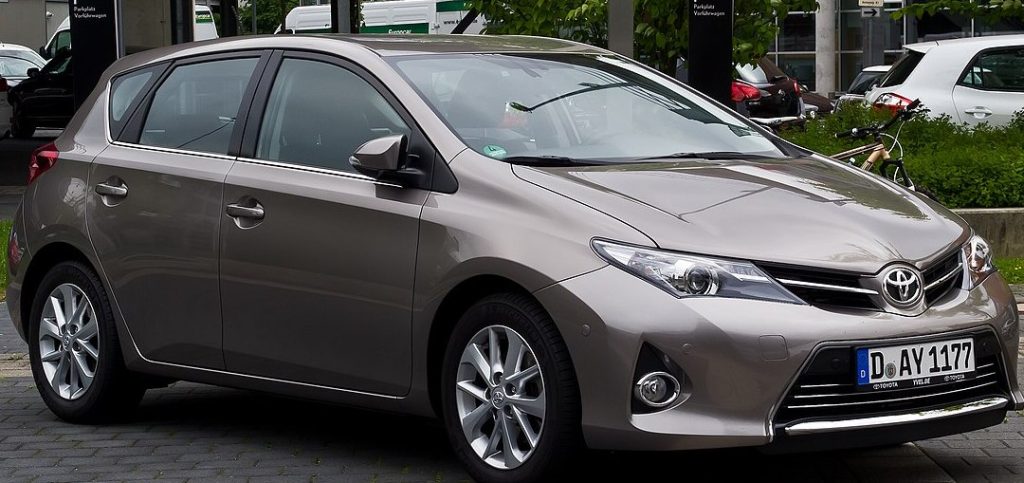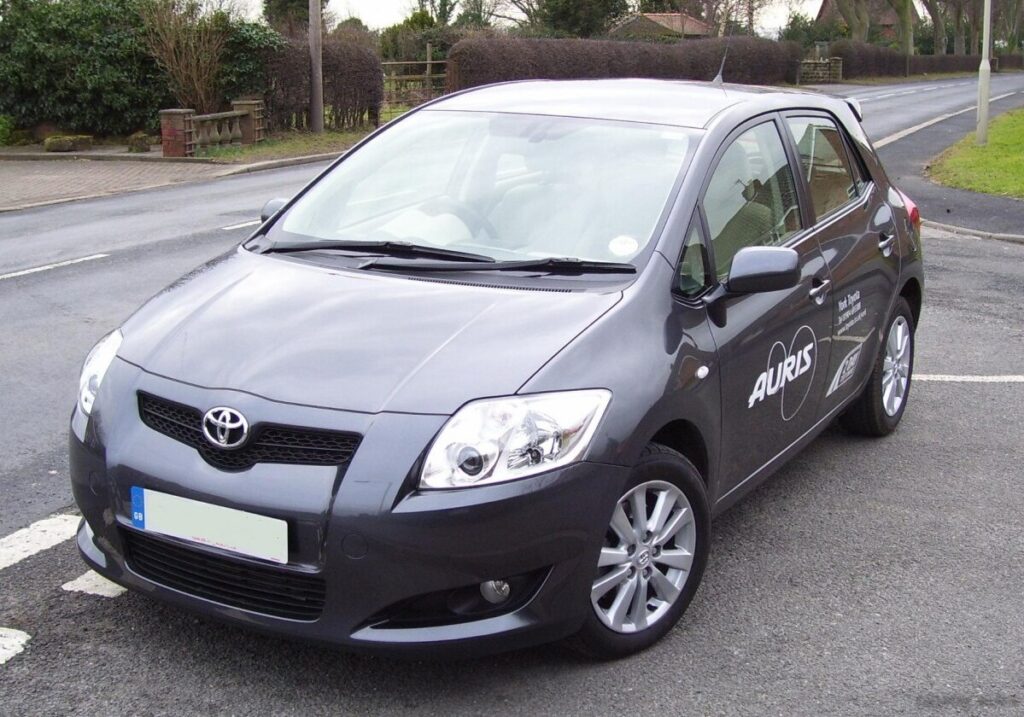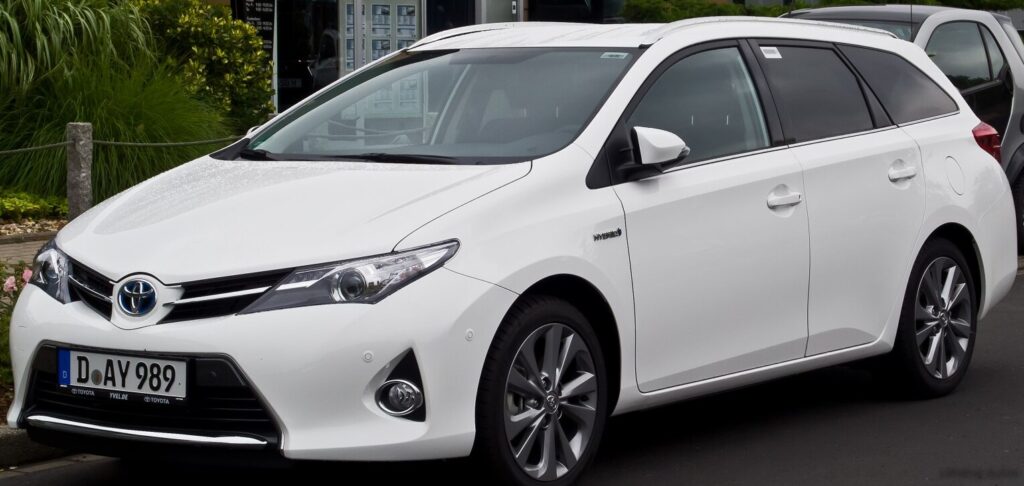
The Toyota Auris II Touring Sports 1.8 VVT-i Hybrid, produced from 2012 to 2015, represents Toyota’s entry into the European market for a practical, fuel-efficient compact estate car. Positioned as a mid-range offering within the Auris Touring Sports lineup, it combined a 1.8-liter gasoline engine with Toyota’s Hybrid Synergy Drive system. This variant aimed to appeal to buyers seeking a balance between fuel economy, practicality, and reasonable performance. It was part of the second-generation Auris (E180 series), specifically the Touring Sports body style, which offered increased cargo capacity compared to the hatchback version. The Auris was Toyota’s replacement for the Corolla Hatchback in the European market.
Technical Specifications
| Brand | Toyota |
| Model | Auris |
| Generation | Auris II Touring Sports |
| Type (Engine) | 1.8 VVT-i (136 Hp) Hybrid e-CVT |
| Start of production | 2012 |
| End of production | 2015 |
| Powertrain Architecture | FHEV (Full Hybrid Electric Vehicle) |
| Body type | Station wagon (estate) |
| Seats | 5 |
| Doors | 5 |
| Fuel consumption (urban) | 3.7 l/100 km (63.6 US mpg, 76.3 UK mpg, 27 km/l) |
| Fuel consumption (extra urban) | 3.8 l/100 km (61.9 US mpg, 74.3 UK mpg, 26.3 km/l) |
| Fuel consumption (combined) | 3.8 l/100 km (61.9 US mpg, 74.3 UK mpg, 26.3 km/l) |
| CO2 emissions | 88 g/km |
| Fuel Type | Petrol (Gasoline) |
| Acceleration 0 – 100 km/h | 11.2 sec |
| Acceleration 0 – 62 mph | 11.2 sec |
| Acceleration 0 – 60 mph | 10.6 sec |
| Maximum speed | 175 km/h (108.74 mph) |
| Emission standard | Euro 5 |
| Weight-to-power ratio | 9.8 kg/Hp, 101.9 Hp/tonne |
| Weight-to-torque ratio | 9.4 kg/Nm, 106.4 Nm/tonne |
| Gross battery capacity | 1.31 kWh |
| Battery voltage | 201.6 V |
| Battery technology | Nickel-metal hydride (NiMH) |
| Battery location | Under the rear seats |
| Electric motor power | 82 Hp |
| Electric motor Torque | 207 Nm (152.68 lb.-ft.) |
| Electric motor location | Integrated into the transmission |
| System power | 136 Hp @ 5200 rpm |
| System torque | 142 Nm @ 4000 rpm (104.73 lb.-ft. @ 4000 rpm) |
| Internal combustion engine power | 99 Hp @ 5200 rpm |
| Power per litre | 55.1 Hp/l |
| Internal combustion engine torque | 142 Nm @ 4000 rpm (104.73 lb.-ft. @ 4000 rpm) |
| Engine layout | Front, Transverse |
| Engine Model/Code | 2ZR-FXE |
| Engine displacement | 1798 cm3 (109.72 cu. in.) |
| Number of cylinders | 4 |
| Engine configuration | Inline |
| Cylinder Bore | 80.5 mm (3.17 in.) |
| Piston Stroke | 88.3 mm (3.48 in.) |
| Number of valves per cylinder | 4 |
| Fuel injection system | Multi-port manifold injection |
| Engine aspiration | Naturally aspirated engine |
| Valvetrain | DOHC |
| Engine oil capacity | 4.2 l (4.44 US qt | 3.7 UK qt) |
| Coolant capacity | 7 l (7.4 US qt | 6.16 UK qt) |
| Kerb Weight | 1335 kg (2943.17 lbs.) |
| Max. weight | 1815 kg (4001.39 lbs.) |
| Max load | 480 kg (1058.22 lbs.) |
| Trunk (boot) space – minimum | 530 l (18.72 cu. ft.) |
| Trunk (boot) space – maximum | 672 l (23.73 cu. ft.) |
| Fuel tank capacity | 45 l (11.89 US gal | 9.9 UK gal) |
| Permitted towbar download | 55 kg (121.25 lbs.) |
| Length | 4560 mm (179.53 in.) |
| Width | 1760 mm (69.29 in.) |
| Height | 1460 mm (57.48 in.) |
| Wheelbase | 2600 mm (102.36 in.) |
| Front track | 1515-1535 mm (59.65 – 60.43 in.) |
| Rear track | 1505-1525 mm (59.25 – 60.04 in.) |
| Drivetrain Architecture | Front wheel drive. FHEV (Full Hybrid Electric Vehicle). ICE and electric motor drive front wheels. |
| Drive wheel | Front wheel drive |
| Number of gears and type of gearbox | automatic transmission e-CVT |
| Front suspension | Independent, type McPherson with coil spring and anti-roll bar |
| Rear suspension | Double wishbone |
| Front brakes | Ventilated discs |
| Rear brakes | Disc |
| Assisting systems | ABS (Anti-lock braking system) |
| Steering type | Steering rack and pinion |
| Power steering | Electric Steering |
| Tires size | 195/65 R15; 205/55 R16; 225/45 R17 |
| Wheel rims size | 6J x 15; 6.5J x 16; 7J x 17 |
INTRODUCTION
The Toyota Auris II Touring Sports 1.8 VVT-i Hybrid, launched in 2012, was a key model in Toyota’s European lineup. Built on the E180 platform (also known as the 1HX0 for the Touring Sports), it offered a more practical alternative to the standard Auris hatchback. The Touring Sports body style provided a significantly larger cargo area, making it suitable for families and those requiring increased load-carrying capacity. This particular variant, with its 1.8-liter engine and e-CVT transmission, was designed to maximize fuel efficiency while providing adequate performance for everyday driving. It sat in the middle of the Touring Sports range, offering a balance between price, features, and economy.
Powertrain & Engine Architecture
The heart of the Auris Touring Sports 1.8 Hybrid is the 2ZR-FXE 1.8-liter inline-four cylinder gasoline engine. This engine utilizes Toyota’s Valvematic technology, a variable valve lift system, to optimize engine efficiency and power delivery. It produces 99 horsepower at 5200 rpm and 142 Nm (104.73 lb-ft) of torque at 4000 rpm. The engine is paired with Toyota’s Hybrid Synergy Drive system, which incorporates an electric motor producing 82 horsepower and 207 Nm (152.68 lb-ft) of torque. The total system output is 136 horsepower. The e-CVT (electronically controlled continuously variable transmission) seamlessly blends the power from the gasoline engine and the electric motor. Unlike traditional CVTs with belts, Toyota’s e-CVT uses a planetary gearset, offering a more direct and responsive feel. The nickel-metal hydride (NiMH) battery pack, with a gross capacity of 1.31 kWh, is located under the rear seats, minimizing intrusion into the passenger or cargo areas. The engine employs multi-port fuel injection for precise fuel delivery.
Driving Characteristics
The 1.8 Hybrid e-CVT offers a smooth and refined driving experience, prioritizing fuel efficiency over outright performance. Acceleration from 0-60 mph takes around 10.6 seconds, and 0-100 km/h in 11.2 seconds, which is adequate for everyday driving but not particularly sporty. The e-CVT transmission provides seamless acceleration, with the engine speed often decoupled from vehicle speed. This can feel unusual to drivers accustomed to traditional automatic transmissions. The hybrid system allows for short periods of electric-only driving at low speeds, further enhancing fuel economy. Compared to the 1.6-liter gasoline versions of the Auris, the 1.8 Hybrid offers significantly better fuel economy, but slightly less outright acceleration. Compared to the 2.0-liter versions, it offers similar acceleration but superior fuel efficiency. The steering is light and precise, making it easy to maneuver in urban environments.
Equipment & Trim Levels
The 1.8 VVT-i Hybrid trim typically included standard features such as air conditioning, power windows, power mirrors, a touchscreen infotainment system with Bluetooth connectivity, and alloy wheels. Safety features included ABS, Vehicle Stability Control (VSC), and multiple airbags. Optional extras included features like a rear-view camera, parking sensors, automatic climate control, and upgraded audio systems. Interior upholstery was typically cloth, with a focus on durability and practicality. Dashboard design was functional and modern, with a clear and easy-to-read instrument cluster.
Chassis & Braking
The Auris Touring Sports 1.8 Hybrid utilizes a McPherson strut front suspension and a double wishbone rear suspension, providing a comfortable and controlled ride. The suspension is tuned for comfort rather than sporty handling. Front brakes are ventilated discs, while rear brakes are solid discs. ABS (Anti-lock Braking System) is standard, providing enhanced braking performance in emergency situations. Stabilizer bars are fitted to both the front and rear axles to reduce body roll during cornering. The weight distribution is well-balanced, contributing to stable handling.
Market Reception & Comparison
The Auris Touring Sports 1.8 Hybrid was generally well-received by critics for its fuel efficiency and practicality. It was praised for its comfortable ride and refined driving experience. However, some critics noted its lack of outright performance compared to some rivals. Fuel economy figures of around 62-74 mpg (UK) were highly competitive in its class. Compared to other hybrid estate cars, such as the Honda Civic Tourer Hybrid, the Auris offered a similar level of fuel efficiency but a slightly less engaging driving experience. Reliability was generally excellent, consistent with Toyota’s reputation for building durable and dependable vehicles.
Legacy
The Toyota Auris II Touring Sports 1.8 VVT-i Hybrid has proven to be a reliable and economical vehicle in the used car market. The Hybrid Synergy Drive system has a strong track record for longevity, and the 2ZR-FXE engine is known for its durability. Maintenance costs are generally reasonable, although replacement of the hybrid battery may be required after many years of use. The Auris Touring Sports remains a popular choice for buyers seeking a practical, fuel-efficient, and dependable estate car. Its blend of practicality, economy, and Toyota’s renowned reliability ensures its continued appeal in the used car market.