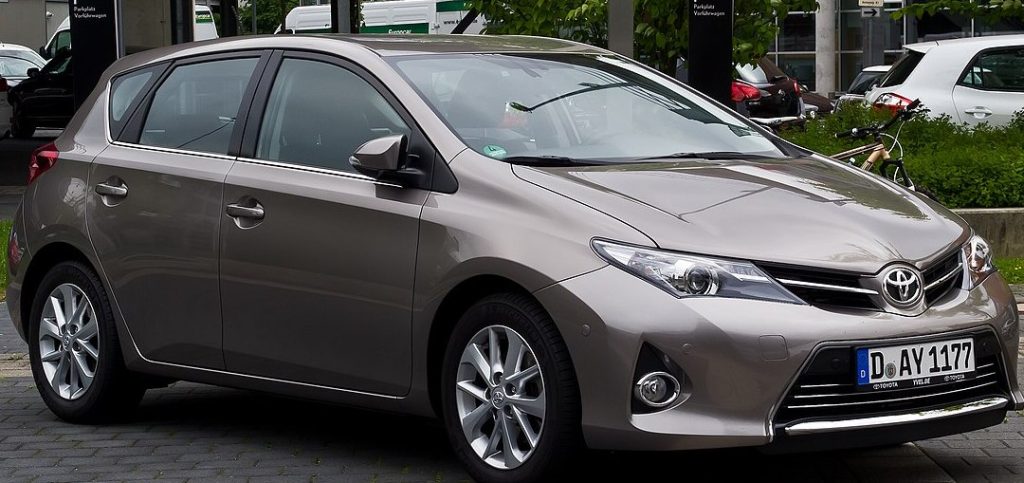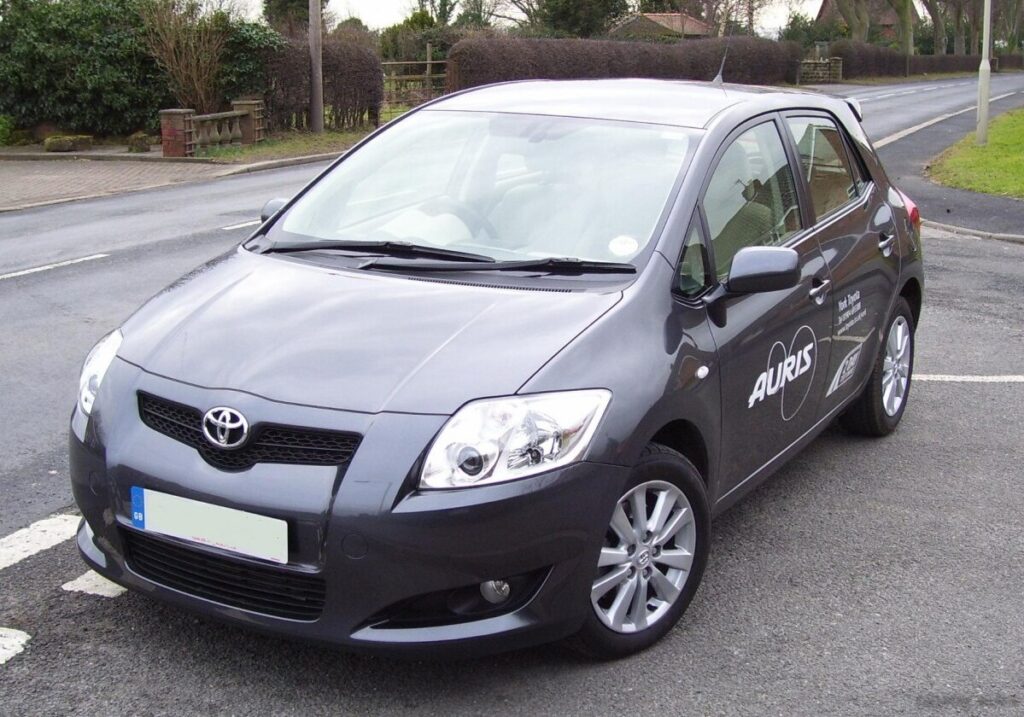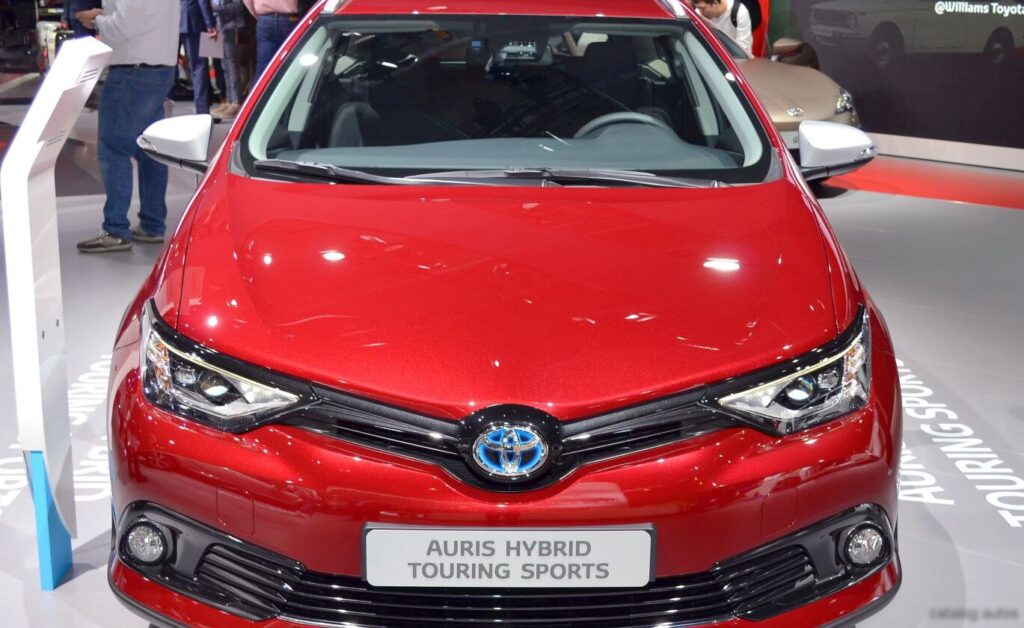
The Toyota Auris II Touring Sports, particularly the facelifted version introduced in 2015, represented Toyota’s entry into the European compact estate market. Positioned as a practical and fuel-efficient option, the Auris Touring Sports aimed to provide the versatility of a wagon with the reliability expected of the Toyota brand. The 1.2-liter (116 horsepower) variant with Start&Stop technology, produced from 2015 to 2018, served as a mid-range offering, balancing affordability with reasonable performance and economy. It was built on the E180 platform, also known as the 1HX0/A3 platform, shared with other compact Toyota and Scion models.
Technical Specifications
| Brand | Toyota |
| Model | Auris |
| Generation | Auris II Touring Sports (facelift 2015) |
| Type (Engine) | 1.2 (116 Hp) start&stop |
| Start of production | 2015 |
| End of production | 2018 |
| Powertrain Architecture | Internal Combustion engine |
| Body type | Station wagon (estate) |
| Seats | 5 |
| Doors | 5 |
| Fuel consumption (urban) | 6.6 l/100 km (35.6 US mpg, 42.8 UK mpg, 15.2 km/l) |
| Fuel consumption (extra urban) | 4.8 l/100 km (49 US mpg, 58.9 UK mpg, 20.8 km/l) |
| Fuel consumption (combined) | 4.8 l/100 km (49 US mpg, 58.9 UK mpg, 20.8 km/l) |
| CO2 emissions | 112 g/km |
| Fuel Type | Petrol (Gasoline) |
| Acceleration 0 – 100 km/h | 10.4 sec |
| Acceleration 0 – 62 mph | 10.4 sec |
| Acceleration 0 – 60 mph | 9.9 sec |
| Maximum speed | 195 km/h (121.17 mph) |
| Emission standard | Euro 6 W |
| Weight-to-power ratio | 11 kg/Hp, 90.6 Hp/tonne |
| Weight-to-torque ratio | 6.9 kg/Nm, 144.5 Nm/tonne |
| Power | 116 Hp @ 5200 rpm |
| Power per litre | 96.9 Hp/l |
| Torque | 185 Nm @ 1500-4000 rpm (136.45 lb.-ft. @ 1500-4000 rpm) |
| Engine layout | Front, Transverse |
| Engine Model/Code | 8NR-FTS |
| Engine displacement | 1197 cm3 (73.05 cu. in.) |
| Number of cylinders | 4 |
| Engine configuration | Inline |
| Compression ratio | 10:1 |
| Number of valves per cylinder | 4 |
| Fuel injection system | Direct injection |
| Engine aspiration | Turbocharger, Intercooler |
| Valvetrain | DOHC |
| Engine oil capacity | 4 l (4.23 US qt | 3.52 UK qt) |
| Coolant | 6.2 l (6.55 US qt | 5.46 UK qt) |
| Kerb Weight | 1280-1460 kg (2821.92 – 3218.75 lbs.) |
| Max. weight | 1835 kg (4045.48 lbs.) |
| Max load | 375-555 kg (826.73 – 1223.57 lbs.) |
| Trunk (boot) space – minimum | 530 l (18.72 cu. ft.) |
| Fuel tank capacity | 50 l (13.21 US gal | 11 UK gal) |
| Max. roof load | 75 kg (165.35 lbs.) |
| Permitted trailer load with brakes (12%) | 1300 kg (2866.01 lbs.) |
| Permitted trailer load without brakes | 450 kg (992.08 lbs.) |
| Permitted towbar download | 55 kg (121.25 lbs.) |
| Length | 4595 mm (180.91 in.) |
| Width | 1760 mm (69.29 in.) |
| Height | 1485 mm (58.46 in.) |
| Wheelbase | 2600 mm (102.36 in.) |
| Front track | 1515 mm (59.65 in.) |
| Rear (Back) track | 1505 mm (59.25 in.) |
| Minimum turning circle | 11.0 m (36.09 ft.) |
| Drivetrain Architecture | Front wheel drive |
| Drive wheel | Front wheel drive |
| Number of gears and type of gearbox | 6 gears, manual transmission |
| Front suspension | Independent, type McPherson with coil spring and anti-roll bar |
| Rear suspension | Double wishbone |
| Front brakes | Disc |
| Rear brakes | Disc |
| Assisting systems | ABS (Anti-lock braking system) |
| Steering type | Steering rack and pinion |
| Power steering | Electric Steering |
| Tires size | 205/55 R16 |
| Wheel rims size | 6.5J x 16 |
Powertrain & Engine Architecture
The heart of this Auris variant is the 8NR-FTS engine, a 1.2-liter turbocharged inline-four cylinder petrol engine. This engine is part of Toyota’s ‘New Global Architecture’ (NGA) engine family, designed for efficiency and reduced emissions. It utilizes direct fuel injection and a twin-scroll turbocharger with an intercooler to deliver a balance of power and fuel economy. The engine’s 116 horsepower peak is achieved at 5200 rpm, while its 185 Nm (136 lb-ft) of torque is available from a low 1500 rpm, providing good responsiveness in everyday driving. The engine features a DOHC (Double Overhead Camshaft) valvetrain with four valves per cylinder. The Start&Stop system, standard on this model, automatically shuts off the engine when the vehicle is stationary (e.g., at traffic lights) to further improve fuel efficiency. The engine is paired with a six-speed manual transmission, delivering power to the front wheels.
Driving Characteristics
The 1.2-liter turbocharged engine provides adequate performance for typical commuting and highway driving. While not particularly sporty, the engine’s torque delivery makes it feel more responsive than its displacement might suggest. Acceleration from 0-60 mph takes around 9.9 seconds, and top speed is rated at 195 km/h (121 mph). Compared to the higher-output 1.6-liter engine offered in some Auris models, the 1.2-liter feels less powerful, especially when fully loaded or tackling steep inclines. However, the 1.2-liter’s lighter weight and lower friction contribute to better fuel economy. The six-speed manual transmission is well-matched to the engine, offering smooth shifts and allowing the driver to keep the engine in its optimal power band. The gear ratios are tuned for efficiency rather than outright acceleration.
Equipment & Trim Levels
The 1.2-liter Touring Sports typically came equipped with a reasonable level of standard features. These included air conditioning, a touchscreen infotainment system with Bluetooth connectivity, power windows and mirrors, and alloy wheels. Safety features such as ABS, Vehicle Stability Control (VSC), and multiple airbags were also standard. Higher trim levels offered additional features like automatic climate control, a rearview camera, parking sensors, and upgraded upholstery. Interior upholstery was typically cloth, with options for partial leather trim on higher-spec models. The dashboard layout was functional and user-friendly, with a focus on ergonomics.
Chassis & Braking
The Auris Touring Sports utilizes a McPherson strut front suspension and a double wishbone rear suspension. This setup provides a comfortable ride quality, absorbing bumps and imperfections in the road surface effectively. The suspension is tuned for comfort rather than sporty handling. Braking duties are handled by disc brakes on all four wheels, providing adequate stopping power. ABS (Anti-lock Braking System) is standard, enhancing safety during emergency braking situations. The steering is electrically assisted, providing light and precise control.
Market Reception & Comparison
The 1.2-liter Auris Touring Sports was generally well-received by critics as a practical and economical estate car. Its fuel efficiency was a major selling point, and its comfortable ride quality made it a good choice for long journeys. Compared to other compact estates in its class, such as the Volkswagen Golf Estate or the Ford Focus Estate, the Auris offered a competitive level of equipment and a strong reputation for reliability. However, some critics found the engine to be somewhat underpowered, particularly when compared to larger-displacement alternatives. The 1.2-liter variant was positioned as an entry-level or mid-range option, appealing to buyers who prioritized fuel economy and practicality over outright performance.
Legacy
The 8NR-FTS engine has proven to be a relatively reliable unit, with few widespread issues reported. The Auris Touring Sports, in general, has a good reputation for build quality and durability. On the used car market, the 1.2-liter variant represents a good value proposition, offering a practical and economical estate car at an affordable price. Maintenance costs are generally reasonable, and parts availability is good. However, as with any turbocharged engine, it’s important to ensure that the turbocharger and associated components are in good working order. Regular servicing and adherence to the manufacturer’s recommended maintenance schedule are crucial for maintaining the long-term reliability of this powertrain.