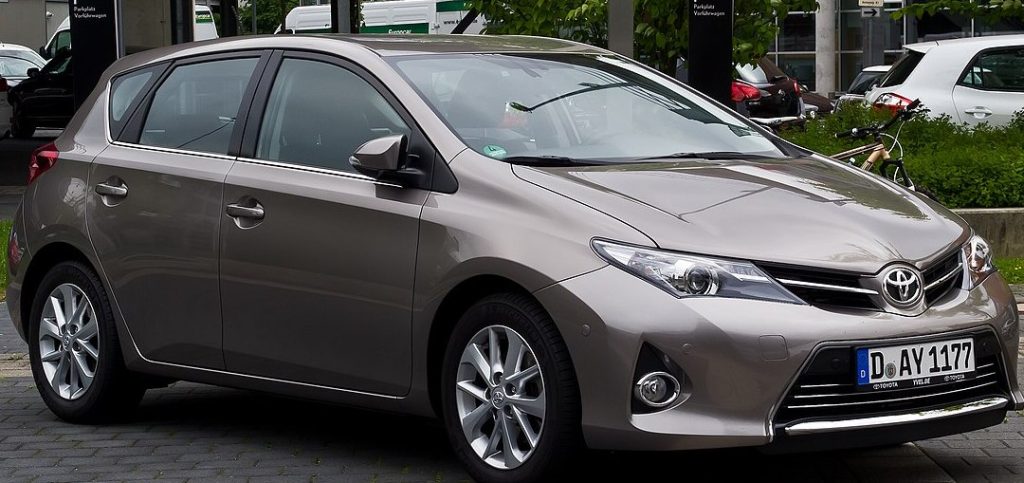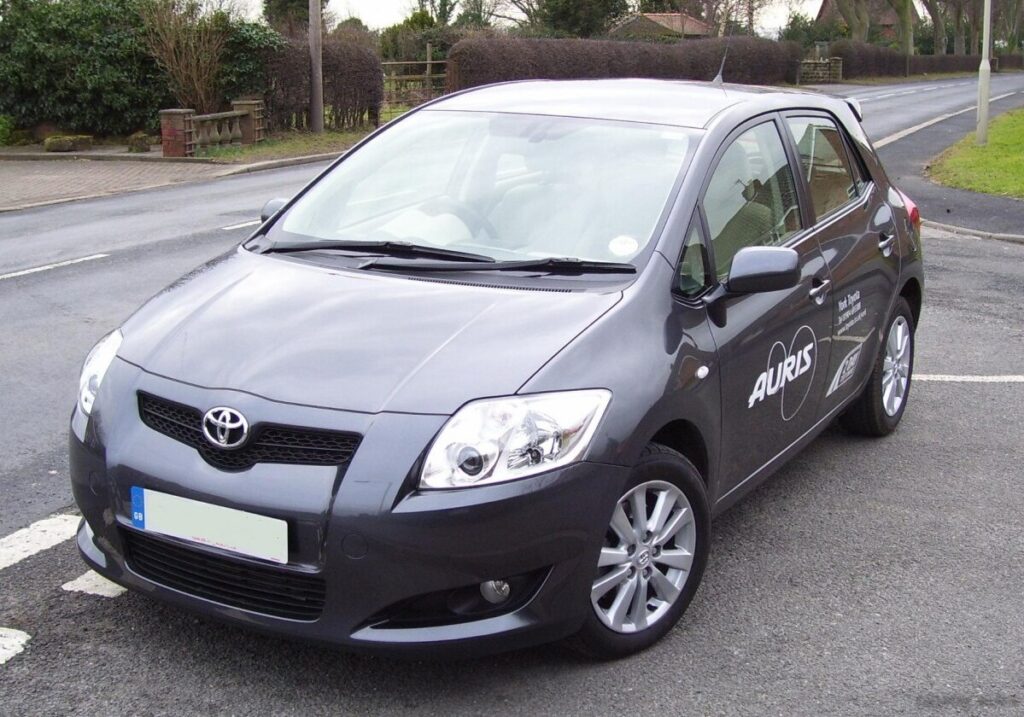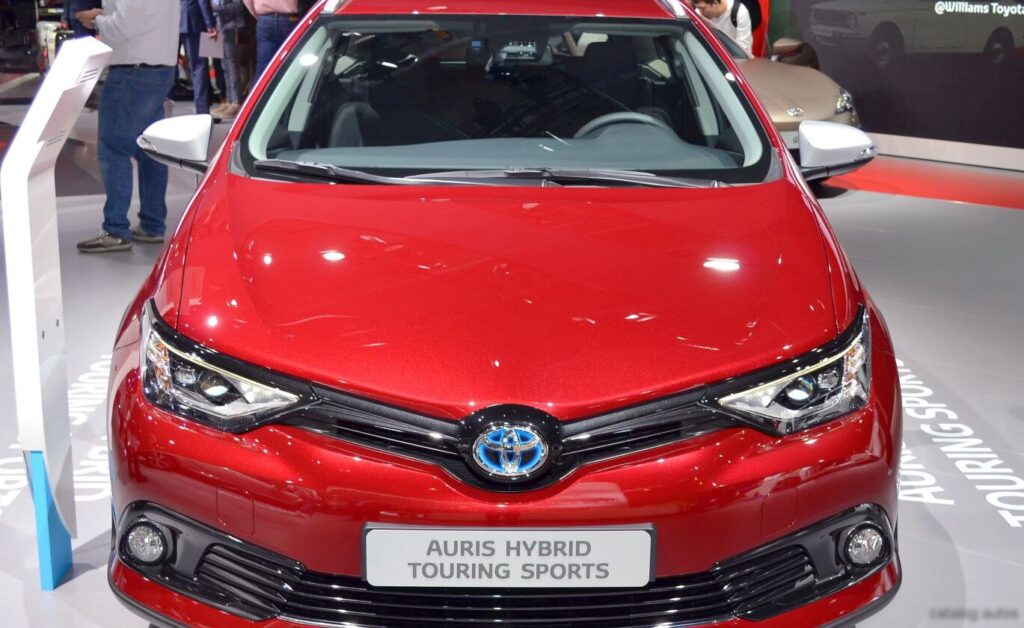
The Toyota Auris II Touring Sports, specifically the 1.33 Dual VVT-i variant producing 99 horsepower, was a key model in Toyota’s European lineup from 2015 to 2018. This version of the Auris, a compact estate car (wagon), represented an entry-level option within the second-generation Auris range, positioned below the 1.6L petrol and hybrid models. It was designed to appeal to buyers seeking a practical, fuel-efficient vehicle for family use or light commercial purposes. The facelifted model, introduced in 2015, brought styling updates and minor mechanical revisions to the Auris range, enhancing its competitiveness in the crowded European C-segment.
Technical Specifications
| Brand | Toyota |
| Model | Auris |
| Generation | Auris II Touring Sports (facelift 2015) |
| Type (Engine) | 1.33 Dual VVT-i (99 Hp) |
| Start of production | 2015 |
| End of production | 2018 |
| Powertrain Architecture | Internal Combustion engine |
| Body type | Station wagon (estate) |
| Seats | 5 |
| Doors | 5 |
| Fuel consumption (urban) | 7.2 l/100 km (32.7 US mpg, 39.2 UK mpg, 13.9 km/l) |
| Fuel consumption (extra urban) | 4.9 l/100 km (48 US mpg, 57.6 UK mpg, 20.4 km/l) |
| Fuel consumption (combined) | 5.6 l/100 km (42 US mpg, 50.4 UK mpg, 17.9 km/l) |
| CO2 emissions | 130 g/km |
| Fuel Type | Petrol (Gasoline) |
| Acceleration 0 – 100 km/h | 13.2 sec |
| Acceleration 0 – 62 mph | 13.2 sec |
| Acceleration 0 – 60 mph | 12.5 sec |
| Maximum speed | 175 km/h (108.74 mph) |
| Emission standard | Euro 6 W |
| Weight-to-power ratio | 12.6 kg/Hp, 79.2 Hp/tonne |
| Weight-to-torque ratio | 9.8 kg/Nm, 102.4 Nm/tonne |
| Power | 99 Hp @ 6000 rpm |
| Power per litre | 74.5 Hp/l |
| Torque | 128 Nm @ 3800 rpm (94.41 lb.-ft. @ 3800 rpm) |
| Engine layout | Front, Transverse |
| Engine Model/Code | 1NR-FE |
| Engine displacement | 1329 cm3 (81.1 cu. in.) |
| Number of cylinders | 4 |
| Engine configuration | Inline |
| Compression ratio | 11.5:1 |
| Number of valves per cylinder | 4 |
| Fuel injection system | Multi-port manifold injection |
| Engine aspiration | Naturally aspirated engine |
| Valvetrain | DOHC |
| Engine oil capacity | 3.4 l (3.59 US qt | 2.99 UK qt) |
| Coolant | 5.7 l (6.02 US qt | 5.02 UK qt) |
| Kerb Weight | 1250-1405 kg (2755.78 – 3097.49 lbs.) |
| Max. weight | 1765 kg (3891.16 lbs.) |
| Max load | 360-515 kg (793.66 – 1135.38 lbs.) |
| Trunk (boot) space – minimum | 530 l (18.72 cu. ft.) |
| Fuel tank capacity | 50 l (13.21 US gal | 11 UK gal) |
| Max. roof load | 75 kg (165.35 lbs.) |
| Permitted trailer load with brakes (12%) | 1000 kg (2204.62 lbs.) |
| Permitted trailer load without brakes | 450 kg (992.08 lbs.) |
| Permitted towbar download | 55 kg (121.25 lbs.) |
| Length | 4595 mm (180.91 in.) |
| Width | 1760 mm (69.29 in.) |
| Height | 1485 mm (58.46 in.) |
| Wheelbase | 2600 mm (102.36 in.) |
| Front track | 1525 mm (60.04 in.) |
| Rear (Back) track | 1515 mm (59.65 in.) |
| Minimum turning circle | 11 m (36.09 ft.) |
| Drivetrain Architecture | Front wheel drive |
| Drive wheel | Front wheel drive |
| Number of gears and type of gearbox | 6 gears, manual transmission |
| Front suspension | Independent, type McPherson with coil spring and anti-roll bar |
| Rear suspension | Double wishbone |
| Front brakes | Disc |
| Rear brakes | Disc |
| Assisting systems | ABS (Anti-lock braking system) |
| Steering type | Steering rack and pinion |
| Power steering | Electric Steering |
| Tires size | 205/55 R16 |
| Wheel rims size | 6.5J x 16 |
Powertrain & Engine Architecture
The heart of this Auris variant is the 1NR-FE engine, a 1.329-liter inline-four cylinder petrol engine. This engine utilizes Toyota’s Dual VVT-i (Variable Valve Timing-intelligent) technology, which optimizes both intake and exhaust valve timing for improved efficiency and power delivery. The 1NR-FE is a naturally aspirated engine, meaning it doesn’t employ turbocharging or supercharging. Fuel is delivered via a multi-port fuel injection system. The engine produces 99 horsepower at 6000 rpm and 128 Nm (94.41 lb-ft) of torque at 3800 rpm. The engine’s relatively simple design contributes to its reliability, but also limits its outright performance. The engine is paired with a six-speed manual transmission, which was the standard offering for this trim level.
Driving Characteristics
The 1.33 Dual VVT-i Auris Touring Sports, with its 99 horsepower, offers modest performance. Acceleration from 0-60 mph takes around 12.5 seconds, and top speed is limited to 175 km/h (108.74 mph). The engine feels adequate for everyday driving, particularly in urban and suburban environments, but can feel strained when fully loaded or when tackling steep inclines. The six-speed manual transmission helps to keep the engine in its optimal power band, but requires frequent shifting to maintain momentum. Compared to the 1.6L petrol or hybrid versions, this variant offers less power and acceleration, but prioritizes fuel economy. The gear ratios are tuned for efficiency rather than outright performance.
Equipment & Trim Levels
The 1.33 Dual VVT-i Auris Touring Sports typically came with a reasonable level of standard equipment. This included air conditioning, power windows, central locking, a basic audio system with USB connectivity, and stability control. Higher trim levels, available as options, added features such as alloy wheels, a touchscreen infotainment system, rear parking sensors, and climate control. Interior upholstery was typically cloth, with a functional and durable design. The dashboard layout was straightforward and user-friendly, prioritizing practicality over luxury.
Chassis & Braking
The Auris Touring Sports utilizes a front-wheel-drive layout with independent McPherson strut suspension at the front and a double wishbone suspension at the rear. This setup provides a comfortable ride quality, although it’s not particularly sporty. The steering is electrically assisted, offering light and precise control. Braking is handled by disc brakes on all four wheels, supplemented by an Anti-lock Braking System (ABS). The suspension is tuned for comfort and stability, rather than aggressive handling.
Market Reception & Comparison
The 1.33 Dual VVT-i Auris Touring Sports was generally well-received by critics as a practical and economical choice. It was praised for its fuel efficiency, spacious interior, and comfortable ride. However, its lack of outright performance was often noted. Compared to the 1.6L petrol version, the 1.33 offered better fuel economy but significantly less power. The hybrid version provided even greater fuel efficiency but came at a higher price point. The 1.33 variant appealed to buyers who prioritized economy and practicality over performance.
Legacy
The 1NR-FE engine, found in this Auris variant, has proven to be a reliable and durable unit. While not known for its exciting performance, it’s generally considered a low-maintenance engine. On the used car market, the 1.33 Auris Touring Sports represents an affordable and economical option. Its fuel efficiency and practicality continue to make it an attractive choice for budget-conscious buyers. However, potential buyers should be aware of its limited power output and ensure the vehicle has been properly maintained.