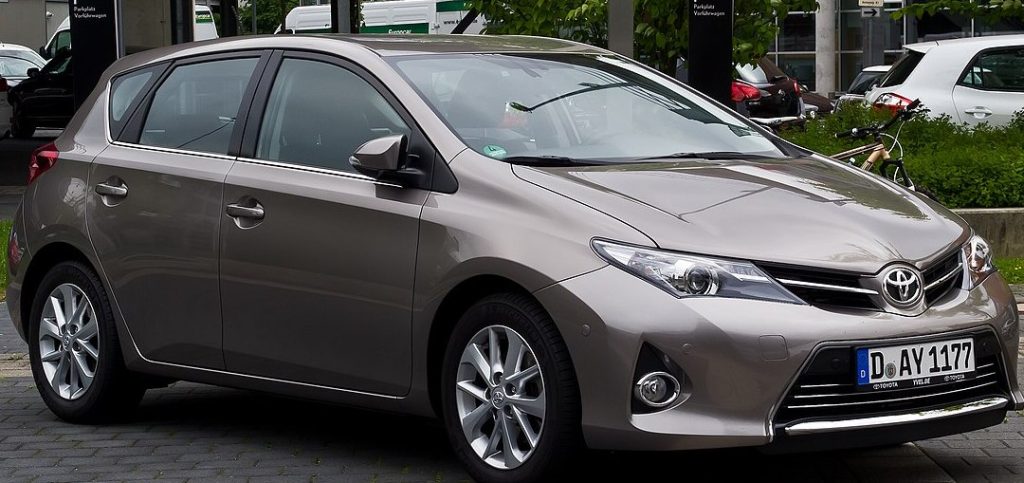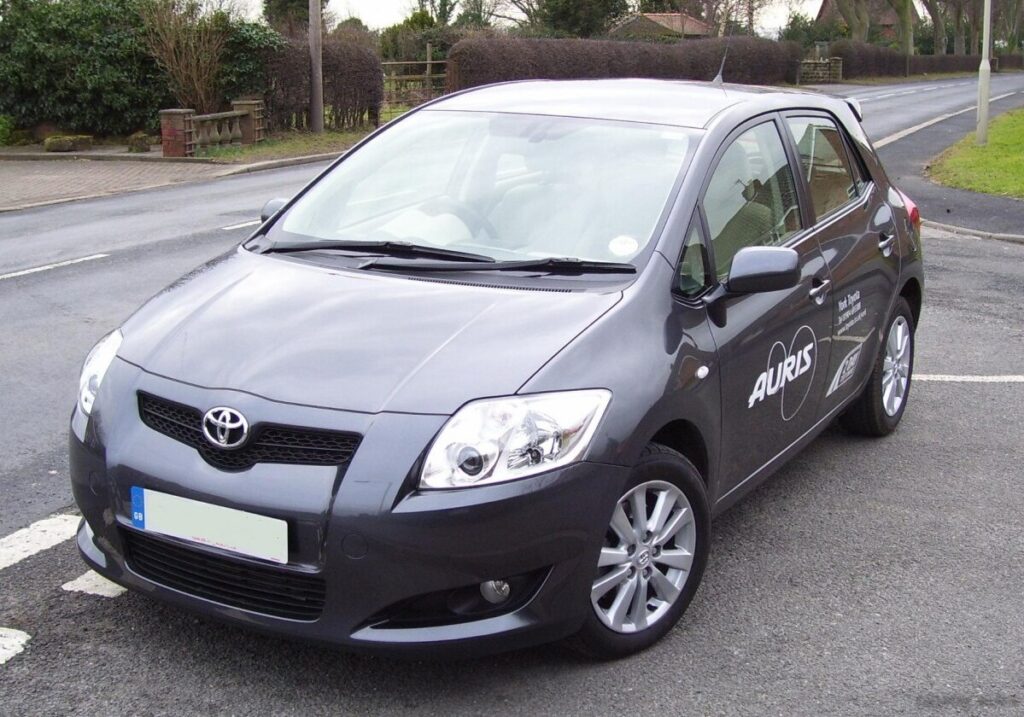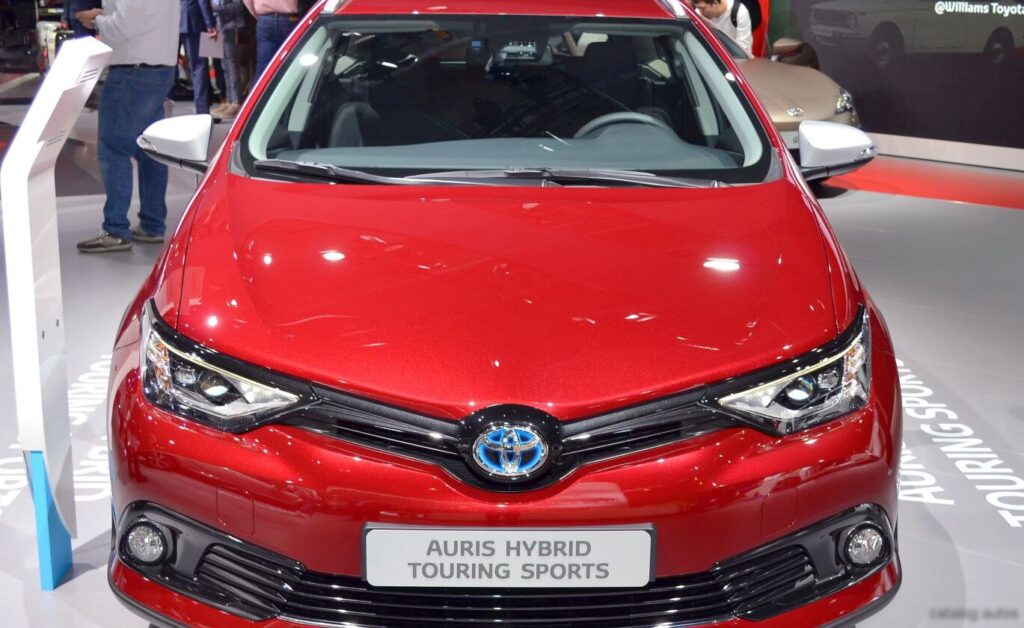
The Toyota Auris II Touring Sports, specifically the 1.8 Hybrid variant introduced with the 2015 facelift, represented a significant step in Toyota’s hybrid technology offering within the European market. Produced from 2015 to 2018, this model combined a 1.8-liter gasoline engine with an electric motor, utilizing Toyota’s Hybrid Synergy Drive system (HSD). Positioned as a mid-range offering within the Auris Touring Sports lineup, it aimed to provide a balance between fuel efficiency, practicality, and reasonable performance for buyers seeking a versatile family vehicle. The Auris, and subsequently the Corolla Touring Sports which replaced it, were designed to appeal to European tastes, offering a station wagon body style not traditionally popular in the North American market.
Technical Specifications
| Brand | Toyota |
| Model | Auris |
| Generation | Auris II Touring Sports (facelift 2015) |
| Type (Engine) | 1.8 (136 Hp) Hybrid e-CVT |
| Start of production | 2015 |
| End of production | 2018 |
| Powertrain Architecture | FHEV (Full Hybrid Electric Vehicle) |
| Body type | Station wagon (estate) |
| Seats | 5 |
| Doors | 5 |
| Fuel consumption (urban) | 4.1-4.2 l/100 km (57.4 – 56 US mpg) |
| Fuel consumption (extra urban) | 3.7-3.9 l/100 km (63.6 – 60.3 US mpg) |
| Fuel consumption (combined) | 4-4.1 l/100 km (58.8 – 57.4 US mpg) |
| CO2 emissions | 90-94 g/km |
| Fuel Type | Petrol (Gasoline) |
| Acceleration 0 – 100 km/h | 10.9 sec |
| Acceleration 0 – 62 mph | 10.9 sec |
| Acceleration 0 – 60 mph | 10.4 sec |
| Maximum speed | 180 km/h (111.85 mph) |
| Emission standard | Euro 6 |
| Weight-to-power ratio | 10.4 kg/Hp |
| Weight-to-torque ratio | 9.9 kg/Nm |
| Gross battery capacity | 1.31 kWh |
| Battery voltage | 201.6 V |
| Battery technology | Nickel-metal hydride (NiMH) |
| Battery location | Under the rear seats |
| Electric motor power | 82 Hp |
| Electric motor Torque | 207 Nm (152.68 lb.-ft.) |
| Electric motor location | Integrated into the transmission |
| System power | 136 Hp @ 5200 rpm |
| System torque | 142 Nm @ 4000 rpm (104.73 lb.-ft. @ 4000 rpm) |
| Internal combustion engine Power | 99 Hp @ 5200 rpm |
| Internal combustion engine Torque | 142 Nm @ 4000 rpm (104.73 lb.-ft. @ 4000 rpm) |
| Engine layout | Front, Transverse |
| Engine Model/Code | 2ZR-FXE |
| Engine displacement | 1798 cm3 (109.72 cu. in.) |
| Number of cylinders | 4 |
| Engine configuration | Inline |
| Cylinder Bore | 80.5 mm (3.17 in.) |
| Piston Stroke | 88.3 mm (3.48 in.) |
| Compression ratio | 13:1 |
| Number of valves per cylinder | 4 |
| Fuel injection system | Multi-port manifold injection |
| Engine aspiration | Naturally aspirated engine |
| Valvetrain | DOHC, VVT-i |
| Engine oil capacity | 4.2 l (4.44 US qt | 3.7 UK qt) |
| Coolant | 7 l (7.4 US qt | 6.16 UK qt) |
| Kerb Weight | 1410-1540 kg (3108.52 – 3395.12 lbs.) |
| Trunk (boot) space (minimum) | 530 l (18.72 cu. ft.) |
| Fuel tank capacity | 45 l (11.89 US gal | 9.9 UK gal) |
| Max. roof load | 75 kg (165.35 lbs.) |
| Permitted trailer load with brakes (12%) | 345 kg (760.59 lbs.) |
| Permitted trailer load without brakes | 345 kg (760.59 lbs.) |
| Permitted towbar download | 55 kg (121.25 lbs.) |
| Length | 4595 mm (180.91 in.) |
| Width | 1760 mm (69.29 in.) |
| Height | 1485 mm (58.46 in.) |
| Wheelbase | 2600 mm (102.36 in.) |
| Front track | 1535 mm (60.43 in.) |
| Rear track | 1525 mm (60.04 in.) |
| Minimum turning circle | 11.0 m (36.09 ft.) |
| Drivetrain Architecture | Front wheel drive. FHEV. ICE and electric motor drive front wheels. |
| Drive wheel | Front wheel drive |
| Number of gears and type of gearbox | automatic transmission e-CVT |
| Front suspension | Independent, type McPherson with coil spring and anti-roll bar |
| Rear suspension | Double wishbone |
| Front brakes | Ventilated discs |
| Rear brakes | Disc |
| Assisting systems | ABS (Anti-lock braking system) |
| Steering type | Steering rack and pinion |
| Power steering | Electric Steering |
| Tires size | 195/65 R15; 205/55 R16 |
| Wheel rims size | 6J x 15; 6.5J x 16 |
INTRODUCTION
The Toyota Auris II Touring Sports 1.8 Hybrid e-CVT, launched in 2015 following a facelift of the second-generation Auris, was a key model in Toyota’s European strategy. Built on the E180 platform (also known as the 1HX0/A3 platform shared with other compact Toyota and Daihatsu models), the Touring Sports variant offered the practicality of a station wagon while leveraging Toyota’s established hybrid technology. This particular trim level aimed to appeal to environmentally conscious buyers who needed the space and versatility of an estate car but didn’t necessarily prioritize outright performance. It filled a gap between the more affordable, lower-powered versions and the potentially more expensive, higher-specification trims.
Powertrain & Engine Architecture
At the heart of the Auris 1.8 Hybrid is Toyota’s 2ZR-FXE 1.8-liter inline-four gasoline engine. This engine utilizes a multi-port fuel injection system and a double overhead camshaft (DOHC) valvetrain with Variable Valve Timing-intelligence (VVT-i) to optimize efficiency and power delivery. The engine itself produces 99 horsepower and 142 Nm of torque. However, the system’s total output, combining the gasoline engine with the electric motor, is rated at 136 horsepower. The electric motor, powered by a nickel-metal hydride (NiMH) battery pack located under the rear seats, contributes 82 horsepower and 207 Nm of torque. The e-CVT (electronically controlled continuously variable transmission) is integral to the Hybrid Synergy Drive system. Unlike traditional CVTs with belts and pulleys, Toyota’s e-CVT uses a planetary gearset to seamlessly blend power from the engine and electric motor, providing a smooth and efficient driving experience. The system automatically switches between electric-only, gasoline-only, and combined operation depending on driving conditions and battery charge.
Driving Characteristics
The 1.8 Hybrid e-CVT prioritizes fuel efficiency over outright acceleration. The 0-60 mph time of around 10.4 seconds reflects this focus. The e-CVT transmission, while smooth, can feel somewhat unresponsive during aggressive acceleration, as it prioritizes maintaining optimal engine speed for efficiency. In typical driving scenarios, the system operates quietly and efficiently, often utilizing electric power at lower speeds. The combined power delivery is adequate for everyday driving, but overtaking maneuvers require careful planning. Compared to the 1.6L gasoline versions, the hybrid offers significantly better fuel economy, but less spirited performance. Against higher-powered gasoline variants, the hybrid trades performance for efficiency and a more relaxed driving experience.
Equipment & Trim Levels
The 1.8 Hybrid trim typically included standard features such as air conditioning, a touchscreen infotainment system, Bluetooth connectivity, and a suite of safety features including ABS, Vehicle Stability Control, and multiple airbags. Interior upholstery was generally cloth, with options for upgraded materials available. Higher trim levels within the hybrid range offered features like automatic climate control, parking sensors, a reversing camera, and alloy wheels. The Auris Touring Sports also offered a generous amount of cargo space, making it a practical choice for families.
Chassis & Braking
The Auris Touring Sports 1.8 Hybrid utilizes an independent McPherson strut suspension at the front and a double wishbone suspension at the rear, providing a comfortable ride quality. The suspension was tuned to balance comfort and handling, prioritizing ride comfort over sporty dynamics. Braking duties are handled by ventilated discs at the front and solid discs at the rear. The hybrid system incorporates regenerative braking, which captures energy during deceleration and uses it to recharge the battery, further enhancing fuel efficiency.
Market Reception & Comparison
The Auris 1.8 Hybrid e-CVT was generally well-received by critics for its fuel efficiency and smooth driving experience. However, some reviewers noted the lack of outright performance and the somewhat uninspiring driving dynamics. Compared to other trims in the Auris lineup, the hybrid offered superior fuel economy but at a slightly higher price point. Its main competitors included other hybrid and diesel-powered compact estate cars, such as the Volkswagen Golf Estate BlueMotion and the Skoda Octavia Combi GreenLine.
Legacy
The Toyota Auris II Touring Sports 1.8 Hybrid e-CVT proved to be a reliable and fuel-efficient vehicle. The Hybrid Synergy Drive system has a strong reputation for longevity, and the 2ZR-FXE engine is known for its durability. In the used car market, these models continue to be sought after by buyers looking for a practical, economical, and environmentally friendly vehicle. The Auris Touring Sports paved the way for the Corolla Touring Sports, which continues Toyota’s commitment to offering hybrid estate cars in the European market.