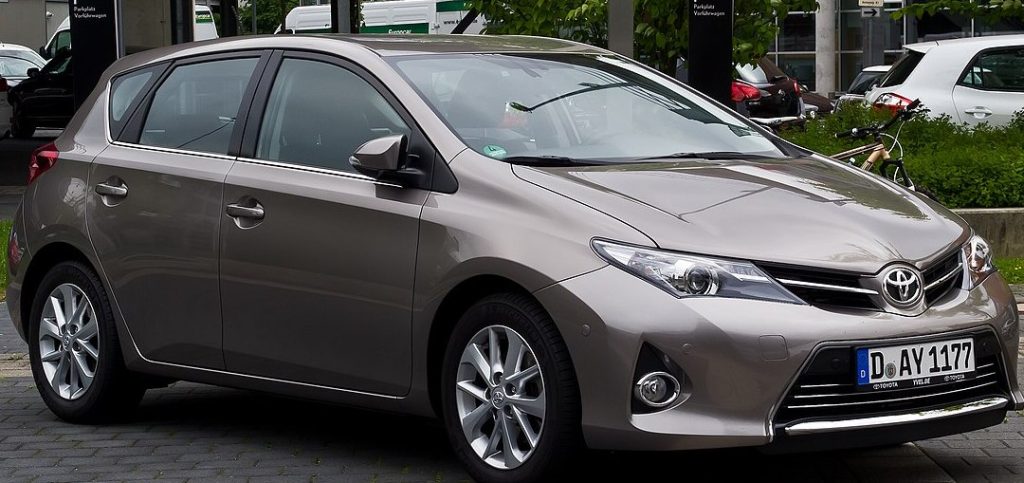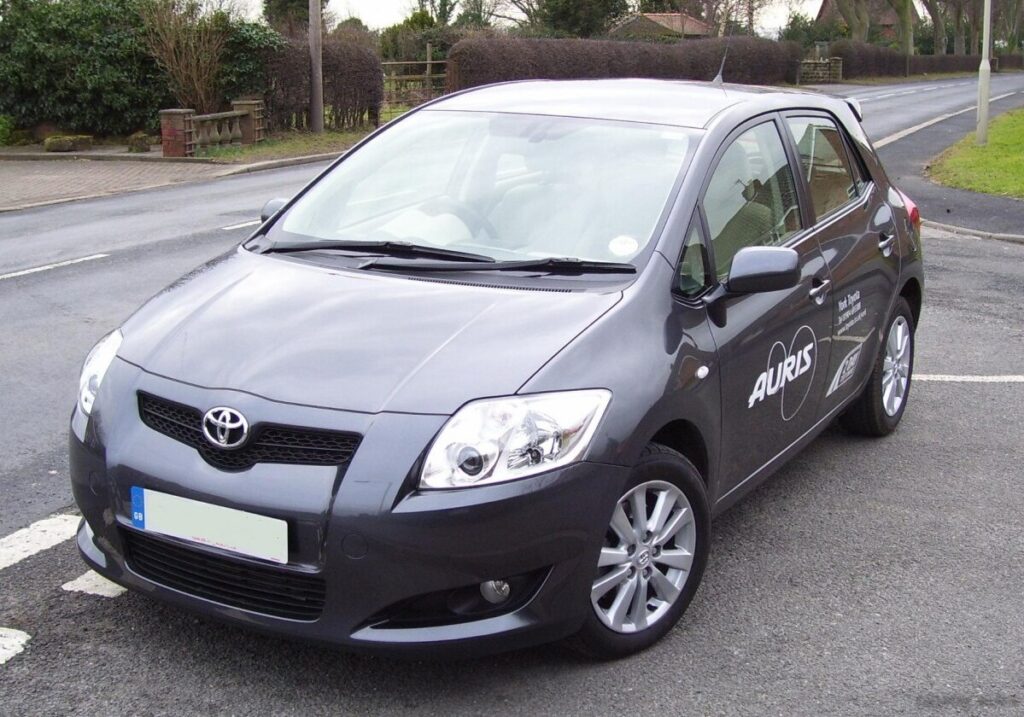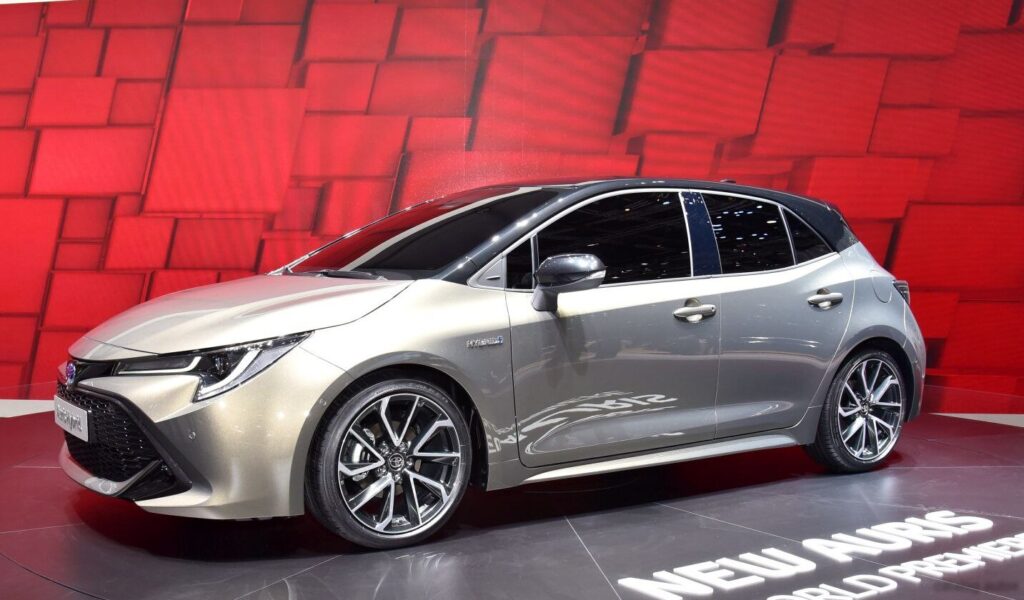
The Toyota Auris III 2.0 (170 hp) CVT, introduced in 2018, represents a significant iteration of Toyota’s compact hatchback, primarily aimed at the European market. Positioned as a mid-to-upper trim level within the Auris III range (E210 generation), this variant offered a blend of performance and fuel efficiency, appealing to buyers seeking a more engaging driving experience than the base 1.2L models, without the added cost of the hybrid options. It served as a bridge between the more economical trims and the technologically advanced hybrid versions, offering a traditional gasoline powertrain with the convenience of a continuously variable transmission.
Technical Specifications
| Brand | Toyota |
| Model | Auris |
| Generation | Auris III |
| Type (Engine) | 2.0 (170 Hp) CVT |
| Start of production | 2018 |
| Powertrain Architecture | Internal Combustion engine |
| Body type | Hatchback |
| Seats | 5 |
| Doors | 5 |
| Fuel consumption (combined) | 6.1 l/100 km (38.6 US mpg, 46.3 UK mpg, 16.4 km/l) |
| Fuel Type | Petrol (Gasoline) |
| Weight-to-power ratio | 8.2 kg/Hp, 122.3 Hp/tonne |
| Weight-to-torque ratio | 7 kg/Nm, 143.9 Nm/tonne |
| Power | 170 Hp @ 6600 rpm |
| Power per litre | 85.6 Hp/l |
| Torque | 200 Nm @ 4400-4800 rpm (147.51 lb.-ft. @ 4400-4800 rpm) |
| Engine layout | Front, Transverse |
| Engine Model/Code | M20A-FKS |
| Engine displacement | 1987 cm3 (121.25 cu. in.) |
| Number of cylinders | 4 |
| Engine configuration | Inline |
| Cylinder Bore | 80.5 mm (3.17 in.) |
| Piston Stroke | 97.6 mm (3.84 in.) |
| Compression ratio | 13:1 |
| Number of valves per cylinder | 4 |
| Fuel injection system | Multi-port manifold injection |
| Engine aspiration | Naturally aspirated engine |
| Valvetrain | DOHC, VVT-i |
| Engine oil capacity | 4.6 l (4.86 US qt | 4.05 UK qt) |
| Kerb Weight | 1390 kg (3064.43 lbs.) |
| Trunk (boot) space – minimum | 926 l (32.7 cu. ft.) |
| Fuel tank capacity | 50 l (13.21 US gal | 11 UK gal) |
| Length | 4375 mm (172.24 in.) |
| Width | 1790 mm (70.47 in.) |
| Height | 1435 mm (56.5 in.) |
| Wheelbase | 2640 mm (103.94 in.) |
| Minimum turning circle | 10.2-10.6 m (33.46 – 34.78 ft.) |
| Drivetrain Architecture | The Internal combustion engine (ICE) drives the front wheels of the vehicle. |
| Drive wheel | Front wheel drive |
| Number of gears and type of gearbox | automatic transmission CVT |
| Front suspension | Independent type McPherson |
| Rear suspension | Double wishbone |
| Front brakes | Disc |
| Rear brakes | Disc |
| Assisting systems | ABS (Anti-lock braking system) |
| Steering type | Steering rack and pinion |
| Power steering | Electric Steering |
| Tires size | 205/55 R16; 225/40 R18 |
| Wheel rims size | 16; 18 |
Powertrain & Engine Architecture
The heart of the Auris III 2.0 CVT is the M20A-FKS engine, a 1.987-liter (121.25 cubic inches) inline-four cylinder gasoline engine. This engine utilizes a multi-port fuel injection system and benefits from Toyota’s Variable Valve Timing-intelligence (VVT-i) technology, optimizing valve timing for improved performance and fuel economy across the rev range. The engine produces 170 horsepower at 6600 rpm and 200 Nm (147.51 lb-ft) of torque between 4400 and 4800 rpm. The high 13:1 compression ratio contributes to its efficiency. Paired with this engine is a continuously variable transmission (CVT), designed to provide smooth, stepless gear changes and maximize fuel efficiency. Unlike traditional automatic transmissions with fixed gear ratios, the CVT allows the engine to operate at its most efficient point for any given speed and load.
Driving Characteristics
The 2.0L CVT Auris offers a noticeably more responsive driving experience compared to the lower-displacement engines. While the CVT doesn’t provide the immediate gear changes of a traditional automatic, it delivers smooth and linear acceleration. The CVT is programmed to mimic stepped gear changes under hard acceleration, providing a more familiar feel for drivers accustomed to conventional automatics. The power delivery is adequate for everyday driving and highway cruising, though it doesn’t offer the same level of outright performance as some of its competitors with turbocharged engines. The CVT’s ratios are tuned for efficiency, meaning the engine can sometimes feel strained during aggressive acceleration. Compared to the six-speed manual version of the 2.0L Auris, the CVT sacrifices some responsiveness for the sake of convenience and fuel economy.
Equipment & Trim Levels
The 2.0 CVT trim of the Auris III typically included a generous level of standard equipment. Features commonly found on this variant include air conditioning, a touchscreen infotainment system with Bluetooth connectivity, alloy wheels (typically 16 or 18 inch depending on the package), and a suite of safety features such as ABS, electronic stability control, and multiple airbags. Higher trim levels within the 2.0 range offered options like leather upholstery, a panoramic sunroof, parking sensors, and a more advanced infotainment system with navigation. Interior upholstery was generally cloth, with leather available as an upgrade. The dashboard layout was modern and functional, with a focus on ergonomics.
Chassis & Braking
The Auris III 2.0 CVT utilizes a McPherson strut front suspension and a double wishbone rear suspension, providing a comfortable and controlled ride. The suspension is tuned to balance ride comfort with handling stability. Braking duties are handled by disc brakes on all four wheels, providing adequate stopping power. ABS (Anti-lock Braking System) is standard, enhancing safety during emergency braking situations. The steering is electrically assisted, offering light and precise control. Stabilizer bars are fitted to both the front and rear axles to reduce body roll during cornering.
Market Reception & Comparison
The Toyota Auris III 2.0 CVT received generally positive reviews from automotive critics. It was praised for its comfortable ride, fuel efficiency, and smooth CVT transmission. However, some reviewers noted that the engine lacked the punch of turbocharged competitors and that the CVT could feel somewhat unresponsive during aggressive driving. Compared to the 1.2L turbocharged engine, the 2.0L offered more power but at the expense of slightly higher fuel consumption. Against the hybrid Auris models, the 2.0L CVT provided a more traditional driving experience but couldn’t match the hybrid’s exceptional fuel economy. Reliability was a strong point, as expected from Toyota, with few reported issues specific to this powertrain combination.
Legacy
The Toyota Auris III 2.0 CVT has proven to be a reliable and durable vehicle in the used car market. The M20A-FKS engine is known for its longevity, and the CVT transmission, while sometimes criticized for its driving characteristics, has generally proven to be dependable with proper maintenance. These vehicles represent a good value proposition for buyers seeking a comfortable, fuel-efficient, and reliable compact hatchback. Parts availability is good, and maintenance costs are relatively low, making it an attractive option for budget-conscious buyers. The Auris III was eventually replaced by the Corolla Hatchback, but the 2.0L CVT variant remains a popular choice in the used car market due to its blend of practicality and dependability.