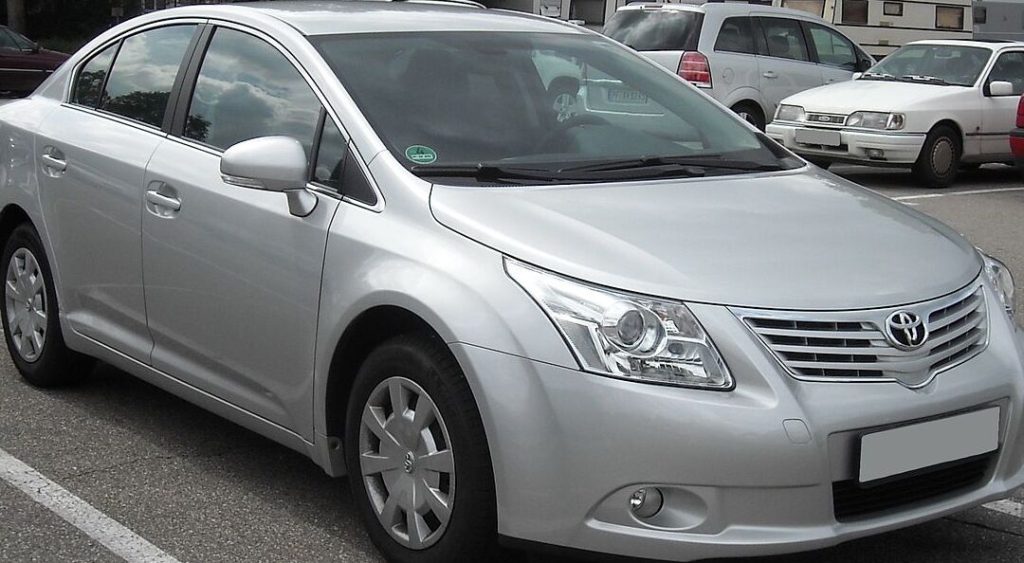
The Toyota Avensis Hatch (T22) 2.0 TD, producing 90 horsepower, was a significant offering in Toyota’s European lineup from 1997 to 2003. Positioned as an entry-level diesel variant within the T22 Avensis range, it aimed to provide fuel efficiency and practicality for family buyers. This model represented Toyota’s increasing focus on diesel technology in the European market, where diesel engines were favored for their economy. The Avensis, in general, was designed to compete with established European rivals like the Ford Mondeo and Vauxhall/Opel Vectra, offering a blend of reliability, comfort, and value. This particular 2.0 TD variant served as a more affordable alternative to the petrol-powered Avensis models and the higher-output diesel options.
Technical Specifications
| Brand | Toyota |
| Model | Avensis |
| Generation | Avensis Hatch (T22) |
| Type (Engine) | 2.0 TD (90 Hp) |
| Start of production | 1997 |
| End of production | 2003 |
| Powertrain Architecture | Internal Combustion engine |
| Body type | Hatchback |
| Seats | 5 |
| Doors | 5 |
| Fuel consumption (urban) | 8.5 l/100 km (27.7 US mpg) |
| Fuel consumption (extra urban) | 5.4 l/100 km (43.6 US mpg) |
| Fuel Type | Diesel |
| Acceleration 0 – 100 km/h | 12 sec |
| Acceleration 0 – 62 mph | 12 sec |
| Acceleration 0 – 60 mph | 11.4 sec |
| Maximum speed | 180 km/h (111.85 mph) |
| Weight-to-power ratio | 15.1 kg/Hp |
| Weight-to-torque ratio | 6.7 kg/Nm |
| Power | 90 Hp @ 4000 rpm |
| Torque | 203 Nm @ 2200 rpm (149.73 lb.-ft. @ 2200 rpm) |
| Engine layout | Front, Transverse |
| Engine Model/Code | 2C-TE |
| Engine displacement | 1975 cm3 (120.52 cu. in.) |
| Number of cylinders | 4 |
| Engine configuration | Inline |
| Cylinder Bore | 86 mm (3.39 in.) |
| Piston Stroke | 85 mm (3.35 in.) |
| Compression ratio | 23:1 |
| Number of valves per cylinder | 2 |
| Fuel injection system | Precombustion chamber injection |
| Engine aspiration | Turbocharger |
| Valvetrain | OHC |
| Engine oil capacity | 5.1 l (5.39 US qt | 4.49 UK qt) |
| Coolant capacity | 6.9 l (7.29 US qt | 6.07 UK qt) |
| Kerb Weight | 1360 kg (2998.29 lbs.) |
| Max. weight | 1830 kg (4034.46 lbs.) |
| Max load | 470 kg (1036.17 lbs.) |
| Trunk (boot) space – minimum | 510 l (18.01 cu. ft.) |
| Fuel tank capacity | 60 l (15.85 US gal | 13.2 UK gal) |
| Length | 4490 mm (176.77 in.) |
| Width | 1710 mm (67.32 in.) |
| Height | 1425 mm (56.1 in.) |
| Wheelbase | 2630 mm (103.54 in.) |
| Front track | 1480 mm (58.27 in.) |
| Rear track | 1450 mm (57.09 in.) |
| Drivetrain Architecture | Front wheel drive |
| Number of gears | 5 |
| Gearbox type | Manual transmission |
| Front suspension | Spring Strut |
| Rear suspension | Coil spring |
| Front brakes | Ventilated discs |
| Rear brakes | Drum |
| Assisting systems | ABS (Anti-lock braking system) |
| Steering type | Steering rack and pinion |
| Power steering | Hydraulic Steering |
| Tires size | 185/65 R14 |
Powertrain & Engine Architecture
The heart of the Avensis 2.0 TD (90 Hp) was the 2C-TE engine, a 1.975-liter inline-four cylinder diesel. This engine utilized a precombustion chamber injection system, a common technology in diesel engines of the era, designed to improve combustion efficiency and reduce noise. The 2C-TE was turbocharged, which helped to boost power output to 90 horsepower and 203 Nm (149.73 lb.-ft.) of torque. The engine featured an overhead camshaft (OHC) valvetrain with two valves per cylinder. The five-speed manual transmission was the standard offering, providing a balance between fuel economy and drivability. The engine’s design prioritized durability and low-end torque, characteristics valued in a family car intended for everyday use.
Driving Characteristics
The 90 hp 2.0 TD Avensis Hatch offered modest performance. Acceleration from 0 to 60 mph took around 11.4 seconds, and top speed was limited to 111.85 mph. While not particularly sporty, the engine delivered adequate power for typical driving situations, especially when utilizing the available low-end torque. The five-speed manual transmission allowed drivers to keep the engine in its optimal power band. Compared to the higher-output diesel versions or the petrol engines, this variant felt less responsive, but it excelled in fuel economy. The gear ratios were tuned for efficiency rather than outright acceleration, making it a comfortable cruiser on highways but requiring more planning when overtaking.
Equipment & Trim Levels
The 2.0 TD variant of the Avensis Hatch typically came with a reasonable level of standard equipment. This included central locking, power steering, electric front windows, and an adjustable steering column. Interior upholstery was generally cloth, and the dashboard featured a functional, if somewhat understated, design. Optional extras included air conditioning, alloy wheels, and a radio/cassette player. The trim level was generally considered to be entry-level to mid-range within the Avensis lineup, offering a good balance of features for the price.
Chassis & Braking
The Avensis Hatch featured a conventional chassis layout with a MacPherson strut front suspension and a coil spring rear suspension. This setup provided a comfortable ride quality, suitable for everyday driving. The front brakes were ventilated discs, offering good stopping power, while the rear brakes were drums, a cost-saving measure common in this class of vehicle. Anti-lock Braking System (ABS) was standard, enhancing safety. The suspension was tuned for comfort rather than sporty handling, prioritizing a smooth ride over sharp cornering.
Market Reception & Comparison
The Avensis 2.0 TD (90 Hp) was generally well-received by critics as a practical and economical family car. It was praised for its reliability and fuel efficiency, but some reviewers noted its lack of outright performance compared to petrol-powered rivals. Compared to the higher-output diesel versions of the Avensis, this variant offered lower running costs but sacrificed some performance. Against competitors like the Ford Mondeo and Vauxhall/Opel Vectra, the Avensis offered a strong value proposition, particularly in terms of reliability and build quality. Fuel economy was a key selling point, with the 2.0 TD achieving around 43.6 US mpg on the extra-urban cycle.
Legacy
The 2C-TE engine, while not known for being particularly sophisticated, proved to be remarkably durable and reliable. Avensis models equipped with this engine have a reputation for longevity, and many examples are still on the road today. In the used car market, the 2.0 TD variant is often sought after by buyers looking for an affordable and dependable vehicle. Maintenance costs are generally low, and parts availability is good. While it may not offer the performance or refinement of more modern diesel engines, the Avensis 2.0 TD (90 Hp) remains a practical and economical choice for those seeking a reliable family car.