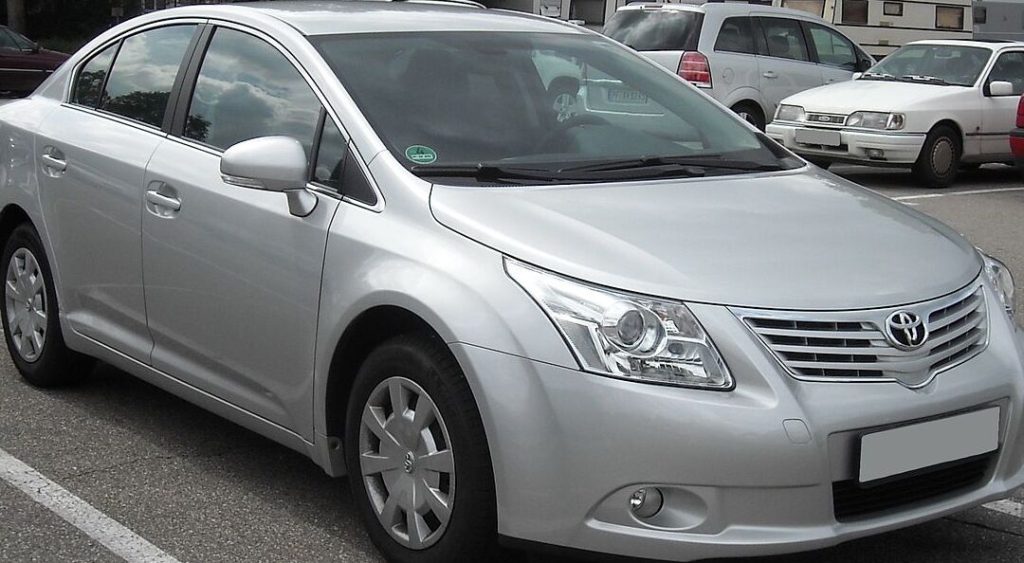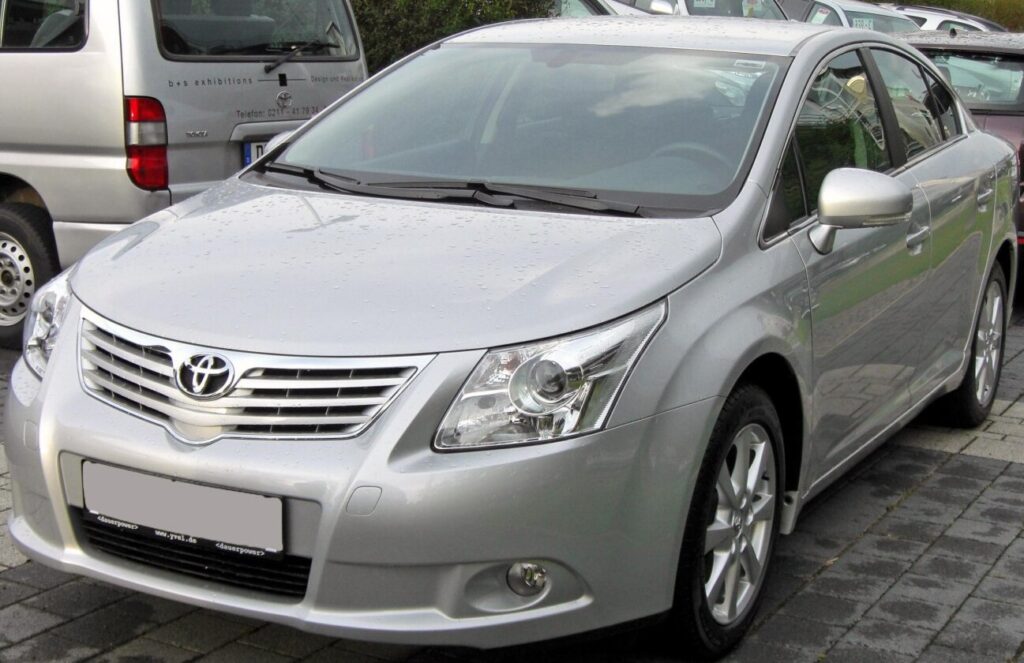
The Toyota Avensis III 1.8i, equipped with the Multidrive S continuously variable transmission, was a mainstay of the Avensis lineup from 2009 to 2011. Positioned as a mid-range offering, it aimed to balance fuel efficiency with acceptable performance for everyday driving. This variant occupied a space between the more economical base models and the higher-performance 2.0-liter and 2.2-liter diesel options. The Avensis III, built upon the Toyota K platform, represented a significant step forward in terms of refinement and technology for Toyota’s D-segment offering, primarily targeted at the European market, but also sold in Australia and parts of Asia. It was designed to compete with established rivals like the Ford Mondeo, Vauxhall/Opel Vectra, and Volkswagen Passat.
Technical Specifications
| Brand | Toyota |
| Model | Avensis |
| Generation | Avensis III |
| Type (Engine) | 1.8i (147 Hp) Multidrive |
| Start of production | 2009 |
| End of production | 2011 |
| Powertrain Architecture | Internal Combustion engine |
| Body type | Sedan |
| Seats | 5 |
| Doors | 4 |
| Fuel consumption (urban) | 8.6 l/100 km (27.4 US mpg) |
| Fuel consumption (extra urban) | 5.6 l/100 km (42 US mpg) |
| Fuel consumption (combined) | 6.7 l/100 km (35.1 US mpg) |
| Fuel Type | Petrol (Gasoline) |
| Acceleration 0 – 100 km/h | 10.4 sec |
| Acceleration 0 – 62 mph | 10.4 sec |
| Acceleration 0 – 60 mph | 9.9 sec |
| Maximum speed | 200 km/h (124.27 mph) |
| Emission standard | Euro 5 |
| Weight-to-power ratio | 9.6 kg/Hp |
| Weight-to-torque ratio | 7.8 kg/Nm |
| Power | 147 Hp @ 6000 rpm |
| Torque | 180 Nm @ 4000 rpm (132.76 lb.-ft. @ 4000 rpm) |
| Engine layout | Front, Transverse |
| Engine Model/Code | 2ZR-FAE |
| Engine displacement | 1798 cm3 (109.72 cu. in.) |
| Number of cylinders | 4 |
| Engine configuration | Inline |
| Number of valves per cylinder | 4 |
| Fuel injection system | Multi-port manifold injection |
| Engine aspiration | Naturally aspirated engine |
| Valvetrain | DOHC |
| Engine oil capacity | 4.2 l (4.44 US qt | 3.7 UK qt) |
| Coolant capacity | 6.2 l (6.55 US qt | 5.46 UK qt) |
| Kerb Weight | 1405 kg (3097.49 lbs.) |
| Max. weight | 2020 kg (4453.34 lbs.) |
| Max load | 615 kg (1355.84 lbs.) |
| Trunk (boot) space – minimum | 509 l (17.98 cu. ft.) |
| Fuel tank capacity | 60 l (15.85 US gal | 13.2 UK gal) |
| Length | 4695 mm (184.84 in.) |
| Width | 1810 mm (71.26 in.) |
| Height | 1480 mm (58.27 in.) |
| Wheelbase | 2700 mm (106.3 in.) |
| Front track | 1550 mm (61.02 in.) |
| Rear track | 1540 mm (60.63 in.) |
| Minimum turning circle | 10.8 m (35.43 ft.) |
Powertrain & Engine Architecture
The heart of the Avensis III 1.8i Multidrive is the 2ZR-FAE engine, a 1.8-liter (1798cc) inline-four cylinder gasoline engine. This engine utilizes a dual overhead camshaft (DOHC) valvetrain with four valves per cylinder, contributing to its relatively efficient breathing. Fuel delivery is managed by a multi-port fuel injection system. The 2ZR-FAE is a naturally aspirated engine, meaning it doesn’t rely on turbocharging or supercharging for increased power. It produces 147 horsepower at 6000 rpm and 180 Nm (132.76 lb-ft) of torque at 4000 rpm. The Multidrive S transmission is a continuously variable transmission (CVT) offering stepless gear ratios. Unlike traditional automatic transmissions with fixed gears, the Multidrive S simulates gear changes, providing a smoother driving experience and optimizing engine efficiency. It features a manual mode with seven simulated gear ratios for more driver control.
Driving Characteristics
The 1.8i Multidrive Avensis delivers a comfortable and refined driving experience, prioritizing smoothness over outright performance. Acceleration from 0-60 mph takes approximately 9.9 seconds, which is adequate for everyday driving but doesn’t offer particularly brisk performance. The CVT transmission contributes to a seamless power delivery, but can sometimes feel less responsive than a traditional automatic or manual gearbox, especially during quick acceleration. The Multidrive S transmission is programmed to hold lower “gears” when accelerating, keeping the engine in its optimal power band. Compared to the manual transmission versions of the 1.8i, the Multidrive S offers greater convenience, particularly in urban traffic. However, the manual version typically achieves slightly better fuel economy due to the reduced drivetrain losses.
Equipment & Trim Levels
The 1.8i Multidrive trim typically included features such as air conditioning, power windows, power mirrors, a CD/radio system with auxiliary input, and alloy wheels. Higher trim levels, such as the T2 and T3, added features like automatic climate control, rain-sensing wipers, rear parking sensors, and upgraded interior upholstery. Optional extras included a touchscreen navigation system, Bluetooth connectivity, and leather seats. Interior materials were generally of good quality, reflecting Toyota’s reputation for build quality and reliability. The dashboard layout was functional and user-friendly, with logically placed controls.
Chassis & Braking
The Avensis III utilizes an independent McPherson strut suspension at the front and a double wishbone suspension at the rear, providing a comfortable ride and good handling characteristics. The front brakes are ventilated discs, while the rear brakes are solid discs. Anti-lock Braking System (ABS) is standard. Electric power steering provides light and precise steering feel. Stabilizer bars are fitted to both the front and rear axles to reduce body roll during cornering. The suspension tuning is geared towards comfort, prioritizing a smooth ride over sporty handling. The weight of the vehicle (approximately 1405 kg or 3097 lbs) is relatively moderate, contributing to manageable handling characteristics.
Market Reception & Comparison
The Avensis III 1.8i Multidrive was generally well-received by automotive critics, who praised its comfortable ride, refined interior, and fuel efficiency. However, some critics noted that the engine lacked outright power and that the CVT transmission could feel somewhat unresponsive. Compared to the 2.0-liter petrol and 2.2-liter diesel variants, the 1.8i offered lower running costs but less performance. The 1.8i was often seen as a sensible choice for drivers who prioritized fuel economy and comfort over sporty driving dynamics. Fuel economy figures of around 35.1 US mpg (combined) were competitive for its class. Reliability was a strong point, as expected from a Toyota, with few reported issues with the engine or transmission.
Legacy
The Toyota Avensis III 1.8i Multidrive has proven to be a reliable and durable vehicle, with many examples still on the road today. The 2ZR-FAE engine is known for its longevity and relatively low maintenance costs. The Multidrive S transmission, while not without its critics, has also proven to be generally reliable, provided it is serviced according to Toyota’s recommendations. In the used car market, the Avensis III 1.8i Multidrive represents a good value proposition for buyers seeking a comfortable, reliable, and fuel-efficient family sedan. Its reputation for dependability and relatively low running costs continues to make it a popular choice among used car buyers.