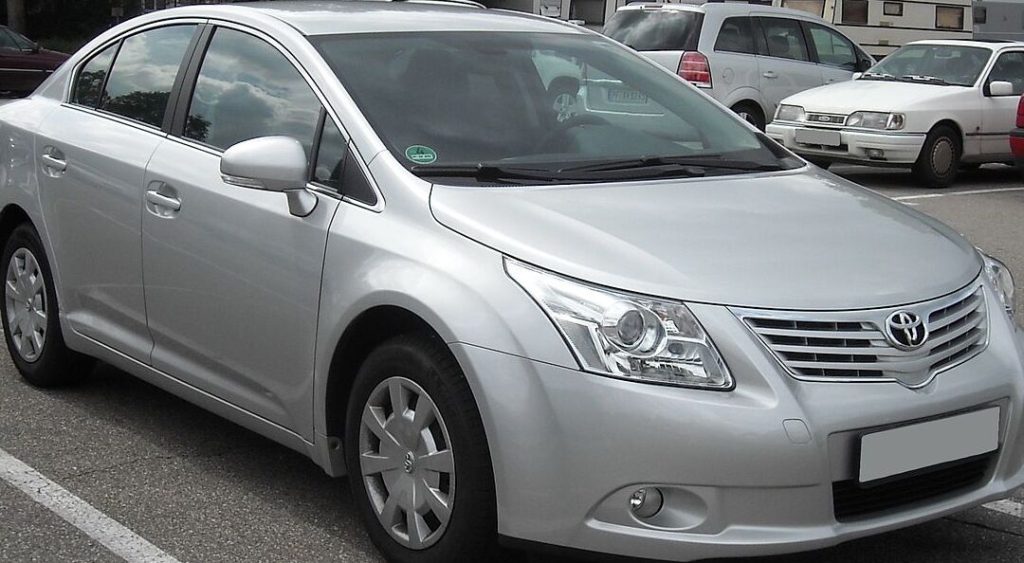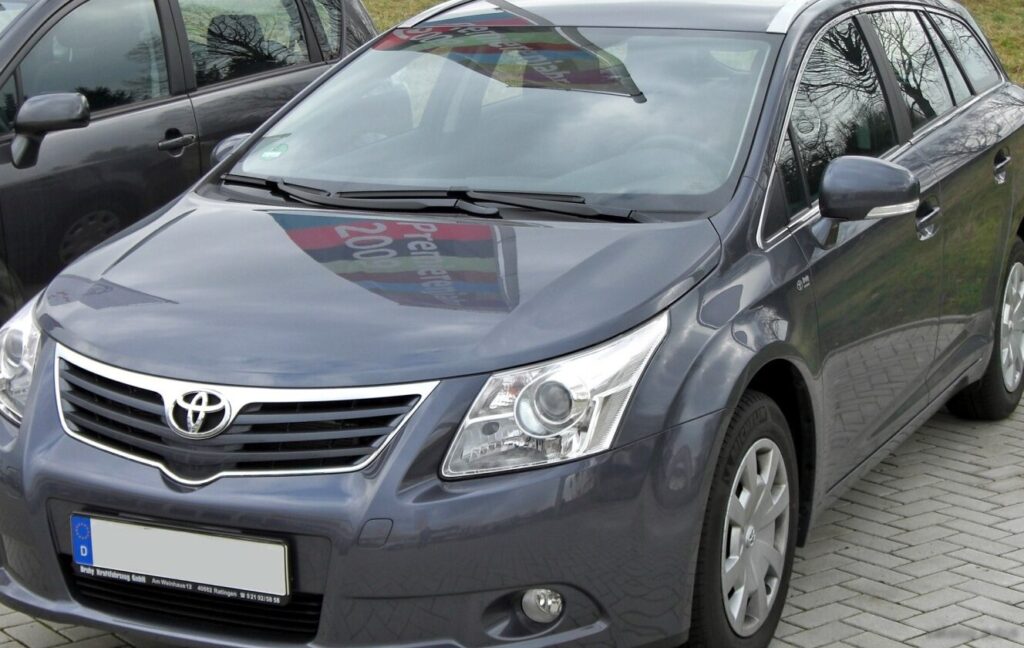
The Toyota Avensis III Wagon 2.0i (152 hp) Multidrive S, produced between 2009 and 2011, represents a significant iteration of Toyota’s mid-size family wagon. Positioned as a mid-range offering within the Avensis III generation (introduced in 2009 and based on the Toyota K platform), this variant aimed to balance fuel efficiency with respectable performance, appealing to buyers seeking a practical and comfortable vehicle for long journeys and family transport. The Avensis, in general, was primarily marketed in Europe as a competitor to vehicles like the Ford Mondeo, Vauxhall/Opel Vectra, and Peugeot 407, offering Toyota’s renowned reliability and build quality. This specific 2.0i Multidrive S trim occupied a space between the more economical 1.8-liter models and the higher-performance 2.4-liter variants.
Technical Specifications
| Brand | Toyota |
| Model | Avensis |
| Generation | Avensis III Wagon |
| Type (Engine) | 2.0i (152 Hp) Multidrive S |
| Start of production | 2009 |
| End of production | 2011 |
| Powertrain Architecture | Internal Combustion engine |
| Body type | Station wagon (estate) |
| Seats | 5 |
| Doors | 5 |
| Fuel consumption (urban) | 9.2 l/100 km (25.6 US mpg) |
| Fuel consumption (extra urban) | 5.7 l/100 km (41.3 US mpg) |
| Fuel consumption (combined) | 7 l/100 km (33.6 US mpg) |
| Fuel Type | Petrol (Gasoline) |
| Acceleration 0 – 100 km/h | 10.3 sec |
| Acceleration 0 – 62 mph | 10.3 sec |
| Acceleration 0 – 60 mph | 9.8 sec |
| Maximum speed | 200 km/h (124.27 mph) |
| Emission standard | Euro 5 |
| Weight-to-power ratio | 9.6 kg/Hp |
| Weight-to-torque ratio | 7.5 kg/Nm |
| Power | 152 Hp @ 6200 rpm |
| Torque | 196 Nm @ 4000 rpm (144.56 lb.-ft. @ 4000 rpm) |
| Engine layout | Front, Transverse |
| Engine Model/Code | 3ZR-FAE |
| Engine displacement | 1987 cm3 (121.25 cu. in.) |
| Number of cylinders | 4 |
| Engine configuration | Inline |
| Number of valves per cylinder | 4 |
| Fuel injection system | Multi-port manifold injection |
| Engine aspiration | Naturally aspirated engine |
| Engine oil capacity | 4.2 l (4.44 US qt | 3.7 UK qt) |
| Coolant capacity | 6.2 l (6.55 US qt | 5.46 UK qt) |
| Kerb Weight | 1465 kg (3229.77 lbs) |
| Max. weight | 2070 kg (4563.57 lbs) |
| Max load | 605 kg (1333.8 lbs) |
| Trunk (boot) space – minimum | 543 l (19.18 cu. ft) |
| Trunk (boot) space – maximum | 1609 l (56.82 cu. ft) |
| Fuel tank capacity | 60 l (15.85 US gal | 13.2 UK gal) |
| Length | 4765 mm (187.6 in) |
| Width | 1810 mm (71.26 in) |
| Height | 1480 mm (58.27 in) |
| Wheelbase | 2700 mm (106.3 in) |
| Front track | 1550 mm (61.02 in) |
| Rear track | 1540 mm (60.63 in) |
| Minimum turning circle | 10.8 m (35.43 ft) |
| Drivetrain Architecture | Front wheel drive |
| Front suspension | Independent type McPherson |
| Rear suspension | Double wishbone |
| Front brakes | Ventilated discs |
| Rear brakes | Disc |
| Tires size | 215/55R17 |
Powertrain & Engine Architecture
The heart of the Avensis III Wagon 2.0i Multidrive S is the 3ZR-FAE engine, a 1.987-liter (121.25 cubic inches) inline-four cylinder gasoline engine. This engine utilizes multi-port fuel injection and a dual overhead camshaft (DOHC) valvetrain with four valves per cylinder. The 3ZR-FAE is a naturally aspirated engine, meaning it doesn’t employ forced induction like a turbocharger or supercharger. It produces 152 horsepower at 6,200 rpm and 196 Nm (144.56 lb-ft) of torque at 4,000 rpm. The engine is known for its relatively smooth operation and decent responsiveness. Paired with this engine is Toyota’s Multidrive S transmission, a continuously variable transmission (CVT). Unlike traditional stepped automatic transmissions, a CVT provides a seamless and theoretically infinite number of gear ratios within its operating range, optimizing engine speed for efficiency or performance. The Multidrive S also features a simulated seven-speed sequential shift mode for drivers who prefer a more conventional driving experience.
Driving Characteristics
The 2.0i Multidrive S offers a comfortable and refined driving experience. The CVT, while efficient, doesn’t provide the immediate response of a traditional automatic or manual transmission. Acceleration from 0-60 mph takes approximately 9.8 seconds, and 0-100 km/h in 10.3 seconds, which is adequate for everyday driving but doesn’t offer particularly sporty performance. The CVT’s programming prioritizes fuel economy, resulting in a smooth but sometimes less engaging driving experience. Compared to the 1.8-liter Avensis Wagon, the 2.0i offers noticeably more power and torque, making it more capable when fully loaded or tackling inclines. However, it lacks the punch of the 2.4-liter variant. The CVT’s ability to keep the engine in its optimal power band helps to mitigate some of the performance deficit compared to a traditional automatic.
Equipment & Trim Levels
The 2.0i Multidrive S trim typically included a generous level of standard equipment. Features commonly found on this variant include air conditioning, power windows and mirrors, a CD/radio system with auxiliary input, alloy wheels, and ABS brakes. Higher trim levels offered options such as leather upholstery, a sunroof, navigation system, and parking sensors. Interior upholstery was generally cloth, with higher-spec models offering partial or full leather options. The dashboard layout was functional and ergonomically designed, prioritizing ease of use. Safety features were also a strong point, with multiple airbags and stability control systems included as standard.
Chassis & Braking
The Avensis III Wagon utilizes an independent McPherson strut suspension at the front and a double wishbone suspension at the rear, providing a comfortable ride and predictable handling. The front brakes are ventilated discs, while the rear brakes are solid discs. ABS (Anti-lock Braking System) is standard, enhancing braking performance and stability. The suspension tuning is geared towards comfort rather than outright sportiness, absorbing bumps and imperfections in the road surface effectively. Stabilizer bars are fitted to both the front and rear axles to reduce body roll during cornering.
Market Reception & Comparison
The Avensis III Wagon 2.0i Multidrive S was generally well-received by automotive critics. It was praised for its comfortable ride, spacious interior, and Toyota’s reputation for reliability. However, the CVT transmission was sometimes criticized for its lack of responsiveness and the engine’s performance was considered adequate but not exceptional. Compared to the 1.8-liter models, the 2.0i offered a noticeable improvement in performance, while maintaining good fuel economy (around 33.6 US mpg combined). The 2.4-liter variant provided more power but at the expense of fuel efficiency. The Avensis consistently scored well in reliability surveys, making it a popular choice for buyers prioritizing long-term ownership costs.
Legacy
The 3ZR-FAE engine and Multidrive S transmission combination proved to be relatively reliable in the Avensis III Wagon. While CVTs, in general, have sometimes been associated with higher maintenance costs, Toyota’s Multidrive S transmission has demonstrated good durability when properly maintained. Today, used Avensis III Wagon 2.0i models represent a good value proposition for buyers seeking a practical, comfortable, and reliable family wagon. Regular maintenance, including fluid changes for the CVT, is crucial to ensure long-term reliability. The Avensis, while not a particularly exciting vehicle, remains a solid and dependable choice in the used car market.