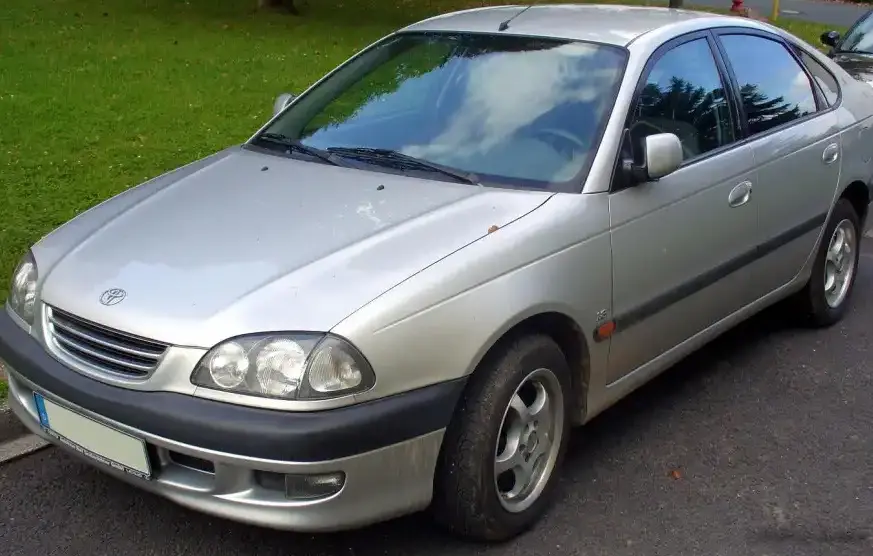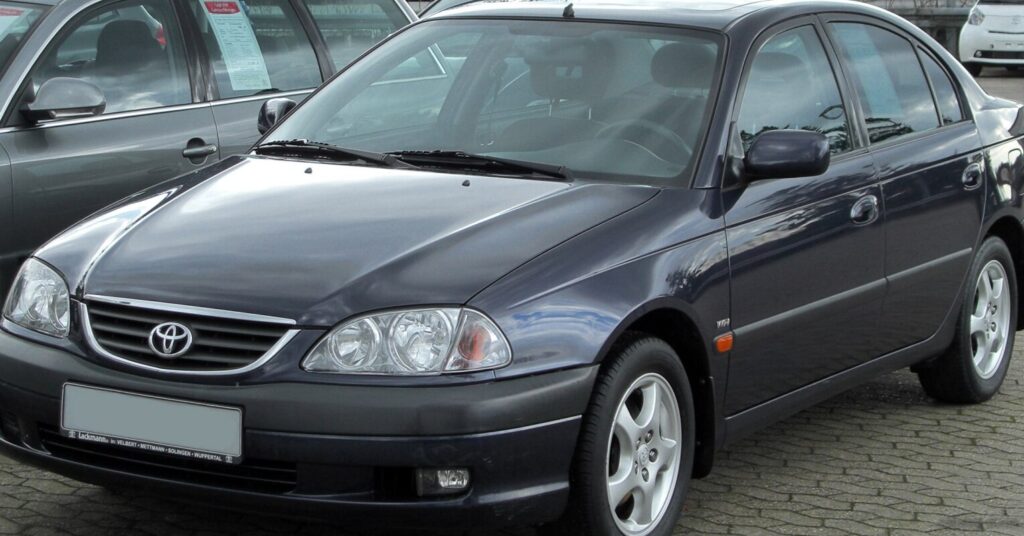
The Toyota Avensis (T22) 1.6, producing 110 horsepower, was a mainstay of the Avensis lineup from 1997 to 2003. Positioned as the entry-level engine option, it catered to buyers prioritizing fuel efficiency and affordability within the mid-size sedan segment. The T22 generation Avensis represented Toyota’s attempt to create a genuinely competitive European-focused family car, replacing the aging Camry and Corolla models in many markets. This variant, with its 1.6-liter engine and typically paired with a five-speed manual transmission (though a four-speed automatic was also available), played a significant role in establishing the Avensis as a practical and reliable choice for families and fleet buyers.
Technical Specifications
| Brand | Toyota |
| Model | Avensis |
| Generation | Avensis (T22) |
| Type (Engine) | 1.6 (110 Hp) |
| Start of production | 1997 |
| End of production | 2003 |
| Powertrain Architecture | Internal Combustion engine |
| Body type | Sedan |
| Seats | 5 |
| Doors | 4 |
| Fuel consumption (urban) | 10.8 l/100 km (21.8 US mpg) |
| Fuel consumption (extra urban) | 6.1 l/100 km (38.6 US mpg) |
| Fuel Type | Petrol (Gasoline) |
| Acceleration 0 – 100 km/h | 11 sec |
| Acceleration 0 – 62 mph | 11 sec |
| Acceleration 0 – 60 mph | 10.5 sec |
| Maximum speed | 195 km/h (121.17 mph) |
| Weight-to-power ratio | 11.3 kg/Hp |
| Weight-to-torque ratio | 8.6 kg/Nm |
| Power | 110 Hp @ 6000 rpm |
| Torque | 145 Nm @ 4800 rpm (106.95 lb.-ft. @ 4800 rpm) |
| Engine layout | Front, Transverse |
| Engine Model/Code | 3ZZ-FE |
| Engine displacement | 1587 cm3 (96.84 cu. in.) |
| Number of cylinders | 4 |
| Engine configuration | Inline |
| Cylinder Bore | 81 mm (3.19 in.) |
| Piston Stroke | 77 mm (3.03 in.) |
| Compression ratio | 9.5:1 |
| Number of valves per cylinder | 4 |
| Fuel injection system | Multi-port manifold injection |
| Engine aspiration | Naturally aspirated engine |
| Valvetrain | DOHC |
| Engine oil capacity | 3.7 l (3.91 US qt | 3.26 UK qt) |
| Coolant capacity | 7.4 l (7.82 US qt | 6.51 UK qt) |
| Kerb Weight | 1245 kg (2744.76 lbs.) |
| Max. weight | 1775 kg (3913.21 lbs.) |
| Max load | 530 kg (1168.45 lbs.) |
| Trunk (boot) space – minimum | 500 l (17.66 cu. ft.) |
| Fuel tank capacity | 60 l (15.85 US gal | 13.2 UK gal) |
| Length | 4490 mm (176.77 in.) |
| Width | 1710 mm (67.32 in.) |
| Height | 1425 mm (56.1 in.) |
| Wheelbase | 2630 mm (103.54 in.) |
| Front track | 1480 mm (58.27 in.) |
| Rear track | 1450 mm (57.09 in.) |
| Drivetrain Architecture | Front wheel drive |
| Number of gears | 5 |
| Gearbox type | Manual transmission |
| Front suspension | Spring Strut |
| Rear suspension | Coil spring |
| Front brakes | Ventilated discs |
| Rear brakes | Drum |
| Assisting systems | ABS (Anti-lock braking system) |
| Steering type | Steering rack and pinion |
| Power steering | Hydraulic Steering |
| Tires size | 185/65R14 |
Powertrain & Engine Architecture
The heart of the Avensis 1.6 was the 3ZZ-FE engine, a 1.6-liter (1587 cc) inline-four cylinder gasoline engine. This engine utilized a multi-port fuel injection system and a double overhead camshaft (DOHC) valvetrain, contributing to its relatively smooth operation and decent power output for its displacement. The 3ZZ-FE was known for its reliability, though it wasn’t a particularly groundbreaking engine in terms of technology. The four-speed automatic transmission, when equipped, was a conventional torque converter automatic, prioritizing smooth shifts over outright performance. The manual transmission, a five-speed unit, offered a more engaging driving experience and slightly improved fuel economy.
Driving Characteristics
The 1.6-liter engine, producing 110 horsepower, provided adequate, but not exhilarating, performance. Acceleration from 0-60 mph took around 10.5 to 11 seconds, making it suitable for everyday commuting and highway cruising. The automatic transmission, while smooth, could feel somewhat sluggish, particularly when attempting to overtake. The manual transmission offered a more responsive feel, allowing drivers to better utilize the engine’s available power. Gear ratios were tuned for fuel efficiency rather than sporty acceleration. Compared to the higher-output 2.0-liter variants, the 1.6 felt noticeably less powerful, especially when fully loaded with passengers and luggage.
Equipment & Trim Levels
The 1.6-liter Avensis typically came with a fairly basic level of equipment, reflecting its position as the entry-level model. Standard features generally included power steering, central locking, electric front windows, and an AM/FM radio. Air conditioning was often an optional extra. Interior upholstery was typically cloth, and the dashboard featured a functional, if somewhat plain, design. Higher trim levels added features like alloy wheels, upgraded audio systems, and climate control. The focus was on providing a comfortable and practical interior rather than luxury.
Chassis & Braking
The Avensis T22 featured a conventional front-wheel-drive chassis with a MacPherson strut front suspension and a coil spring rear suspension. The braking system consisted of ventilated discs on the front wheels and drum brakes on the rear. ABS (Anti-lock Braking System) was standard equipment, enhancing safety. The suspension was tuned for comfort, providing a relatively smooth ride, although it wasn’t particularly sporty. Stabilizer bars were fitted to reduce body roll, but the overall handling was geared towards everyday usability rather than dynamic performance.
Market Reception & Comparison
The Avensis 1.6 was generally well-received by critics as a sensible and reliable family car. It offered good value for money, particularly compared to some of its more expensive rivals. However, the 1.6-liter engine was often criticized for being underpowered, especially when compared to the 2.0-liter variants. Fuel economy was a strong point, making it an attractive option for drivers covering long distances. In terms of reliability, the 3ZZ-FE engine proved to be durable, although regular maintenance was essential. Compared to the 1.8L and 2.0L models, the 1.6 offered a lower purchase price but sacrificed performance.
Legacy
The Toyota Avensis (T22) 1.6 remains a relatively common sight on used car markets today. The 3ZZ-FE engine is known for its longevity, and many examples have covered high mileages with minimal issues, provided they have been properly maintained. While not a particularly exciting car to drive, the Avensis 1.6 offers a dependable and affordable option for those seeking a practical family sedan. Its reputation for reliability has ensured its continued popularity among budget-conscious buyers. Parts availability is generally good, making it relatively easy and inexpensive to keep these vehicles on the road.