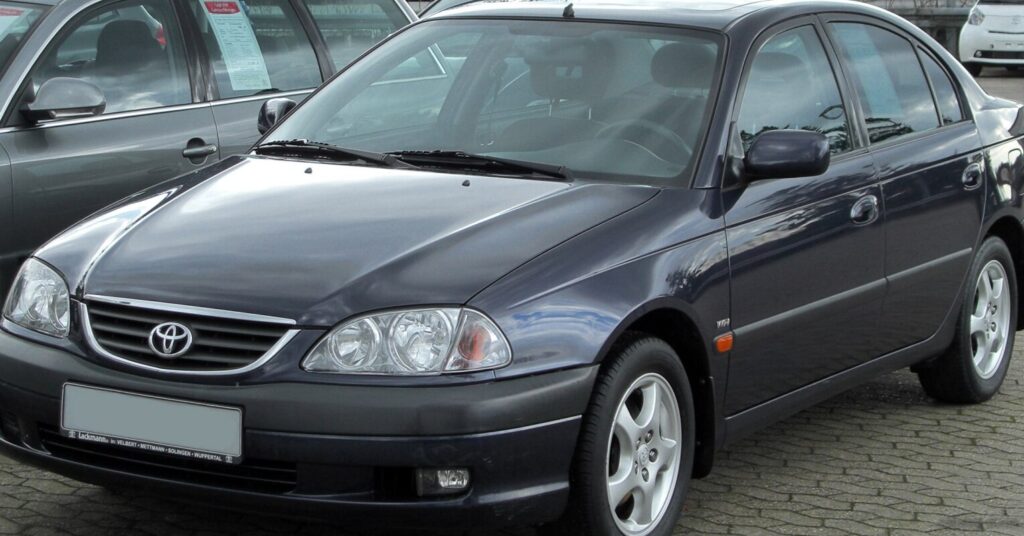
The Toyota Avensis (T22) 2.0 TD, producing 90 horsepower, was a significant offering in Toyota’s European lineup from 1997 to 2003. Positioned as an entry-level diesel variant within the second-generation Avensis range (designated T22), it aimed to provide fuel efficiency and practicality for family transportation. This model played a crucial role in establishing the Avensis as a credible competitor to established European and Japanese rivals in the mid-size segment, particularly in markets where diesel engines were favored. The T22 Avensis was built to replace the first-generation model (T20) and represented a substantial step forward in terms of refinement, space, and overall build quality.
Technical Specifications
| Brand | Toyota |
| Model | Avensis |
| Generation | Avensis (T22) |
| Type (Engine) | 2.0 TD (90 Hp) |
| Start of production | 1997 |
| End of production | 2003 |
| Powertrain Architecture | Internal Combustion engine |
| Body type | Sedan |
| Seats | 5 |
| Doors | 4 |
| Fuel consumption (urban) | 8.5 l/100 km (27.7 US mpg) |
| Fuel consumption (extra urban) | 5.4 l/100 km (43.6 US mpg) |
| Fuel Type | Diesel |
| Acceleration 0 – 100 km/h | 12 sec |
| Acceleration 0 – 62 mph | 12 sec |
| Acceleration 0 – 60 mph | 11.4 sec |
| Maximum speed | 180 km/h (111.85 mph) |
| Weight-to-power ratio | 15.1 kg/Hp |
| Weight-to-torque ratio | 6.7 kg/Nm |
| Power | 90 Hp @ 4000 rpm |
| Power per litre | 45.6 Hp/l |
| Torque | 203 Nm @ 2200 rpm (149.73 lb.-ft. @ 2200 rpm) |
| Engine layout | Front, Transverse |
| Engine Model/Code | 2C-TE |
| Engine displacement | 1975 cm3 (120.52 cu. in.) |
| Number of cylinders | 4 |
| Engine configuration | Inline |
| Cylinder Bore | 86 mm (3.39 in.) |
| Piston Stroke | 85 mm (3.35 in.) |
| Compression ratio | 23:1 |
| Number of valves per cylinder | 2 |
| Fuel injection system | Diesel Commonrail |
| Engine aspiration | Turbocharger |
| Valvetrain | OHC |
| Engine oil capacity | 5.1 l (5.39 US qt | 4.49 UK qt) |
| Coolant | 6.9 l (7.29 US qt | 6.07 UK qt) |
| Kerb Weight | 1360 kg (2998.29 lbs.) |
| Max. weight | 1830 kg (4034.46 lbs.) |
| Max load | 470 kg (1036.17 lbs.) |
| Trunk (boot) space – minimum | 500 l (17.66 cu. ft.) |
| Fuel tank capacity | 60 l (15.85 US gal | 13.2 UK gal) |
| Length | 4490 mm (176.77 in.) |
| Width | 1710 mm (67.32 in.) |
| Height | 1425 mm (56.1 in.) |
| Wheelbase | 2630 mm (103.54 in.) |
| Front track | 1480 mm (58.27 in.) |
| Rear (Back) track | 1450 mm (57.09 in.) |
| Drivetrain Architecture | The Internal combustion engine (ICE) drives the front wheels of the vehicle. |
| Drive wheel | Front wheel drive |
| Number of gears and type of gearbox | 5 gears, manual transmission |
| Front suspension | Spring Strut |
| Rear suspension | Coil spring |
| Front brakes | Ventilated discs |
| Rear brakes | Drum |
| Assisting systems | ABS (Anti-lock braking system) |
| Steering type | Steering rack and pinion |
| Power steering | Hydraulic Steering |
| Tires size | 185/65R14 |
Powertrain & Engine Architecture
The heart of the Avensis 2.0 TD (90 Hp) was the 2C-TE engine, a 1.975-liter inline-four cylinder diesel. This engine was a mainstay in Toyota’s diesel offerings during the late 1990s and early 2000s. The ‘2C’ designation indicated its displacement class, while the ‘TE’ suffix denoted a turbocharged and intercooled version. The 2C-TE utilized a single overhead camshaft (OHC) valvetrain with two valves per cylinder. Crucially, this version employed a diesel common rail fuel injection system, a relatively advanced technology for its time, which improved fuel atomization and combustion efficiency. The turbocharger, a Garrett unit in many cases, provided a boost in power and torque compared to naturally aspirated diesel engines. The five-speed manual transmission was the standard offering, designed to efficiently deliver the engine’s power to the front wheels. The engine’s robust construction and relatively simple design contributed to its reputation for reliability.
Driving Characteristics
The 90 horsepower output of the 2.0 TD, coupled with 203 Nm (149.73 lb-ft) of torque, resulted in a driving experience focused on fuel economy and practicality rather than outright performance. Acceleration from 0-60 mph took around 11.4 seconds, and top speed was limited to 111.85 mph. The engine’s torque peak at 2200 rpm provided adequate pulling power for everyday driving and overtaking maneuvers, but it wasn’t particularly responsive at higher engine speeds. The five-speed manual transmission was well-matched to the engine’s characteristics, offering a reasonable spread of gears. Compared to the higher-output 2.0 D-4D variants introduced later, the 2.0 TD felt noticeably less powerful, but it offered a smoother, more linear power delivery. The manual transmission also provided a more engaging driving experience than the optional four-speed automatic transmission, which further reduced performance.
Equipment & Trim Levels
The 2.0 TD variant of the Avensis T22 typically occupied a mid-range position in the lineup. Standard equipment generally included power steering, central locking, electric front windows, and an adjustable steering column. Air conditioning was often an optional extra. Interior upholstery was typically cloth, with a relatively simple dashboard layout. Higher trim levels, such as the ‘CD’ or ‘GL’ models, added features like alloy wheels, a CD player, and upgraded interior trim. Safety features included ABS brakes and driver and passenger airbags. The overall interior ambiance was functional and durable, prioritizing practicality over luxury.
Chassis & Braking
The Avensis T22 featured a MacPherson strut front suspension and a coil spring rear suspension. This setup provided a comfortable ride quality, although it wasn’t particularly sporty. The front brakes were ventilated discs, providing adequate stopping power, while the rear brakes were drums, a cost-saving measure common in this class of vehicle. The steering was a rack and pinion system with hydraulic power assistance, offering a reasonable level of feel and precision. Stabilizer bars were fitted to both the front and rear axles to reduce body roll during cornering. The chassis was designed to provide a balance between comfort, handling, and structural rigidity.
Market Reception & Comparison
The Avensis 2.0 TD (90 Hp) was generally well-received by automotive critics as a practical and reliable family car. Its fuel efficiency was a major selling point, particularly in Europe where diesel fuel was often cheaper than gasoline. However, some reviewers criticized its lack of outright performance compared to some of its rivals. Compared to the petrol-powered Avensis variants, the 2.0 TD offered significantly better fuel economy but less refinement. Against competitors like the Ford Mondeo, Vauxhall/Opel Vectra, and Volkswagen Passat, the Avensis offered a compelling combination of reliability, practicality, and value for money. The 2.0 TD was often seen as a sensible choice for drivers who prioritized fuel economy and low running costs over sporty driving dynamics.
Legacy
The 2C-TE engine, found in the Avensis 2.0 TD, gained a reputation for exceptional durability and longevity. Many examples remain on the road today, testament to its robust construction. While not known for being particularly high-tech, the engine’s simplicity contributed to its reliability. Common issues are typically related to age and mileage, such as turbocharger wear and fuel injector problems. In the used car market, the Avensis 2.0 TD (90 Hp) represents a relatively affordable and dependable option for those seeking a practical and fuel-efficient family car. Its enduring reputation for reliability continues to make it a popular choice among budget-conscious buyers.