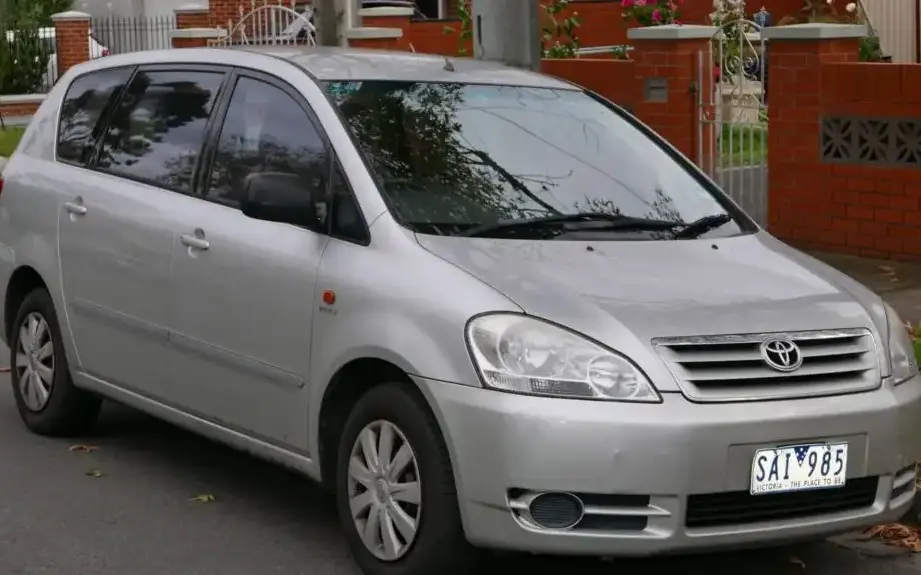
The Toyota Avensis Verso 2.0, producing 150 horsepower, was a key variant within the first generation (ACM20/CLM20) of Toyota’s mid-size MPV, sold from August 2001 to October 2003. Designed primarily for the European market, the Avensis Verso aimed to provide a practical and spacious family vehicle with a focus on versatility. This 2.0-liter engine option occupied a middle ground in the Verso lineup, offering a balance between performance and fuel economy, positioned above the lower-displacement engines and below the more powerful, though less common, variants. The Verso, meaning “flexible” in Italian, distinguished itself from the standard Avensis sedan and wagon with its seven-seat configuration and more upright styling.
Technical Specifications
| Brand | Toyota |
| Model | Avensis Verso |
| Generation | Avensis Verso (ACM20/CLM20) |
| Type (Engine) | 2.0 (150 Hp) |
| Start of production | August, 2001 |
| End of production | October, 2003 |
| Powertrain Architecture | Internal Combustion engine |
| Body type | MPV |
| Seats | 7 |
| Doors | 4 |
| Fuel consumption (urban) | 11.6 l/100 km (20.3 US mpg) |
| Fuel consumption (extra urban) | 7 l/100 km (33.6 US mpg) |
| Fuel consumption (combined) | 8.5 l/100 km (27.7 US mpg) |
| Fuel Type | Petrol (Gasoline) |
| Acceleration 0 – 100 km/h | 11.4 sec |
| Acceleration 0 – 62 mph | 11.4 sec |
| Acceleration 0 – 60 mph | 10.8 sec |
| Maximum speed | 192 km/h (119.3 mph) |
| Weight-to-power ratio | 10 kg/Hp |
| Weight-to-torque ratio | 7.8 kg/Nm |
| Power | 150 Hp @ 6000 rpm |
| Torque | 192 Nm @ 4000 rpm (141.61 lb.-ft. @ 4000 rpm) |
| Engine layout | Front, Transverse |
| Engine Model/Code | 1AZ-FE |
| Engine displacement | 1998 cm3 (121.93 cu. in.) |
| Number of cylinders | 4 |
| Engine configuration | Inline |
| Cylinder Bore | 86 mm (3.39 in.) |
| Piston Stroke | 86 mm (3.39 in.) |
| Compression ratio | 9.8:1 |
| Number of valves per cylinder | 4 |
| Fuel injection system | Multi-port manifold injection |
| Engine aspiration | Naturally aspirated engine |
| Valvetrain | DOHC |
| Engine oil capacity | 4.2 l (4.44 US qt | 3.7 UK qt) |
| Coolant capacity | 5.9 l (6.23 US qt | 5.19 UK qt) |
| Kerb Weight | 1495 kg (3295.91 lbs.) |
| Max. weight | 2140 kg (4717.89 lbs.) |
| Max load | 645 kg (1421.98 lbs.) |
| Trunk (boot) space – minimum | 282 l (9.96 cu. ft.) |
| Trunk (boot) space – maximum | 2422 l (85.53 cu. ft.) |
| Fuel tank capacity | 60 l (15.85 US gal | 13.2 UK gal) |
| Length | 4650 mm (183.07 in.) |
| Width | 1760 mm (69.29 in.) |
| Height | 1675 mm (65.94 in.) |
| Wheelbase | 2825 mm (111.22 in.) |
| Front track | 1505 mm (59.25 in.) |
| Rear (Back) track | 1500 mm (59.06 in.) |
| Drivetrain Architecture | Front wheel drive |
| Number of gears | 5 gears, manual transmission |
| Front suspension | Wishbone |
| Rear suspension | Coil spring |
| Front brakes | Ventilated discs |
| Rear brakes | Disc |
| Assisting systems | ABS (Anti-lock braking system) |
| Steering type | Steering rack and pinion |
| Power steering | Hydraulic Steering |
| Tires size | 205/65 R15 |
| Wheel rims size | 15 |
INTRODUCTION
The Toyota Avensis Verso 2.0 (150 Hp) was introduced as part of the ACM20/CLM20 series, representing Toyota’s entry into the increasingly popular compact MPV segment. Production ran from 2001 to 2003, and it was specifically tailored to meet the demands of European families seeking a versatile and reliable vehicle. The Verso differentiated itself from the standard Avensis range by offering a seven-seat layout, achieved through a longer wheelbase and a more upright roofline. This 2.0-liter engine variant was positioned as a mainstream offering, balancing performance with affordability and fuel efficiency, making it a popular choice within the Verso lineup.
Powertrain & Engine Architecture
At the heart of the Avensis Verso 2.0 lay the 1AZ-FE engine, a 1.998-liter (121.93 cubic inches) inline-four cylinder gasoline engine. This engine utilized a naturally aspirated configuration and featured a double overhead camshaft (DOHC) valvetrain with four valves per cylinder. The 1AZ-FE employed multi-port fuel injection, delivering fuel directly into the intake ports for optimized combustion. The engine produced a peak power output of 150 horsepower at 6000 rpm and 192 Nm (141.61 lb-ft) of torque at 4000 rpm. The engine’s 9.8:1 compression ratio was a compromise between performance and the ability to run on readily available fuel grades. The 5-speed manual transmission was the standard pairing for this engine, offering a relatively direct driving experience. The transmission was chosen for its durability and cost-effectiveness, typical of Toyota’s engineering philosophy.
Driving Characteristics
The Avensis Verso 2.0 with a manual transmission provided adequate, though not exhilarating, performance. Acceleration from 0 to 60 mph took approximately 10.8 seconds, and the top speed was around 119.3 mph. The engine’s torque curve was relatively flat, providing usable power across a broad range of engine speeds. However, it did require the driver to work the engine somewhat to achieve brisk acceleration, particularly when fully loaded with passengers and luggage. Compared to the lower-displacement 1.8-liter versions, the 2.0-liter engine offered noticeably more power and responsiveness. It also felt less strained during highway cruising and uphill climbs. The 5-speed manual transmission offered precise shifts, but the gear ratios were geared more towards fuel efficiency than outright performance. The Verso’s weight, approximately 1495 kg (3295.91 lbs), did impact its overall agility, making it feel less nimble than smaller hatchbacks.
Equipment & Trim Levels
The Avensis Verso 2.0 typically came equipped with a reasonable level of standard features. These included power windows, central locking, air conditioning, and an audio system. Interior upholstery was typically cloth, with a focus on durability and practicality. Higher trim levels offered options such as alloy wheels, upgraded audio systems, and climate control. The Verso’s interior was designed with family use in mind, featuring numerous storage compartments and cupholders. The seven-seat configuration offered flexibility, with the third-row seats folding flat into the floor when not in use. Safety features included ABS brakes and driver and passenger airbags.
Chassis & Braking
The Avensis Verso 2.0 utilized a front-wheel-drive layout with a wishbone front suspension and a coil spring rear suspension. This suspension setup prioritized ride comfort and stability over sporty handling. The front brakes were ventilated discs, providing good stopping power, while the rear brakes were solid discs. The steering was a rack-and-pinion system with hydraulic power assistance, offering a reasonably light and precise feel. The Verso rode on 205/65 R15 tires, which provided a good balance between comfort and grip. The chassis was designed to accommodate the Verso’s increased weight and length compared to the standard Avensis models.
Market Reception & Comparison
The Toyota Avensis Verso 2.0 was generally well-received by automotive critics. It was praised for its spacious interior, versatility, and Toyota’s reputation for reliability. However, some critics noted that the engine lacked outright power and that the handling was not particularly engaging. Compared to other MPVs in its class, such as the Renault Scenic and Citroën Xsara Picasso, the Verso offered a more conservative and understated design. Fuel economy was competitive, averaging around 27.7 US mpg in combined driving. The Verso’s reliability proved to be a strong selling point, with owners reporting few major mechanical issues.
Legacy
The 1AZ-FE engine, found in the Avensis Verso 2.0, is known for its durability and relatively low maintenance costs. While not a high-performance engine, it has proven to be a reliable workhorse over the long term. Today, used examples of the Avensis Verso 2.0 are still relatively common, and well-maintained vehicles can offer a practical and affordable family transportation solution. The Verso’s seven-seat configuration and spacious interior continue to appeal to families, and its Toyota badge provides a degree of confidence in its reliability. However, potential buyers should be aware of the vehicle’s age and potential for wear and tear on components such as the suspension and brakes.