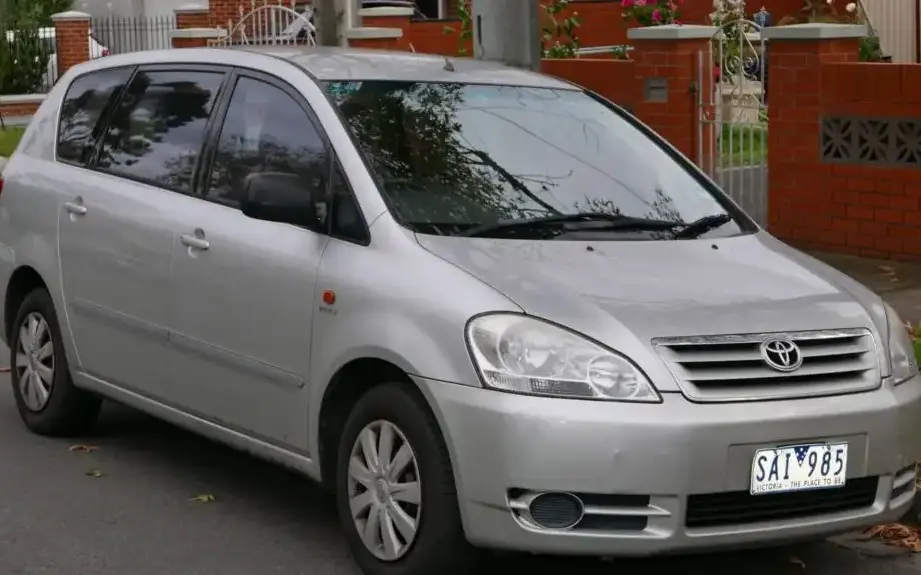
The Toyota Avensis Verso 2.0 D-4D (116 hp) was a diesel-powered multi-purpose vehicle (MPV) produced by Toyota between August 2001 and October 2003. Part of the first generation Avensis Verso (ACM20/CLM20 series), this variant occupied a mid-range position within the lineup, offering a balance between fuel efficiency, practicality, and affordability. It was primarily marketed in Europe as a competitor to vehicles like the Renault Espace and Citroën Evasion, catering to families needing seven-passenger capacity and versatile cargo space. The Avensis Verso represented Toyota’s entry into the increasingly popular compact MPV segment, emphasizing reliability and a comfortable driving experience.
Technical Specifications
| Brand | Toyota |
| Model | Avensis Verso |
| Generation | Avensis Verso |
| Type (Engine) | 2.0 D-4D (116 Hp) |
| Start of production | August, 2001 |
| End of production | October, 2003 |
| Powertrain Architecture | Internal Combustion engine |
| Body type | MPV |
| Seats | 7 |
| Doors | 4 |
| Fuel consumption (urban) | 8.1 l/100 km (29 US mpg, 34.9 UK mpg, 12.3 km/l) |
| Fuel consumption (extra urban) | 5.6 l/100 km (42 US mpg, 50.4 UK mpg, 17.9 km/l) |
| Fuel consumption (combined) | 6.5 l/100 km (36.2 US mpg, 43.5 UK mpg, 15.4 km/l) |
| Fuel Type | Diesel |
| Acceleration 0 – 100 km/h | 12.5 sec |
| Acceleration 0 – 62 mph | 12.5 sec |
| Acceleration 0 – 60 mph | 11.9 sec |
| Maximum speed | 180 km/h (111.85 mph) |
| Weight-to-power ratio | 13.8 kg/Hp, 72.5 Hp/tonne |
| Weight-to-torque ratio | 5.7 kg/Nm, 175 Nm/tonne |
| Power | 116 Hp @ 3600 rpm |
| Power per litre | 58.1 Hp/l |
| Torque | 280 Nm @ 2000 rpm (206.52 lb.-ft. @ 2000 rpm) |
| Engine layout | Front, Transverse |
| Engine Model/Code | 1CD-FTV |
| Engine displacement | 1995 cm3 (121.74 cu. in.) |
| Number of cylinders | 4 |
| Engine configuration | Inline |
| Cylinder Bore | 82.2 mm (3.24 in.) |
| Piston Stroke | 94 mm (3.7 in.) |
| Compression ratio | 18.6:1 |
| Number of valves per cylinder | 4 |
| Fuel injection system | Diesel Commonrail |
| Engine aspiration | Turbocharger, Intercooler |
| Valvetrain | DOHC |
| Engine oil capacity | 5.9 l (6.23 US qt | 5.19 UK qt) |
| Coolant | 8.8 l (9.3 US qt | 7.74 UK qt) |
| Kerb Weight | 1600 kg (3527.4 lbs.) |
| Max. weight | 2250 kg (4960.4 lbs.) |
| Max load | 650 kg (1433 lbs.) |
| Trunk (boot) space – minimum | 282 l (9.96 cu. ft.) |
| Trunk (boot) space – maximum | 2422 l (85.53 cu. ft.) |
| Fuel tank capacity | 60 l (15.85 US gal | 13.2 UK gal) |
| Length | 4650 mm (183.07 in.) |
| Width | 1760 mm (69.29 in.) |
| Height | 1675 mm (65.94 in.) |
| Wheelbase | 2825 mm (111.22 in.) |
| Front track | 1505 mm (59.25 in.) |
| Rear (Back) track | 1500 mm (59.06 in.) |
| Drivetrain Architecture | The Internal combustion engine (ICE) drives the front wheels of the vehicle. |
| Drive wheel | Front wheel drive |
| Number of gears and type of gearbox | 5 gears, manual transmission |
| Front suspension | Wishbone |
| Rear suspension | Coil spring |
| Front brakes | Ventilated discs |
| Rear brakes | Disc |
| Assisting systems | ABS (Anti-lock braking system) |
| Steering type | Steering rack and pinion |
| Power steering | Hydraulic Steering |
| Tires size | 205/65 R15 |
Powertrain & Engine Architecture
The heart of the Avensis Verso 2.0 D-4D was the 1CD-FTV engine, a 1.995-liter inline-four cylinder diesel. This engine was a key component of Toyota’s D-4D (Direct-injection 4-cylinder Diesel) series, known for its focus on efficiency and reduced emissions. The 1CD-FTV utilized a common rail direct injection system, delivering fuel at extremely high pressure for improved combustion and reduced noise. It featured a single overhead camshaft (SOHC) design operating four valves per cylinder (DOHC). A turbocharger with an intercooler was employed to boost power output, resulting in 116 horsepower at 3600 rpm and 280 Nm (206 lb-ft) of torque at 2000 rpm. The engine’s relatively low compression ratio of 18.6:1 contributed to its smooth operation and reduced engine knock. The engine was transversely mounted in the front of the vehicle. The 5-speed manual transmission was the standard offering for this variant, providing a balance between fuel economy and drivability.
Driving Characteristics
The 2.0 D-4D engine in the Avensis Verso, paired with the 5-speed manual transmission, offered adequate performance for everyday driving. Acceleration from 0 to 60 mph took around 11.9 seconds, and top speed was limited to 111.85 mph. While not particularly sporty, the engine provided sufficient torque for comfortable cruising and overtaking maneuvers. The gear ratios were tuned for fuel efficiency, meaning the engine needed to be revved somewhat to achieve brisk acceleration. Compared to higher-output versions of the Avensis Verso, such as those with gasoline engines, the 2.0 D-4D prioritized fuel economy over outright performance. The manual transmission allowed for greater driver control, but the shift quality was generally considered average. The relatively long gearing contributed to a relaxed driving experience on the highway.
Equipment & Trim Levels
The 2.0 D-4D Avensis Verso typically came with a reasonable level of standard equipment. This included power steering, central locking, electric front windows, and an anti-lock braking system (ABS). Interior upholstery was typically cloth, with a functional and durable design. Optional extras included air conditioning, alloy wheels, a CD player, and rear parking sensors. Trim levels varied slightly depending on the market, but generally, the 2.0 D-4D sat in the middle of the range, offering a good balance of features and price. The seven-seat configuration was standard, with the rear seats folding flat to maximize cargo space.
Chassis & Braking
The Avensis Verso featured a front-wheel-drive layout with independent wishbone suspension at the front and a coil spring setup at the rear. This suspension configuration provided a comfortable ride, although it wasn’t particularly sporty. The front brakes were ventilated discs, while the rear brakes were solid discs. ABS was standard, enhancing braking performance and stability. The steering was a hydraulic rack and pinion system, offering reasonable precision and feedback. The tires were typically 205/65 R15 size, providing a good compromise between grip and ride comfort.
Market Reception & Comparison
The Toyota Avensis Verso 2.0 D-4D was generally well-received by automotive critics. It was praised for its fuel efficiency, spacious interior, and reliability. However, some reviewers noted that the engine was somewhat noisy and lacked the refinement of some competitors. Compared to the gasoline-powered versions of the Avensis Verso, the 2.0 D-4D offered significantly better fuel economy, making it a popular choice for drivers covering long distances. Its fuel consumption of around 36.2 US mpg combined was a key selling point. In terms of reliability, the Avensis Verso generally proved to be a durable vehicle, with few major issues reported.
Legacy
The 1CD-FTV engine, found in the Avensis Verso 2.0 D-4D, has proven to be a relatively reliable powertrain. While early common rail diesel engines were sometimes prone to injector issues, the 1CD-FTV generally held up well with proper maintenance. Today, used examples of the Avensis Verso 2.0 D-4D are still relatively common, and they represent a good value for money for buyers seeking a practical and economical MPV. However, potential buyers should be aware of the age-related wear and tear that is typical of older vehicles, and a thorough inspection is recommended before purchase. The Avensis Verso helped establish Toyota as a major player in the European MPV market, and its reputation for reliability continues to attract buyers today.