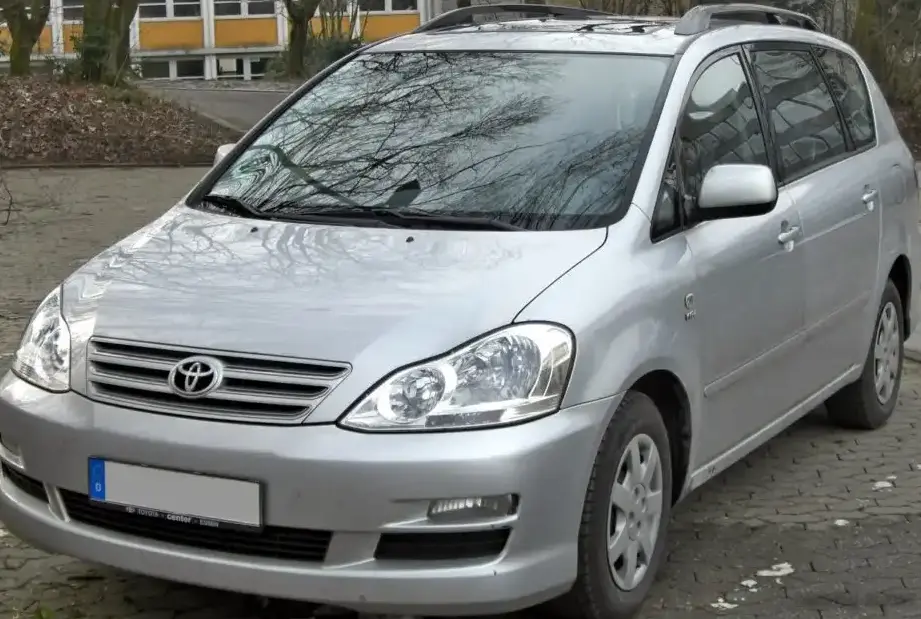
The Toyota Avensis Verso (facelift, introduced in November 2003 and produced through February 2009) 2.0i variant, equipped with a 150 horsepower engine and automatic transmission, represented a mid-range offering within the second-generation Avensis Verso lineup. Positioned as a practical and family-oriented MPV (Multi-Purpose Vehicle), the facelift brought styling updates and minor mechanical refinements to the original model, which was based on the Toyota’s ‘MC’ platform – also known as the 1HX0/A3 platform. This generation of Avensis Verso aimed to provide a spacious and versatile alternative to traditional station wagons and smaller MPVs, particularly in the European market where it found its largest customer base.
Technical Specifications
| Brand | Toyota |
| Model | Avensis Verso |
| Generation | Avensis Verso (facelift 2003) |
| Type (Engine) | 2.0i (150 Hp) Automatic |
| Start of production | November, 2003 |
| End of production | February, 2009 |
| Powertrain Architecture | Internal Combustion engine |
| Body type | MPV |
| Seats | 7 |
| Doors | 5 |
| Fuel consumption (urban) | 12 l/100 km (19.6 US mpg, 23.5 UK mpg, 8.3 km/l) |
| Fuel consumption (extra urban) | 7.3 l/100 km (32.2 US mpg, 38.7 UK mpg, 13.7 km/l) |
| Fuel consumption (combined) | 8.9 l/100 km (26.4 US mpg, 31.7 UK mpg, 11.2 km/l) |
| CO2 emissions | 213 g/km |
| Fuel Type | Petrol (Gasoline) |
| Acceleration 0 – 100 km/h | 12.1 sec |
| Acceleration 0 – 62 mph | 12.1 sec |
| Acceleration 0 – 60 mph | 11.5 sec |
| Maximum speed | 180 km/h (111.85 mph) |
| Weight-to-power ratio | 9.6 kg/Hp, 104.5 Hp/tonne |
| Weight-to-torque ratio | 7.5 kg/Nm, 133.8 Nm/tonne |
| Power | 150 Hp @ 6000 rpm |
| Power per litre | 75.1 Hp/l |
| Torque | 192 Nm @ 4000 rpm (141.61 lb.-ft. @ 4000 rpm) |
| Engine layout | Front, Transverse |
| Engine Model/Code | 1AZ-FE |
| Engine displacement | 1998 cm3 (121.93 cu. in.) |
| Number of cylinders | 4 |
| Engine configuration | Inline |
| Cylinder Bore | 86 mm (3.39 in.) |
| Piston Stroke | 86 mm (3.39 in.) |
| Compression ratio | 9.8:1 |
| Number of valves per cylinder | 4 |
| Fuel injection system | Multi-port manifold injection |
| Engine aspiration | Naturally aspirated engine |
| Valvetrain | DOHC |
| Engine oil capacity | 4.2 l (4.44 US qt | 3.7 UK qt) |
| Coolant | 5.9 l (6.23 US qt | 5.19 UK qt) |
| Kerb Weight | 1435 kg (3163.63 lbs.) |
| Trunk (boot) space – minimum | 282 l (9.96 cu. ft.) |
| Trunk (boot) space – maximum | 2422 l (85.53 cu. ft.) |
| Fuel tank capacity | 60 l (15.85 US gal | 13.2 UK gal) |
| Length | 4690 mm (184.65 in.) |
| Width | 1760 mm (69.29 in.) |
| Height | 1680 mm (66.14 in.) |
| Wheelbase | 2820 mm (111.02 in.) |
| Front track | 1506 mm (59.29 in.) |
| Rear (Back) track | 1500 mm (59.06 in.) |
| Ride height (ground clearance) | 150 mm (5.91 in.) |
| Minimum turning circle | 11 m (36.09 ft.) |
| Drivetrain Architecture | Front wheel drive |
| Number of gears | 4 |
| Gearbox type | automatic transmission |
| Front suspension | Independent type McPherson |
| Rear suspension | Torsion |
| Front brakes | Disc |
| Rear brakes | Disc |
| Assisting systems | ABS (Anti-lock braking system) |
| Steering type | Steering rack and pinion |
| Tires size | 205/60 R16 |
| Wheel rims size | 16 |
Powertrain & Engine Architecture
The heart of the Avensis Verso 2.0i Automatic is the 1AZ-FE engine, a 1.998-liter (2.0-liter) inline-four cylinder gasoline engine. This engine is a naturally aspirated design, meaning it doesn’t utilize a turbocharger or supercharger. It features a double overhead camshaft (DOHC) valvetrain with four valves per cylinder, contributing to its relatively efficient breathing. Fuel delivery is managed by a multi-port fuel injection system. The 1AZ-FE is known for its generally robust nature and relatively simple construction, making it easier to maintain compared to more complex engine designs. The engine produces 150 horsepower at 6000 rpm and 192 Nm (141.61 lb-ft) of torque at 4000 rpm. Paired with this engine is a four-speed automatic transmission. While not the most modern transmission by today’s standards, it was a common choice for providing comfortable and convenient driving in the early 2000s. The transmission’s gear ratios were tuned for a balance between fuel economy and acceptable acceleration.
Driving Characteristics
The 2.0i Automatic Avensis Verso offered a comfortable, if not particularly sporty, driving experience. The four-speed automatic transmission, while smooth, lacked the responsiveness of a manual gearbox or a more modern automatic with a greater number of gears. Acceleration from 0-60 mph took around 11.5 to 12.1 seconds, making it adequate for everyday driving but not particularly quick. The engine’s torque delivery was fairly linear, providing usable power throughout the rev range, but it didn’t offer the strong low-end grunt of a turbocharged engine or a larger displacement naturally aspirated engine. Compared to the manual transmission version of the same engine, the automatic suffered a slight performance penalty due to the transmission’s inherent efficiency losses. The Verso’s focus was on providing a relaxed and easy-to-drive experience, prioritizing comfort and practicality over outright performance.
Equipment & Trim Levels
The 2.0i Automatic trim level typically included features such as air conditioning, power windows, power door locks, central locking, and an integrated audio system. Higher trim levels, often denoted by additional suffixes, added features like alloy wheels, upgraded interior upholstery, a sunroof, and more advanced audio systems. Safety features included ABS (Anti-lock Braking System) and front airbags as standard equipment. The interior was designed with family use in mind, offering a flexible seating arrangement with the ability to fold down the second and third-row seats to maximize cargo space. The dashboard layout was functional and straightforward, prioritizing ease of use over stylistic flair.
Chassis & Braking
The Avensis Verso utilized an independent McPherson strut suspension setup at the front and a torsion beam suspension at the rear. This configuration provided a reasonable balance between ride comfort and handling. The torsion beam rear suspension was a cost-effective solution commonly used in family vehicles of this era. Braking duties were handled by disc brakes on all four wheels, providing adequate stopping power for the vehicle’s weight and performance. The ABS system helped to prevent wheel lockup during hard braking, enhancing safety and control.
Market Reception & Comparison
The Avensis Verso 2.0i Automatic was generally well-received by automotive critics as a practical and spacious MPV. However, some reviewers noted that the automatic transmission felt somewhat dated and that the engine, while adequate, wasn’t particularly exciting. Fuel economy was considered average for its class. Compared to other MPVs available at the time, such as the Renault Scenic or Citroën Picasso, the Avensis Verso offered a more conservative and understated design. It was often praised for its build quality and reliability, hallmarks of the Toyota brand. The 1.8L engine variant offered a more economical option, while higher-powered engines provided more spirited performance, but at a higher price point.
Legacy
The Toyota Avensis Verso 2.0i Automatic has proven to be a relatively reliable vehicle in the used car market. The 1AZ-FE engine is known for its durability, and the automatic transmission, while not cutting-edge, has generally held up well over time. Common maintenance items include regular oil changes, timing belt replacement (typically every 60,000-90,000 miles), and inspection of suspension components. Today, these vehicles are often sought after by buyers looking for an affordable and practical family vehicle with a reputation for dependability. While not a performance icon, the Avensis Verso 2.0i Automatic remains a testament to Toyota’s commitment to building reliable and functional vehicles.