Technical Specifications
| Brand | Toyota |
| Model | Avensis |
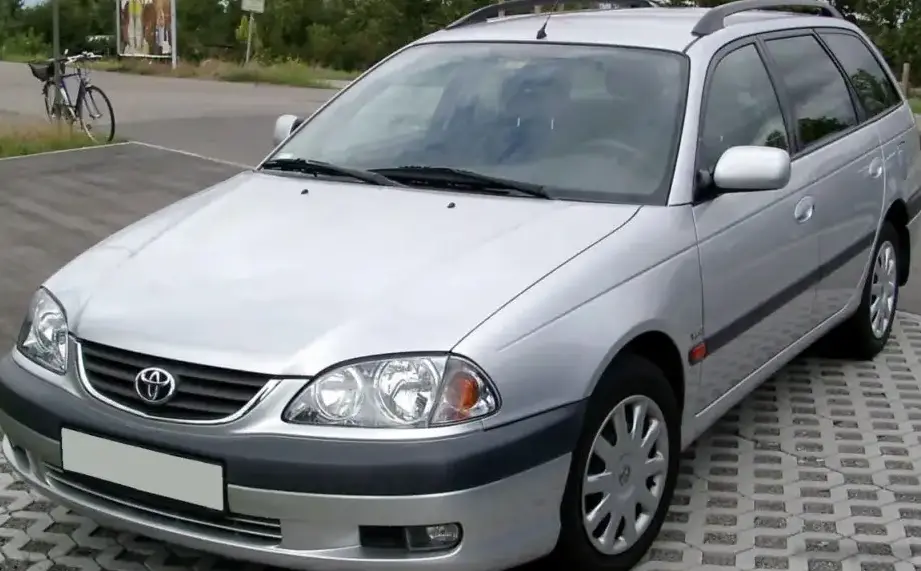
| Generation | Avensis Wagon (T22) |
| Type (Engine) | 1.6 (101 Hp) |
| Start of production | 1997 |
| End of production | 2003 |
| Powertrain Architecture | Internal Combustion engine |
| Body type | Station wagon (estate) |
| Seats | 5 |
| Doors | 5 |
| Fuel consumption (urban) | 9.9 l/100 km (23.8 US mpg) |
| Fuel consumption (extra urban) | 6.3 l/100 km (37.3 US mpg) |
| Fuel Type | Petrol (Gasoline) |
| Acceleration 0 – 100 km/h | 12.3 sec |
| Acceleration 0 – 62 mph | 12.3 sec |
| Acceleration 0 – 60 mph | 11.7 sec |
| Maximum speed | 185 km/h (114.95 mph) |
| Weight-to-power ratio | 12.7 kg/Hp |
| Weight-to-torque ratio | 9.4 kg/Nm |
| Power | 101 Hp @ 5800 rpm |
| Torque | 136 Nm @ 4400 rpm (100.31 lb.-ft. @ 4400 rpm) |
| Engine layout | Front, Transverse |
| Engine Model/Code | 3ZZ-FE |
| Engine displacement | 1587 cm3 (96.84 cu. in.) |
| Number of cylinders | 4 |
| Engine configuration | Inline |
| Cylinder Bore | 81 mm (3.19 in.) |
| Piston Stroke | 77 mm (3.03 in.) |
| Compression ratio | 9.5:1 |
| Number of valves per cylinder | 4 |
| Fuel injection system | Multi-port manifold injection |
| Engine aspiration | Naturally aspirated |
| Engine oil capacity | 3.7 l (3.91 US qt | 3.26 UK qt) |
| Coolant capacity | 7.4 l (7.82 US qt | 6.51 UK qt) |
| Kerb Weight | 1280 kg (2821.92 lbs.) |
| Max. weight | 1775 kg (3913.21 lbs.) |
| Max load | 495 kg (1091.29 lbs.) |
| Trunk (boot) space – minimum | 580 l (20.48 cu. ft.) |
| Trunk (boot) space – maximum | 1996 l (70.49 cu. ft.) |
| Fuel tank capacity | 60 l (15.85 US gal | 13.2 UK gal) |
| Length | 4570 mm (179.92 in.) |
| Width | 1710 mm (67.32 in.) |
| Height | 1500 mm (59.06 in.) |
| Wheelbase | 2630 mm (103.54 in.) |
| Front track | 1480 mm (58.27 in.) |
| Rear track | 1450 mm (57.09 in.) |
| Drivetrain | Front wheel drive |
| Number of gears | 5 gears, manual transmission |
| Front suspension | Spring Strut |
| Rear suspension | Coil spring |
| Front brakes | Ventilated discs |
| Rear brakes | Drum |
| Assisting systems | ABS (Anti-lock braking system) |
| Steering type | Steering rack and pinion |
| Power steering | Hydraulic |
| Tires size | 185/65 R14 |
The Toyota Avensis Wagon (T22) 1.6, producing 101 horsepower, was a common sight on European roads from 1997 to 2003. It served as the entry point into the Avensis wagon range, offering a practical and economical solution for families and individuals needing a versatile vehicle. The T22 Avensis marked Toyota’s serious attempt to establish itself in the competitive mid-size family car segment, directly challenging established European models like the Ford Mondeo and Volkswagen Passat. This particular 1.6-liter variant was specifically targeted at buyers who prioritized fuel efficiency and affordability over outright performance, making it a sensible choice for everyday use.
Powertrain & Engine Architecture
The Avensis 1.6 was powered by the 3ZZ-FE engine, a 1.6-liter inline-four cylinder gasoline engine. This engine belonged to Toyota’s ZZ engine family, which was designed with a focus on lightweight construction. The 3ZZ-FE utilized an aluminum alloy cylinder head to reduce weight. It featured multi-port fuel injection, delivering fuel directly to the intake ports, and a double overhead camshaft (DOHC) valvetrain with four valves per cylinder. This configuration optimized airflow into and out of the cylinders, contributing to the engine’s power output for its displacement. The engine’s 9.5:1 compression ratio was typical for naturally aspirated engines of the period. A five-speed manual transmission was the most frequently offered option, though a four-speed automatic transmission was also available. The automatic, while providing convenience, did result in a noticeable decrease in both acceleration and fuel economy.
Driving Characteristics
With 101 horsepower on tap, the 1.6-liter Avensis Wagon wasn’t built for exhilarating performance. Acceleration from 0 to 60 mph took approximately 11.7 seconds, and its top speed was around 115 mph. The engine could feel somewhat strained when pushed hard, especially when the vehicle was fully loaded with passengers and cargo. However, in typical daily driving scenarios – commuting, errands, and general transportation – it provided sufficient power. The five-speed manual transmission allowed drivers to maintain the engine within its optimal power band, while the four-speed automatic, though smoother, resulted in a more relaxed, but less responsive, driving experience. The gear ratios were optimized for fuel efficiency, prioritizing comfortable cruising over rapid acceleration. Compared to the more powerful 2.0-liter and V6 Avensis models, the 1.6 felt considerably less responsive and lacked the same level of refinement.
Equipment & Trim Levels
The 1.6-liter Avensis Wagon generally came equipped with a basic, but functional, set of standard features. These typically included central locking, power steering, electric front windows, and an AM/FM radio. Air conditioning was often offered as an optional extra, as were alloy wheels and a CD player. Interior upholstery was usually cloth, and the dashboard layout was relatively simple and straightforward. Higher trim levels, such as the GLS, added features like climate control, upgraded audio systems, and more luxurious interior appointments. The emphasis with the 1.6 was on providing a practical and affordable vehicle, so more premium features were generally reserved for the higher-specification models.
Chassis & Braking
The Avensis Wagon utilized a MacPherson strut front suspension and a coil spring rear suspension. This setup prioritized ride comfort, providing a reasonably smooth experience on most road surfaces, although it wasn’t particularly sporty in its handling characteristics. The front brakes were ventilated discs, offering adequate stopping power, while the rear brakes were drums – a cost-saving measure common in vehicles of this class. An Anti-lock Braking System (ABS) was standard equipment, enhancing safety. The chassis was designed to strike a balance between ride comfort and handling, but it didn’t quite match the refinement of some of its European competitors. Stabilizer bars were fitted to both the front and rear axles to help minimize body roll during cornering.
Market Reception & Comparison
The Avensis 1.6 Wagon was generally well-regarded by automotive critics as a practical and reliable family car. However, it often received criticism for its relatively uninspired performance and somewhat bland styling. Compared to the 2.0-liter and V6 models, the 1.6 offered significantly lower running costs, making it an appealing option for budget-conscious buyers. Fuel economy was a strong point, with combined fuel consumption averaging between 30 and 35 miles per gallon. Reliability was also a key strength, as Toyota had built a strong reputation for producing durable and dependable vehicles. The 1.6L automatic transmission was often viewed as a compromise, trading performance for the convenience of automatic gear changes.
Legacy
The 3ZZ-FE engine, while not known for being a performance powerhouse, proved to be a remarkably reliable and durable unit. Avensis Wagons equipped with this engine are still frequently found on the used car market today. They are often sought after by buyers looking for an affordable and dependable family vehicle. Routine maintenance costs are generally low, but it’s important to inspect for potential oil leaks and ensure that the timing belt has been replaced according to the manufacturer’s recommended service intervals. The Avensis 1.6 Wagon represents a solid, if not spectacular, offering in the mid-size estate car segment, providing a blend of practicality, reliability, and affordability that continues to appeal to buyers today.