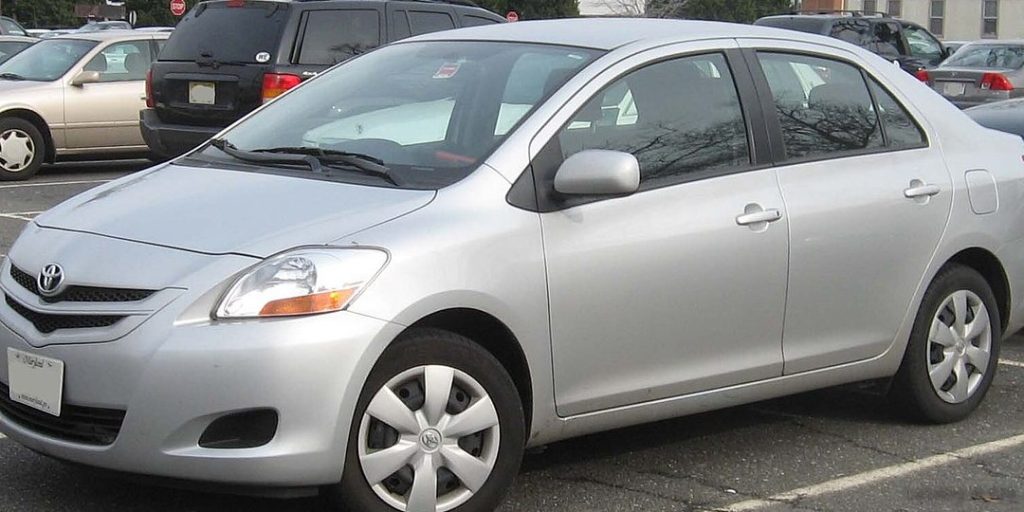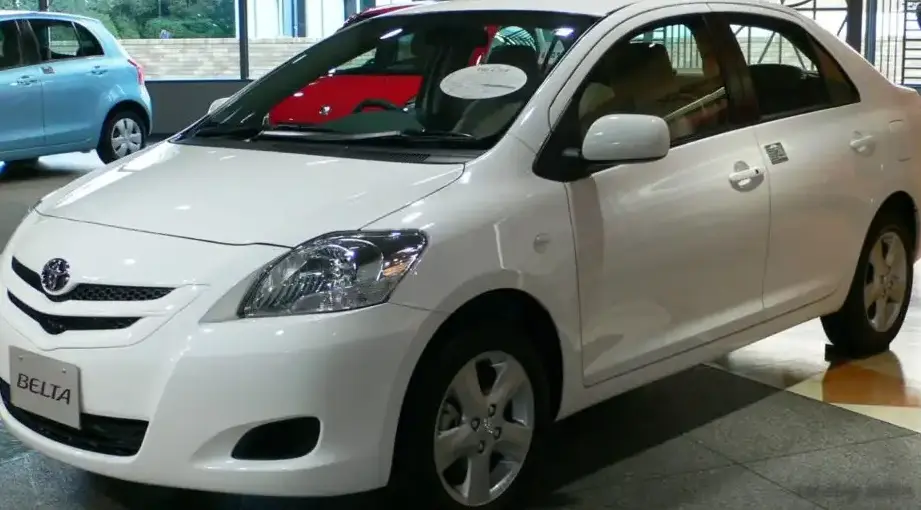
The Toyota Belta 1.6, produced from November 2005 to June 2012, was a compact sedan primarily aimed at the Japanese domestic market (JDM) and select export markets. Positioned as an affordable and practical vehicle, the Belta occupied a crucial segment for Toyota, offering a balance between fuel efficiency, reliability, and reasonable space. It was essentially a rebadged and slightly modified version of the Toyota Vios, tailored to meet the specific demands and regulations of the Japanese market. The 1.6-liter variant, producing 106 horsepower, represented a mid-range offering within the Belta lineup, slotting between the base 1.3-liter engine and potentially higher-specification trims depending on the market.
Technical Specifications
| Brand | Toyota |
| Model | Belta |
| Generation | Belta |
| Type (Engine) | 1.6 (106 Hp) |
| Start of production | November, 2005 |
| End of production | June, 2012 |
| Powertrain Architecture | Internal Combustion engine |
| Body type | Sedan |
| Seats | 5 |
| Doors | 4 |
| Fuel Type | Petrol (Gasoline) |
| Power | 106 Hp @ 6000 rpm |
| Power per litre | 70.8 Hp/l |
| Torque | 145 Nm @ 4200 rpm |
| Torque (lb-ft) | 106.95 lb.-ft. @ 4200 rpm |
| Engine layout | Front, Transverse |
| Engine Model/Code | 4ZR-FE |
| Engine displacement | 1497 cm3 |
| Engine displacement (cu. in.) | 91.35 cu. in. |
| Number of cylinders | 4 |
| Engine configuration | Inline |
| Cylinder Bore | 75 mm |
| Cylinder Bore (in.) | 2.95 in. |
| Piston Stroke | 84.7 mm |
| Piston Stroke (in.) | 3.33 in. |
| Compression ratio | 10.5:1 |
| Number of valves per cylinder | 4 |
| Fuel injection system | Multi-port manifold injection |
| Engine aspiration | Naturally aspirated engine |
| Valvetrain | DOHC |
| Fuel tank capacity | 42 l |
| Fuel tank capacity (US gal) | 11.1 US gal |
| Fuel tank capacity (UK gal) | 9.24 UK gal |
| Length | 4300 mm |
| Length (in.) | 169.29 in. |
| Width | 1895 mm |
| Width (in.) | 74.61 in. |
| Height | 1460 mm |
| Height (in.) | 57.48 in. |
| Wheelbase | 2550 mm |
| Wheelbase (in.) | 100.39 in. |
| Drivetrain Architecture | The Internal combustion engine (ICE) drives the front wheels of the vehicle. |
| Drive wheel | Front wheel drive |
| Number of gears and type of gearbox | 5 gears, manual transmission |
Powertrain & Engine Architecture
The heart of the Belta 1.6 is the 4ZR-FE engine, a 1.497-liter (91.35 cubic inches) inline-four cylinder gasoline engine. This engine utilizes a double overhead camshaft (DOHC) valvetrain with four valves per cylinder, contributing to its relatively efficient operation. Fuel delivery is managed by a multi-port fuel injection system, a common setup for engines of this era. The 4ZR-FE is a naturally aspirated engine, meaning it doesn’t employ forced induction like a turbocharger or supercharger. This results in a linear power delivery, prioritizing smoothness and predictability over outright performance. The engine’s 106 horsepower at 6000 rpm and 145 Nm (106.95 lb-ft) of torque at 4200 rpm are respectable figures for a vehicle of this class and size. The engine was known for its reliability and relatively low maintenance requirements, typical of Toyota’s engineering philosophy.
Driving Characteristics
The Belta 1.6 with a manual transmission offered a reasonably engaging driving experience for its class. While not a sports car, the engine provided sufficient power for everyday driving, including highway merging and overtaking. The five-speed manual gearbox allowed drivers to maintain control over the engine’s revs, optimizing fuel efficiency or extracting maximum performance when needed. Compared to a potential automatic transmission variant (not detailed in the provided data, but commonly available), the manual offered a more direct connection to the engine and better fuel economy. The power delivery was smooth and predictable, making it an easy car to drive for both novice and experienced drivers. However, it lacked the punch of larger-displacement engines or those equipped with forced induction.
Equipment & Trim Levels
The Belta 1.6 typically came equipped with standard features expected of a compact sedan in its market segment. These included air conditioning, power windows, power steering, and a basic audio system. Higher trim levels, depending on the market, could add features like alloy wheels, a more sophisticated audio system with CD player, and upgraded interior upholstery. Interior materials were generally durable and practical, prioritizing functionality over luxury. The dashboard layout was straightforward and user-friendly, with clearly labeled controls. Safety features typically included dual front airbags and anti-lock brakes (ABS) as standard or optional equipment.
Chassis & Braking
The Belta 1.6 utilized a front-wheel-drive layout with a MacPherson strut suspension in the front and a torsion beam suspension in the rear. This suspension setup provided a comfortable ride quality, suitable for everyday commuting. The braking system typically consisted of disc brakes in the front and drum brakes in the rear, a common configuration for vehicles in this price range. The brakes were adequate for normal driving conditions, but lacked the stopping power of more advanced braking systems. The chassis was designed to prioritize fuel efficiency and affordability, rather than sporty handling.
Market Reception & Comparison
The Toyota Belta 1.6 was generally well-received in its target markets, particularly in Japan, where it was praised for its reliability, fuel efficiency, and practicality. Critics noted that it wasn’t the most exciting car to drive, but it offered a solid and dependable transportation solution. Compared to other compact sedans available at the time, the Belta 1.6 offered a competitive combination of features and price. It often outperformed rivals in terms of long-term reliability and resale value. The 1.6-liter engine provided a good balance between performance and fuel economy, making it a popular choice for drivers who prioritized both factors.
Legacy
The Toyota Belta, and specifically the 1.6-liter variant, has established a reputation for long-term reliability and durability. In the used car market, these vehicles are often sought after for their affordability and low maintenance costs. The 4ZR-FE engine is known to be a robust and dependable unit, capable of high mileage with proper maintenance. While not a collector’s item, the Belta 1.6 remains a practical and economical choice for budget-conscious buyers seeking a reliable compact sedan. Its simple design and readily available parts contribute to its continued appeal in the used car market.