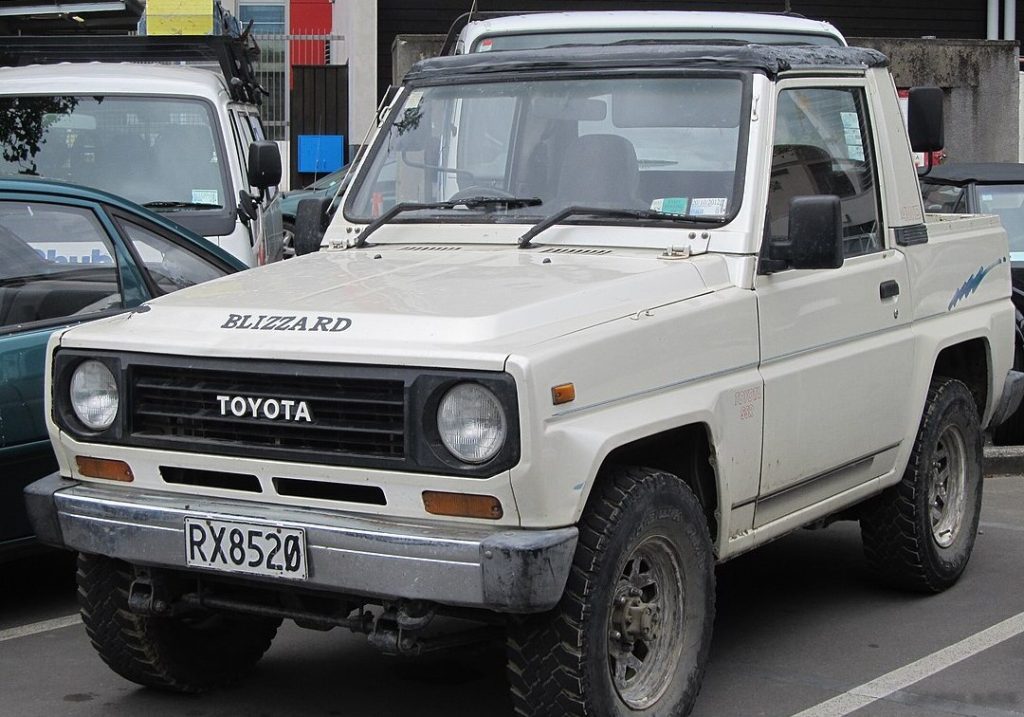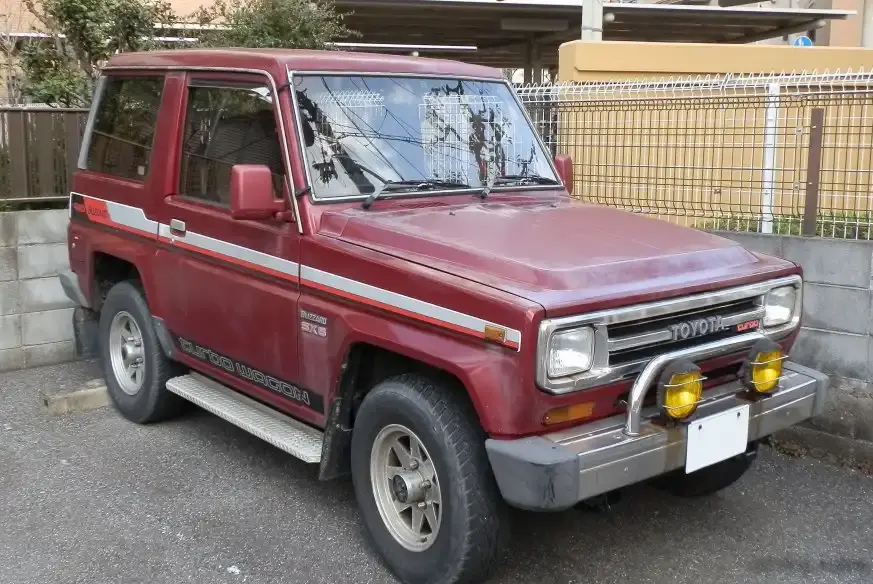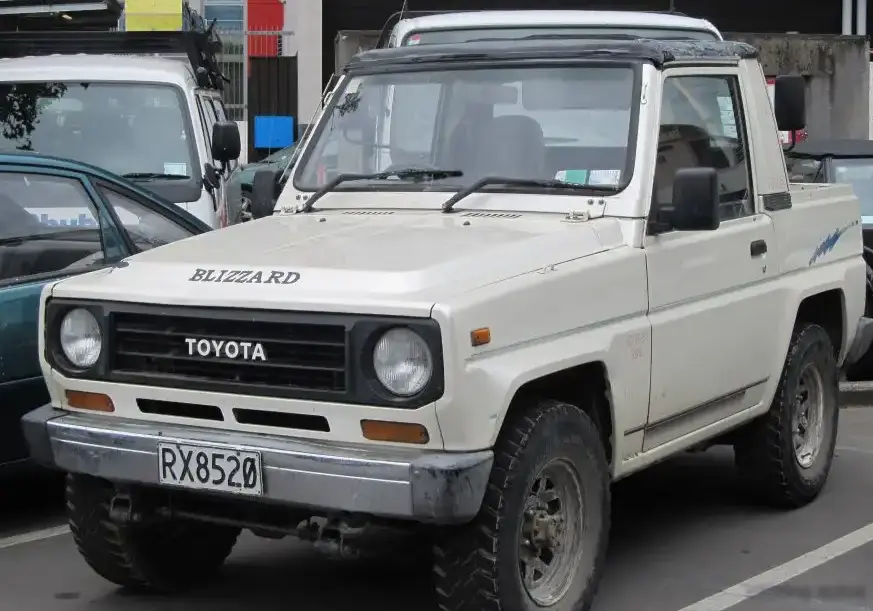
The Toyota Blizzard Soft Top 2.45 TD 4WD, produced between 1985 and 1994, was a unique offering from Toyota, primarily aimed at the European market. It represented a blend of rugged off-road capability and practical, everyday usability. Built upon the chassis of the Hilux, the Blizzard distinguished itself with its distinctive soft top and diesel engine options. This particular variant, equipped with the 2.45-liter turbocharged diesel engine producing 85 horsepower, occupied a middle ground in the Blizzard lineup, offering a balance between affordability and performance. It was positioned below the gasoline-powered models and above any potential base-level diesel trims.
Technical Specifications
| Brand | Toyota |
| Model | Blizzard |
| Generation | Blizzard Soft Top |
| Type (Engine) | 2.45 TD 4WD (85 Hp) |
| Start of production | 1985 |
| End of production | 1994 |
| Powertrain Architecture | Internal Combustion engine |
| Body type | Off-road vehicle |
| Seats | 5 |
| Doors | 3 |
| Fuel consumption (urban) | 13 l/100 km (18.1 US mpg, 21.7 UK mpg) |
| Fuel consumption (extra urban) | 8 l/100 km (29.4 US mpg, 35.3 UK mpg) |
| Fuel Type | Diesel |
| Maximum speed | 135 km/h (83.89 mph) |
| Weight-to-power ratio | 15.9 kg/Hp (63 Hp/tonne) |
| Weight-to-torque ratio | 7.2 kg/Nm (139.3 Nm/tonne) |
| Power | 85 Hp @ 4000 rpm |
| Power per litre | 34.8 Hp/l |
| Torque | 188 Nm @ 2400 rpm (138.66 lb.-ft. @ 2400 rpm) |
| Engine layout | Front, Longitudinal |
| Engine displacement | 2445 cm3 (149.2 cu. in.) |
| Number of cylinders | 4 |
| Engine configuration | Inline |
| Cylinder Bore | 92 mm (3.62 in.) |
| Piston Stroke | 92 mm (3.62 in.) |
| Compression ratio | 20:1 |
| Number of valves per cylinder | 2 |
| Fuel injection system | Precombustion chamber injection |
| Engine aspiration | Turbocharger |
| Kerb Weight | 1350 kg (2976.24 lbs.) |
| Fuel tank capacity | 60 l (15.85 US gal | 13.2 UK gal) |
| Length | 3965 mm (156.1 in.) |
| Width | 1580 mm (62.2 in.) |
| Height | 1840 mm (72.44 in.) |
| Wheelbase | 2205 mm (86.81 in.) |
| Front track | 1320 mm (51.97 in.) |
| Rear track | 1300 mm (51.18 in.) |
| Drive wheel | All wheel drive (4×4) |
| Number of gears and type of gearbox | 5 gears, manual transmission |
| Front suspension | Coil spring |
| Rear suspension | Coil spring |
| Front brakes | Disc |
| Rear brakes | Drum |
| Assisting systems | ABS (Anti-lock braking system) |
| Power steering | Hydraulic Steering |
| Tires size | 215/80 R15 |
| Wheel rims size | 6Jx15 ET10 5×139.7 |
Powertrain & Engine Architecture
The heart of this Blizzard variant is the 2.45-liter (2445 cc) inline-four cylinder diesel engine. Designated with various codes depending on the specific market, this engine utilized a precombustion chamber injection system. This system, common in older diesel engines, involved injecting fuel into a precombustion chamber connected to the main cylinder, promoting more complete combustion. The engine was turbocharged, which significantly improved power output compared to naturally aspirated versions. The turbocharger boosted output to 85 horsepower at 4000 rpm and 188 Nm (138.66 lb.-ft.) of torque at 2400 rpm. The engine featured a relatively high compression ratio of 20:1, typical for diesel engines. The five-speed manual transmission was the only gearbox option available with this engine, providing a good balance of fuel efficiency and usability.
Driving Characteristics
The 85-horsepower diesel engine, coupled with the five-speed manual transmission, provided adequate, though not exhilarating, performance. Acceleration was modest, and the vehicle was geared more towards torque delivery for off-road situations and towing. The turbocharger helped to mitigate some of the inherent sluggishness of diesel engines, providing a noticeable boost in power once spooled up. Compared to the gasoline-powered Blizzards, the diesel offered significantly better fuel economy, but at the expense of outright speed. The manual transmission allowed for greater control in off-road conditions, enabling the driver to select the appropriate gear for optimal traction. The gear ratios were relatively long, prioritizing fuel efficiency and low-speed crawling ability over rapid acceleration.
Equipment & Trim Levels
The Blizzard Soft Top 2.45 TD 4WD was generally equipped with a fairly basic level of trim. Standard features typically included steel wheels, vinyl or cloth upholstery, and a simple dashboard layout. Power steering was often included, but air conditioning and power windows were usually optional extras. The soft top itself was a manually operated canvas top, providing open-air driving capability. Depending on the market, options could include upgraded audio systems, additional lighting, and various off-road accessories such as winch mounts and brush guards. The interior was designed for practicality and durability, rather than luxury.
Chassis & Braking
The Blizzard’s chassis was based on the Toyota Hilux, providing a robust and capable platform for off-road driving. The suspension consisted of coil springs at both the front and rear, offering a reasonable ride quality on paved roads while maintaining sufficient articulation for off-road use. The braking system featured disc brakes on the front wheels and drum brakes on the rear. While adequate for normal driving conditions, the braking system was not particularly powerful. Anti-lock braking system (ABS) was available on some models, enhancing safety. The 4WD system was typically part-time, allowing the driver to switch between two-wheel drive and four-wheel drive as needed.
Market Reception & Comparison
The Toyota Blizzard, and specifically the 2.45 TD 4WD variant, was generally well-received in Europe as a practical and affordable off-road vehicle. Critics praised its ruggedness, fuel efficiency, and 4WD capability. However, some criticized its relatively basic interior and modest performance. Compared to other diesel-powered off-road vehicles of the time, such as the Land Rover Defender and the Nissan Patrol, the Blizzard offered a more affordable and accessible option. The 1.8L gasoline engine was faster, but less fuel efficient. The diesel offered a better balance for those prioritizing economy and durability.
Legacy
The Toyota Blizzard, while not as iconic as some other off-road vehicles, holds a special place in the hearts of many enthusiasts. The 2.45 TD engine, when properly maintained, proved to be remarkably durable and reliable. Today, well-maintained examples are sought after by collectors and off-road enthusiasts. The simplicity of the engine and mechanical components makes it relatively easy to repair and maintain. While finding parts can sometimes be a challenge, the Hilux-based chassis ensures a good level of parts availability. The Blizzard represents a unique chapter in Toyota’s history, showcasing the company’s ability to create versatile and capable vehicles for a variety of markets.