
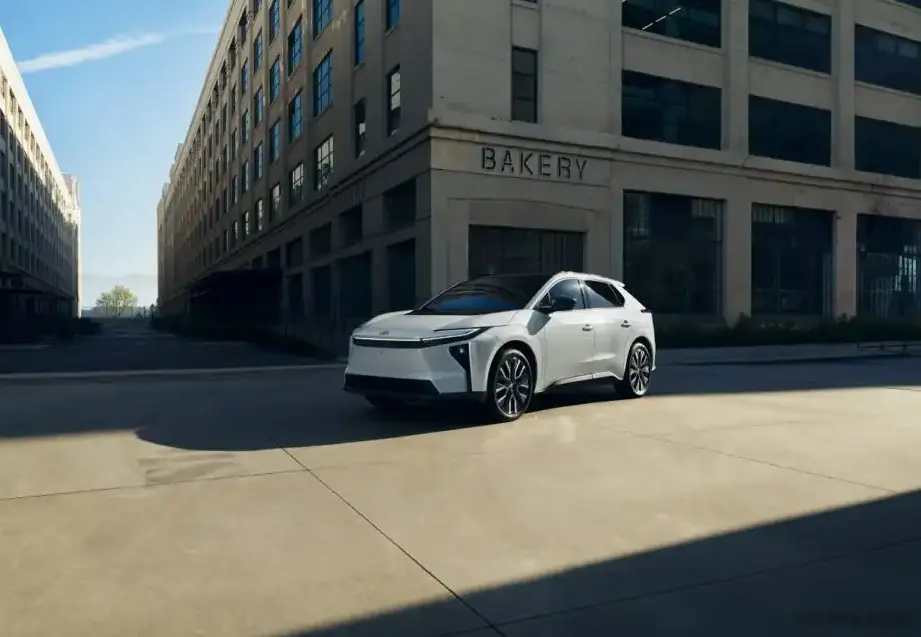
The Toyota bZ, specifically the 57.7 kWh variant producing 168 horsepower, represents Toyota’s initial foray into a dedicated battery electric vehicle (BEV) platform. Introduced for the 2025 model year, the bZ aims to compete in the burgeoning all-electric SUV segment. This model is built upon a new, dedicated EV platform co-developed with Subaru (resulting in the Subaru Solterra), signifying a departure from Toyota’s previous strategy of electrifying existing internal combustion engine (ICE) platforms. The “bZ” designation stands for “Beyond Zero,” reflecting Toyota’s commitment to carbon neutrality. This particular configuration, with its 57.7 kWh battery and front-wheel drive, is positioned as the entry-level offering within the bZ lineup, prioritizing range and affordability over outright performance.
Technical Specifications
| Brand | Toyota |
| Model | bZ |
| Generation | bZ |
| Type (Engine) | 57.7 kWh (168 Hp) |
| Start of production | 2025 |
| Powertrain Architecture | BEV (Electric Vehicle) |
| Body type | SUV |
| Seats | 5 |
| Doors | 5 |
| Fuel Type | Electricity |
| Acceleration 0 – 60 mph | 8 sec |
| Emission standard | ZEV |
| Weight-to-power ratio | 11 kg/Hp, 91.3 Hp/tonne |
| Gross battery capacity | 57.7 kWh |
| Battery voltage | 288.6 V |
| Battery technology | Lithium-ion (Li-Ion) |
| Battery location | Below the floor |
| All-electric range | 378 km (234.88 mi) |
| Electric motor power | 168 Hp |
| Electric motor location | Front axle, Transverse |
| System power | 168 Hp |
| Kerb Weight | 1840 kg (4056.51 lbs) |
| Max. weight | 2465 kg (5434.39 lbs) |
| Max load | 625 kg (1377.89 lbs) |
| Trunk (boot) space – minimum | 784 l (27.69 cu. ft) |
| Length | 4690 mm (184.65 in) |
| Width | 1860 mm (73.23 in) |
| Height | 1650 mm (64.96 in) |
| Wheelbase | 2850 mm (112.2 in) |
| Ride height (ground clearance) | 206 mm (8.11 in) |
| Minimum turning circle (turning diameter) | 12.2 m (40.03 ft) |
| Drivetrain Architecture | One electric motor drives the front wheels |
| Drive wheel | Front wheel drive |
| Number of gears and type of gearbox | 1 gears, automatic transmission |
| Front suspension | Independent, type McPherson with coil spring and anti-roll bar |
| Rear suspension | Independent multi-link spring suspension with stabilizer |
| Front brakes | Ventilated discs, 328 mm |
| Rear brakes | Ventilated discs, 318 mm |
| Assisting systems | ABS (Anti-lock braking system) |
| Steering type | Steering rack and pinion |
| Power steering | Electric Steering |
| Wheel rims size | 18 |
Powertrain & Engine Architecture
The Toyota bZ 57.7 kWh utilizes a single electric motor positioned on the front axle, delivering 168 horsepower. This motor is a permanent magnet synchronous motor, chosen for its efficiency and power density. The 57.7 kWh lithium-ion battery pack is mounted under the floor of the vehicle, contributing to a low center of gravity and maximizing interior space. The battery utilizes a prismatic cell design. The bZ employs a single-speed automatic transmission, typical of most BEVs, as the electric motor provides instant torque across a wide RPM range, negating the need for multiple gears. The vehicle features a standard onboard charger capable of accepting both AC and DC fast charging. The charging port location varies by market, but generally supports CCS (Combined Charging System) for DC fast charging and Type 2 for AC charging in Europe, and CCS1 in North America.
Driving Characteristics
The 168 hp front-wheel drive bZ 57.7 kWh offers adequate, though not exhilarating, performance. Acceleration from 0 to 60 mph is quoted at 8 seconds. The single-speed transmission provides linear acceleration, with the full 168 hp and 184 lb-ft of torque available instantly. Compared to potential future, higher-output dual-motor all-wheel drive variants, this entry-level model prioritizes efficiency and smoothness over outright speed. The front-wheel drive configuration provides predictable handling in most conditions, but may exhibit some torque steer under hard acceleration. The low center of gravity, thanks to the underfloor battery pack, contributes to stable cornering. Regenerative braking is adjustable, allowing drivers to customize the level of deceleration when lifting off the throttle, enhancing energy recovery and extending range.
Equipment & Trim Levels
The base bZ 57.7 kWh trim typically includes standard features such as an 8-inch touchscreen infotainment system with Apple CarPlay and Android Auto compatibility, Toyota Safety Sense 3.0 (a suite of advanced driver-assistance systems), automatic climate control, and LED headlights. Interior upholstery is generally cloth, with options for synthetic leather upgrades on higher trims. Available optional extras include a larger 12.3-inch touchscreen, a panoramic sunroof, heated and ventilated front seats, and a premium audio system. The dashboard layout is modern and minimalist, emphasizing the vehicle’s electric nature. The bZ is offered in a range of exterior colors, with options for two-tone paint schemes.
Chassis & Braking
The bZ utilizes a McPherson strut suspension setup at the front and a multi-link suspension at the rear, providing a comfortable and controlled ride. Stabilizer bars are included on both axles to minimize body roll during cornering. The braking system consists of ventilated disc brakes on all four wheels, measuring 328mm at the front and 318mm at the rear. Anti-lock braking system (ABS) is standard, along with electronic brake-force distribution (EBD) and brake assist. The steering system is an electric power-assisted rack and pinion setup, providing light and precise steering feel. The vehicle rides on 18-inch alloy wheels as standard.
Market Reception & Comparison
Initial reviews of the Toyota bZ 57.7 kWh have been mixed. Critics generally praise the vehicle’s comfortable ride, spacious interior, and standard safety features. However, some have criticized the relatively limited range compared to competitors like the Tesla Model Y or Hyundai IONIQ 5, and the somewhat dated infotainment system. Fuel economy, expressed as MPGe (miles per gallon equivalent), is competitive within the segment, achieving an estimated 114 MPGe combined. Reliability is expected to be strong, consistent with Toyota’s reputation, though long-term data is still emerging. Compared to a potential future all-wheel drive bZ variant, the 57.7 kWh model offers a more affordable entry point, appealing to buyers prioritizing value and efficiency.
Legacy
The Toyota bZ represents a significant step for Toyota in the electric vehicle market. While early adoption has been moderate, the bZ platform is expected to evolve with future iterations, incorporating improved battery technology, increased range, and enhanced performance. The long-term reliability of the 57.7 kWh powertrain remains to be seen, but Toyota’s extensive experience with hybrid technology suggests a robust and durable system. In the used car market, the bZ is likely to appeal to buyers seeking an affordable and practical electric SUV with Toyota’s renowned reputation for reliability. As battery technology advances and charging infrastructure expands, the bZ is poised to become a more compelling option for environmentally conscious consumers.
