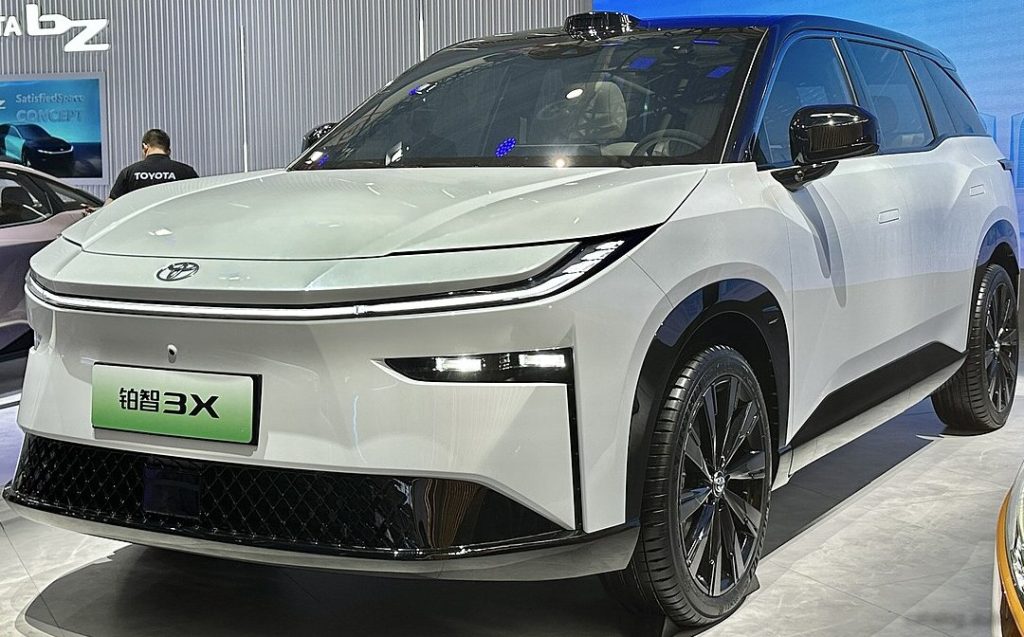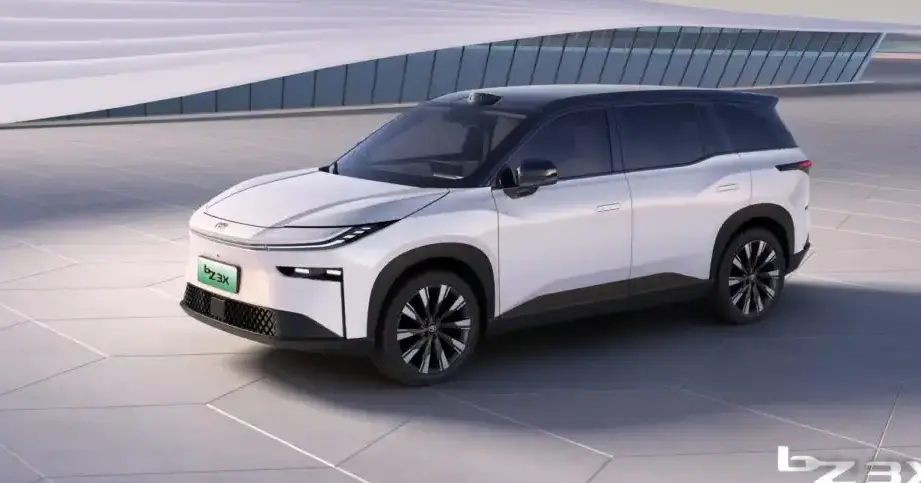
The Toyota bZ3X, specifically the 50.03 kWh variant producing 204 horsepower, represents Toyota’s entry into a rapidly evolving electric vehicle market. Introduced in March 2025, this model is positioned as a mainstream, accessible electric SUV, primarily aimed at consumers seeking a practical and efficient daily driver. It’s built upon a dedicated electric vehicle platform, signifying Toyota’s commitment to electrification beyond hybrid technology. The bZ3X is currently focused on markets outside of North America, serving as a key component in Toyota’s global EV strategy.
Technical Specifications
| Brand | Toyota |
| Model | bZ3X |
| Generation | bZ3X |
| Type (Engine) | 50.03 kWh (204 Hp) |
| Start of production | March, 2025 |
| Powertrain Architecture | BEV (Electric Vehicle) |
| Body type | SUV |
| Seats | 5 |
| Doors | 5 |
| Fuel Type | Electricity |
| Maximum speed | 160 km/h (99.42 mph) |
| Weight-to-power ratio | 8.3 kg/Hp, 120.7 Hp/tonne |
| Weight-to-torque ratio | 8.5 kg/Nm, 118.3 Nm/tonne |
| Gross battery capacity | 50.03 kWh |
| Battery technology | Lithium iron phosphate (LiFePO4) |
| Battery location | Below the floor |
| All-electric range (CLTC) | 430 km (267.19 mi) |
| Average Energy consumption (CLTC) | 12.6 kWh/100 km (20.28 kWh/100 mi, 166 MPGe, 7.9 km/kWh, 4.9 mi/kWh) |
| Electric motor power | 204 Hp |
| Electric motor Torque | 200 Nm (147.51 lb.-ft.) |
| Electric motor model/code | TZ175XSAY501 |
| Electric motor location | Front axle, Transverse |
| Electric motor type | Synchronous |
| System power | 204 Hp |
| System torque | 200 Nm (147.51 lb.-ft.) |
| Kerb Weight | 1690 kg (3725.81 lbs.) |
| Max. weight | 2100 kg (4629.71 lbs.) |
| Max load | 410 kg (903.9 lbs.) |
| Length | 4600 mm (181.1 in.) |
| Width | 1850 mm (72.83 in.) |
| Height | 1660 mm (65.35 in.) |
| Wheelbase | 2765 mm (108.86 in.) |
| Front track | 1600 mm (62.99 in.) |
| Rear (Back) track | 1600 mm (62.99 in.) |
| Drag coefficient (Cd) | 0.27 |
| Minimum turning circle | 11.2 m (36.75 ft.) |
| Approach angle | 18° |
| Departure angle | 25° |
| Drivetrain Architecture | One electric motor drives the front wheels. |
| Drive wheel | Front wheel drive |
| Number of gears | 1 |
| Gearbox type | automatic transmission |
| Front suspension | Independent, type McPherson with coil spring and anti-roll bar |
| Rear suspension | Torsion |
| Front brakes | Ventilated discs |
| Rear brakes | Disc |
| Assisting systems | ABS (Anti-lock braking system) |
| Steering type | Steering rack and pinion |
| Power steering | Electric Steering |
| Tires size | 215/55 R18 |
| Wheel rims size | 18 |
Powertrain & Engine Architecture
The bZ3X 50.03 kWh utilizes a single electric motor driving the front wheels. This motor, designated TZ175XSAY501, is a synchronous motor producing 204 horsepower and 200 Nm (147.51 lb.-ft.) of torque. The powertrain is a fully electric system, relying on a 50.03 kWh Lithium Iron Phosphate (LiFePO4) battery pack located under the vehicle floor. LiFePO4 chemistry is chosen for its improved thermal stability and longer cycle life compared to Nickel Manganese Cobalt (NMC) batteries, though it typically offers slightly lower energy density. The single-speed automatic transmission is a standard component of most modern EVs, providing seamless power delivery. The vehicle’s electronic control unit (ECU) manages power distribution, regenerative braking, and overall system efficiency.
Driving Characteristics
The 204 hp and 200 Nm of torque provide adequate acceleration for everyday driving. While not a performance-oriented EV, the bZ3X offers brisk responsiveness in urban and suburban environments. The single-speed automatic transmission ensures smooth and linear acceleration. Compared to potential higher-output variants (not currently available), this version prioritizes efficiency over outright speed. The front-wheel-drive configuration provides predictable handling, but may exhibit some torque steer under hard acceleration. The relatively low curb weight of 1690 kg (3725.81 lbs.) contributes to a reasonably agile feel.
Equipment & Trim Levels
Specific trim levels and standard equipment vary by market. However, the bZ3X 50.03 kWh generally includes features such as a touchscreen infotainment system, digital instrument cluster, automatic climate control, and a suite of advanced driver-assistance systems (ADAS) including adaptive cruise control and lane-keeping assist. Interior upholstery is typically cloth or a synthetic leatherette. Optional extras may include a panoramic sunroof, upgraded audio system, and premium paint colors. The focus is on providing a well-equipped vehicle at a competitive price point.
Chassis & Braking
The bZ3X utilizes an independent McPherson strut suspension in the front, paired with a torsion beam rear suspension. This configuration balances ride comfort and handling characteristics. Ventilated disc brakes are used on the front wheels, while solid discs are employed at the rear. The inclusion of ABS (Anti-lock Braking System) is standard. The electric steering system provides light and precise steering feel. The vehicle’s relatively low center of gravity, due to the underfloor battery pack, contributes to improved stability.
Market Reception & Comparison
Initial reviews of the bZ3X have focused on its practicality, efficiency, and competitive pricing. Critics have praised the comfortable ride and spacious interior. The CLTC range of 430 km (267.19 mi) is competitive within its segment, though real-world range may vary depending on driving conditions and habits. Compared to other EVs in its class, the bZ3X offers a compelling value proposition, particularly in markets where government incentives are available. The LiFePO4 battery chemistry is seen as a positive attribute for longevity and safety, though it may result in slightly lower energy density compared to NMC batteries.
Legacy
The long-term reliability of the bZ3X powertrain remains to be seen, as it is a relatively new model. However, Toyota’s reputation for building durable and reliable vehicles suggests a positive outlook. The use of LiFePO4 battery technology is expected to contribute to a longer battery lifespan. As the EV market matures, the bZ3X 50.03 kWh is likely to become a popular choice for consumers seeking an affordable and practical electric SUV. Its success will depend on Toyota’s ability to address any potential issues and continue to innovate in the rapidly evolving EV landscape. The vehicle represents a significant step in Toyota’s transition towards a fully electrified future.