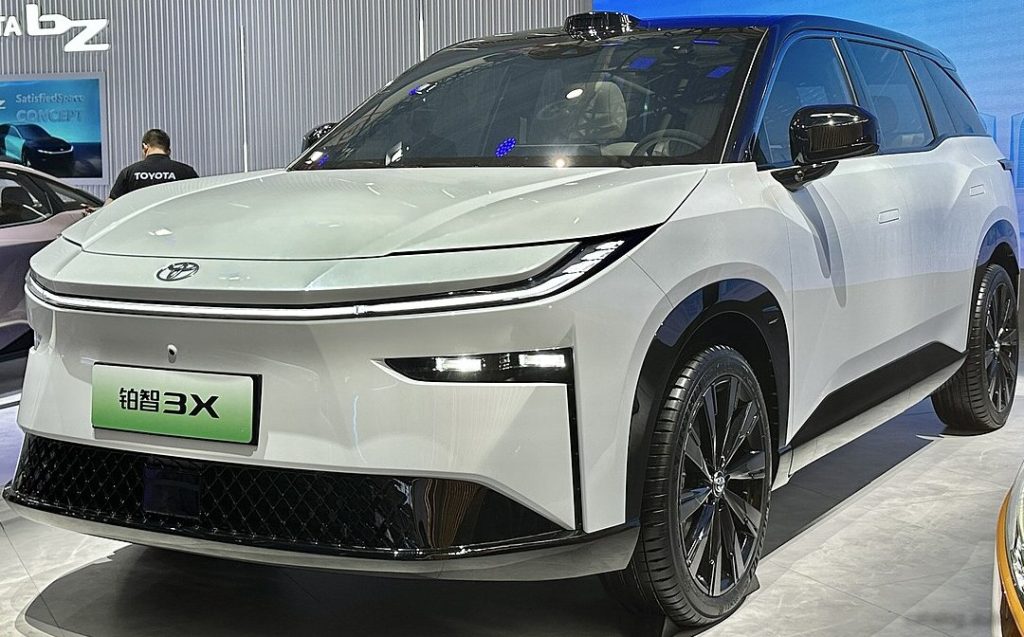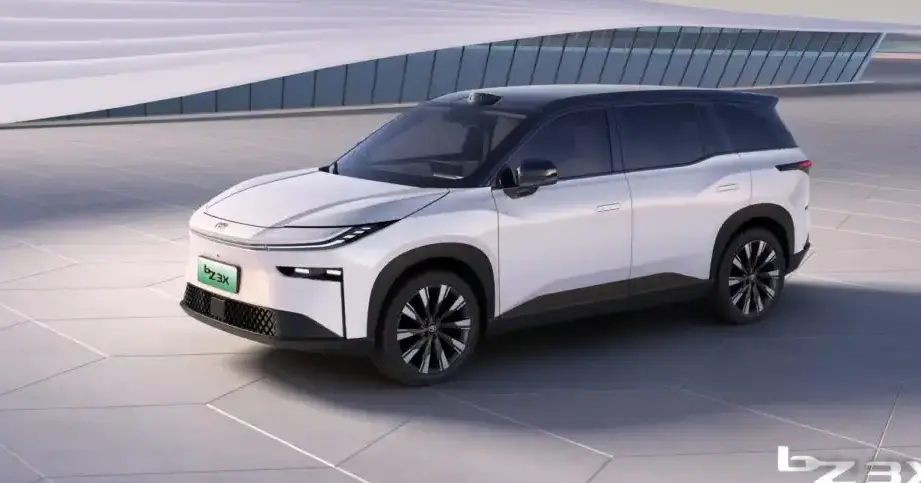
The Toyota bZ3X, launched in March 2025, represents Toyota’s entry into a competitive segment of all-electric crossover SUVs. Positioned as a mainstream electric vehicle, the bZ3X aims to provide a practical and efficient transportation solution for families and commuters. This specific variant features a 58.37 kWh battery pack paired with a single electric motor producing 204 horsepower. It is a key component of Toyota’s broader electrification strategy, leveraging the dedicated “bZ” (Beyond Zero) platform designed specifically for battery electric vehicles. The bZ3X is primarily targeted at the Asian market, with limited initial availability in other regions.
Technical Specifications
| Brand | Toyota |
| Model | bZ3X |
| Generation | bZ3X |
| Type (Engine) | 58.37 kWh (204 Hp) |
| Start of production | March, 2025 |
| Powertrain Architecture | BEV (Electric Vehicle) |
| Body type | SUV |
| Seats | 5 |
| Doors | 5 |
| Fuel Type | Electricity |
| Maximum speed | 160 km/h (99.42 mph) |
| Weight-to-power ratio | 8.6 kg/Hp, 116.9 Hp/tonne |
| Weight-to-torque ratio | 8.7 kg/Nm, 114.6 Nm/tonne |
| Gross battery capacity | 58.37 kWh |
| Battery technology | Lithium iron phosphate (LiFePO4) |
| Battery location | Below the floor |
| All-electric range (CLTC) | 520 km (323.11 mi) |
| Average Energy consumption (CLTC) | 12.5 kWh/100 km (20.12 kWh/100 mi) |
| Average Energy consumption (MPGe) | 168 MPGe |
| Average Energy consumption (km/kWh) | 8 km/kWh |
| Average Energy consumption (mi/kWh) | 5 mi/kWh |
| Electric motor power | 204 Hp |
| Electric motor Torque | 200 Nm (147.51 lb.-ft.) |
| Electric motor model/code | TZ175XSAY501 |
| Electric motor location | Front axle, Transverse |
| Electric motor type | Synchronous |
| System power | 204 Hp |
| System torque | 200 Nm (147.51 lb.-ft.) |
| Kerb Weight | 1745-1760 kg (3847.07 – 3880.14 lbs.) |
| Max. weight | 2185 kg (4817.1 lbs.) |
| Max load | 425-440 kg (936.96 – 970.03 lbs.) |
| Length | 4600 mm (181.1 in.) |
| Width | 1850-1875 mm (72.83 – 73.82 in.) |
| Height | 1645-1660 mm (64.76 – 65.35 in.) |
| Wheelbase | 2765 mm (108.86 in.) |
| Front track | 1600 mm (62.99 in.) |
| Rear (Back) track | 1600 mm (62.99 in.) |
| Drag coefficient (Cd) | 0.27 |
| Minimum turning circle (turning diameter) | 11.2 m (36.75 ft.) |
| Approach angle | 18° |
| Departure angle | 25° |
| Drivetrain Architecture | One electric motor drives the front wheels. |
| Drive wheel | Front wheel drive |
| Number of gears and type of gearbox | 1 gears, automatic transmission |
| Front suspension | Independent, type McPherson with coil spring and anti-roll bar |
| Rear suspension | Torsion |
| Front brakes | Ventilated discs |
| Rear brakes | Disc |
| Assisting systems | ABS (Anti-lock braking system) |
| Steering type | Steering rack and pinion |
| Power steering | Electric Steering |
| Tires size | 215/55 R18 |
| Wheel rims size | 18 |
Powertrain & Engine Architecture
The bZ3X utilizes a front-wheel-drive configuration powered by a single synchronous electric motor, designated TZ175XSAY501. This motor delivers a peak output of 204 horsepower and 200 Nm (147.51 lb.-ft.) of torque. The energy is supplied by a 58.37 kWh Lithium Iron Phosphate (LiFePO4) battery pack, strategically positioned under the vehicle floor to optimize the center of gravity and passenger space. LiFePO4 chemistry is favored for its improved thermal stability and longer cycle life compared to Nickel Manganese Cobalt (NMC) batteries, although it typically offers slightly lower energy density. The single-speed automatic transmission is a standard feature, providing seamless acceleration and contributing to the vehicle’s ease of driving. The vehicle’s electrical architecture is designed for efficient energy management and supports fast charging capabilities.
Driving Characteristics
The bZ3X 58.37 kWh offers a comfortable and predictable driving experience. With 204 hp, acceleration is adequate for everyday driving situations, though it won’t deliver the brisk performance of some higher-powered electric SUVs. The single-speed transmission provides linear power delivery, and the front-wheel-drive configuration offers good traction in most conditions. The relatively low curb weight (1745-1760 kg) helps to mitigate the limitations of the single motor setup. While not a performance-oriented vehicle, the bZ3X prioritizes efficiency and a smooth, quiet ride. The CLTC-rated range of 520 km (323.11 mi) is competitive within its class, but real-world range will vary depending on driving conditions and habits.
Equipment & Trim Levels
The standard equipment list for the bZ3X includes features such as a touchscreen infotainment system, digital instrument cluster, automatic climate control, and a suite of advanced driver-assistance systems (ADAS). These systems typically include adaptive cruise control, lane departure warning, automatic emergency braking, and blind-spot monitoring. Interior upholstery is generally cloth in the base trims, with options for leatherette or full leather available on higher-spec models. Optional extras may include a panoramic sunroof, premium audio system, and heated/ventilated front seats. The overall interior design emphasizes simplicity and functionality, with a focus on creating a spacious and comfortable cabin.
Chassis & Braking
The bZ3X utilizes a McPherson strut suspension setup at the front, paired with a torsion beam rear suspension. This configuration strikes a balance between ride comfort and handling stability. Ventilated disc brakes are fitted to the front wheels, while solid discs are used at the rear. The inclusion of ABS (Anti-lock Braking System) is standard, enhancing braking performance and safety. The electric steering system provides light and precise steering feel, making the bZ3X easy to maneuver in urban environments. The vehicle’s relatively low center of gravity, thanks to the underfloor battery pack, contributes to improved stability and cornering ability.
Market Reception & Comparison
Initial reviews of the bZ3X have been mixed, with critics praising its efficiency and comfortable ride but noting its somewhat unremarkable performance and interior design. Compared to other electric SUVs in its class, such as the Hyundai Kona Electric or the Kia Niro EV, the bZ3X offers a competitive range and price point. However, some reviewers have pointed out that its infotainment system and overall interior quality lag behind those of its rivals. Fuel economy, measured in CLTC figures, is impressive at 12.5 kWh/100 km (20.12 kWh/100 mi), translating to 168 MPGe. Long-term reliability remains to be seen, but Toyota’s reputation for building durable vehicles suggests that the bZ3X should prove to be a dependable choice.
Legacy
The Toyota bZ3X represents a significant step in Toyota’s transition to electric mobility. While it may not be a groundbreaking vehicle in terms of performance or technology, it provides a practical and affordable entry point into the EV market. The use of LiFePO4 battery chemistry is a notable feature, offering potential benefits in terms of safety and longevity. As the electric vehicle market continues to evolve, the bZ3X is likely to be remembered as an important early model in Toyota’s electric lineup, paving the way for future generations of electric vehicles from the Japanese automaker. Its long-term success will depend on its reliability and the continued development of Toyota’s electric vehicle technology.