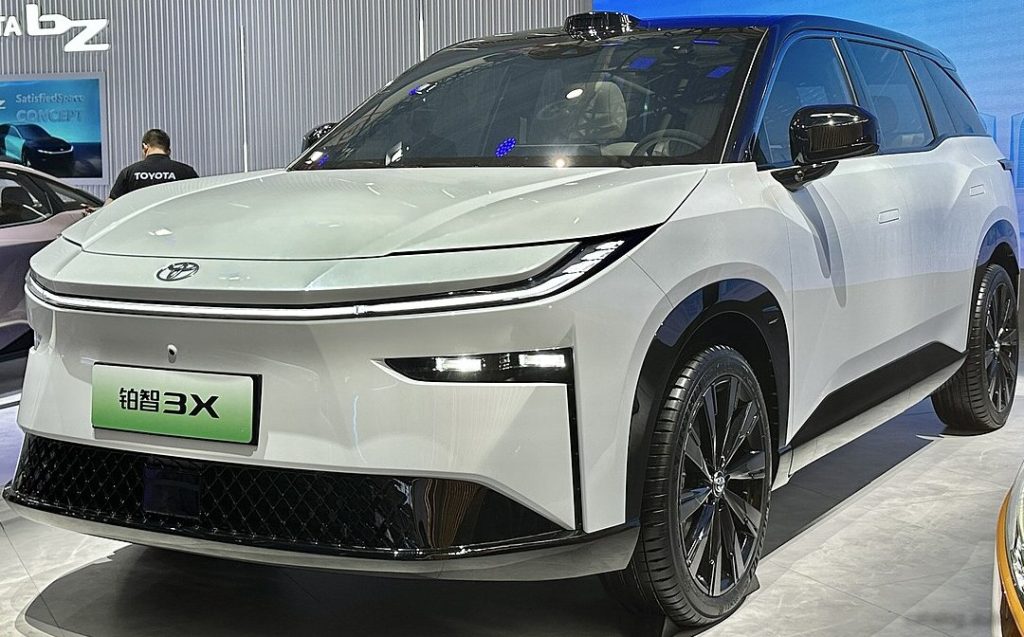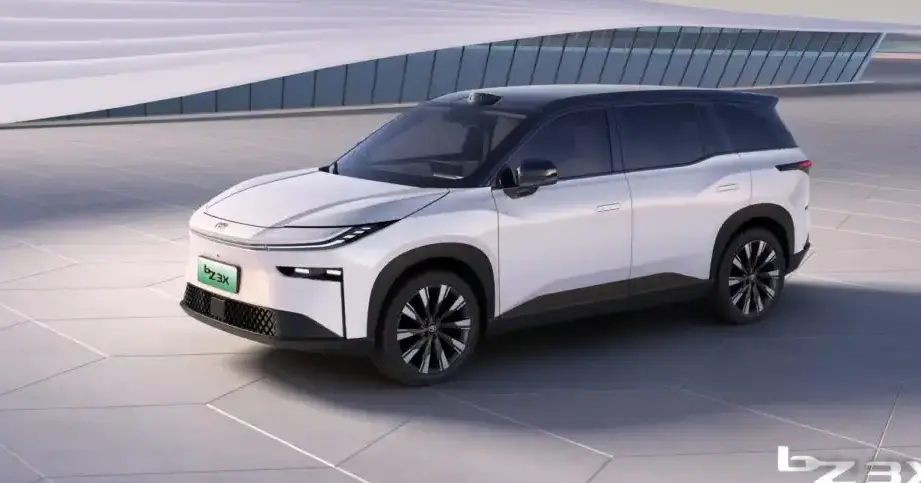
The Toyota bZ3X, equipped with a 67.92 kWh battery pack delivering 224 horsepower, represents Toyota’s entry into a competitive segment of all-electric SUVs. Production commenced in March 2025, positioning the bZ3X as a key model in Toyota’s expanding Beyond Zero (bZ) series, designed to offer a range of electric vehicles. This particular variant is aimed at consumers seeking a practical, mid-range electric SUV with a focus on efficiency and everyday usability. It’s built on a dedicated electric vehicle platform, signifying Toyota’s commitment to a fully electric future.
Technical Specifications
| Brand | Toyota |
| Model | bZ3X |
| Generation | bZ3X |
| Type (Engine) | 67.92 kWh (224 Hp) |
| Start of production | March, 2025 |
| Powertrain Architecture | BEV (Electric Vehicle) |
| Body type | SUV |
| Seats | 5 |
| Doors | 5 |
| Fuel Type | Electricity |
| Maximum speed | 160 km/h (99.42 mph) |
| Weight-to-power ratio | 8.2 kg/Hp, 122.1 Hp/tonne |
| Weight-to-torque ratio | 8.7 kg/Nm, 114.4 Nm/tonne |
| Gross battery capacity | 67.92 kWh |
| Battery technology | Lithium iron phosphate (LiFePO4) |
| Battery location | Below the floor |
| All-electric range (CLTC) | 610 km (379.04 mi) |
| Average Energy consumption (CLTC) | 12.8 kWh/100 km (20.6 kWh/100 mi, 164 MPGe, 7.8 km/kWh, 4.9 mi/kWh) |
| Electric motor power | 224 Hp |
| Electric motor Torque | 210 Nm (154.89 lb.-ft.) |
| Electric motor model/code | TZ180XS135 |
| Electric motor location | Front axle, Transverse |
| Electric motor type | Synchronous |
| System power | 224 Hp |
| System torque | 210 Nm (154.89 lb.-ft.) |
| Kerb Weight | 1835 kg (4045.48 lbs.) |
| Max. weight | 2250 kg (4960.4 lbs.) |
| Max load | 415 kg (914.92 lbs.) |
| Length | 4600 mm (181.1 in.) |
| Width | 1850-1875 mm (72.83 – 73.82 in.) |
| Height | 1645 mm (64.76 in.) |
| Wheelbase | 2765 mm (108.86 in.) |
| Front track | 1600 mm (62.99 in.) |
| Rear (Back) track | 1600 mm (62.99 in.) |
| Drag coefficient (Cd) | 0.27 |
| Minimum turning circle (turning diameter) | 11.2 m (36.75 ft.) |
| Approach angle | 18° |
| Departure angle | 25° |
| Drivetrain Architecture | One electric motor drives the front wheels. |
| Drive wheel | Front wheel drive |
| Number of gears and type of gearbox | 1 gears, automatic transmission |
| Front suspension | Independent, type McPherson with coil spring and anti-roll bar |
| Rear suspension | Torsion |
| Front brakes | Ventilated discs |
| Rear brakes | Disc |
| Assisting systems | ABS (Anti-lock braking system) |
| Steering type | Steering rack and pinion |
| Power steering | Electric Steering |
| Tires size | 225/45 R19 |
| Wheel rims size | 19 |
Powertrain & Engine Architecture
The bZ3X utilizes a front-wheel-drive configuration powered by a single electric motor, designated TZ180XS135. This synchronous motor produces 224 horsepower and 210 Nm (154.89 lb.-ft.) of torque. The heart of the system is the 67.92 kWh Lithium Iron Phosphate (LiFePO4) battery pack, positioned under the vehicle floor to optimize weight distribution and passenger space. LiFePO4 chemistry is chosen for its enhanced thermal stability and longer lifespan compared to traditional Nickel Manganese Cobalt (NMC) batteries, although it typically offers slightly lower energy density. The vehicle employs a single-speed automatic transmission, common in electric vehicles, to deliver seamless power to the front wheels. The charging ports and capabilities are not fully detailed in the provided specifications, but it is expected to support both AC and DC fast charging.
Driving Characteristics
The bZ3X 67.92 kWh offers a comfortable and efficient driving experience. With 224 hp, acceleration is adequate for everyday driving situations, though it won’t deliver the brisk performance of some higher-powered electric SUVs. The single-speed transmission provides linear power delivery, and the front-wheel-drive configuration offers predictable handling. The relatively low curb weight of 1835 kg (4045.48 lbs) contributes to reasonable agility. While specific gear ratios aren’t provided, the single-speed setup is optimized for efficiency and smooth operation. Compared to potential future higher-performance variants, this version prioritizes range and affordability over outright speed.
Equipment & Trim Levels
Details regarding specific trim levels and standard equipment for the bZ3X 67.92 kWh are limited in the provided information. However, it’s anticipated that the base model will include essential features such as a touchscreen infotainment system, climate control, and a suite of advanced driver-assistance systems (ADAS) including ABS. Higher trim levels are expected to offer upgrades like premium upholstery, a larger touchscreen, and additional safety features. The interior design is likely to reflect Toyota’s modern aesthetic, with a focus on functionality and user-friendliness.
Chassis & Braking
The bZ3X utilizes an independent McPherson strut suspension setup at the front, paired with a torsion beam rear suspension. This configuration balances ride comfort and handling characteristics. Ventilated disc brakes are employed at the front, while solid discs are used at the rear, providing adequate stopping power for the vehicle’s weight class. Electric power steering is standard, offering a responsive and precise steering feel. The vehicle rides on 19-inch wheels with 225/45 R19 tires, contributing to a comfortable ride and good grip.
Market Reception & Comparison
As a newly released model (March 2025), comprehensive market reception data for the bZ3X 67.92 kWh is currently unavailable. However, its CLTC range of 610 km (379.04 mi) and energy consumption of 12.8 kWh/100 km (164 MPGe) position it competitively within the electric SUV segment. Compared to other electric SUVs with similar battery capacities, the bZ3X aims to offer a balance of range, efficiency, and affordability. Its use of LiFePO4 battery chemistry may appeal to consumers prioritizing longevity and safety, while its front-wheel-drive configuration may be a drawback for those seeking all-wheel-drive capability.
Legacy
The long-term reliability of the bZ3X powertrain remains to be seen, as it is a relatively new design. However, Toyota has a strong reputation for building durable and reliable vehicles. The use of LiFePO4 battery technology is expected to contribute to a longer battery lifespan compared to some other electric vehicle batteries. In the used car market, the bZ3X 67.92 kWh is likely to be viewed as a practical and efficient electric SUV, appealing to budget-conscious buyers seeking a reliable and environmentally friendly vehicle. Its success will depend on Toyota’s ability to maintain its reputation for quality and provide excellent customer support.