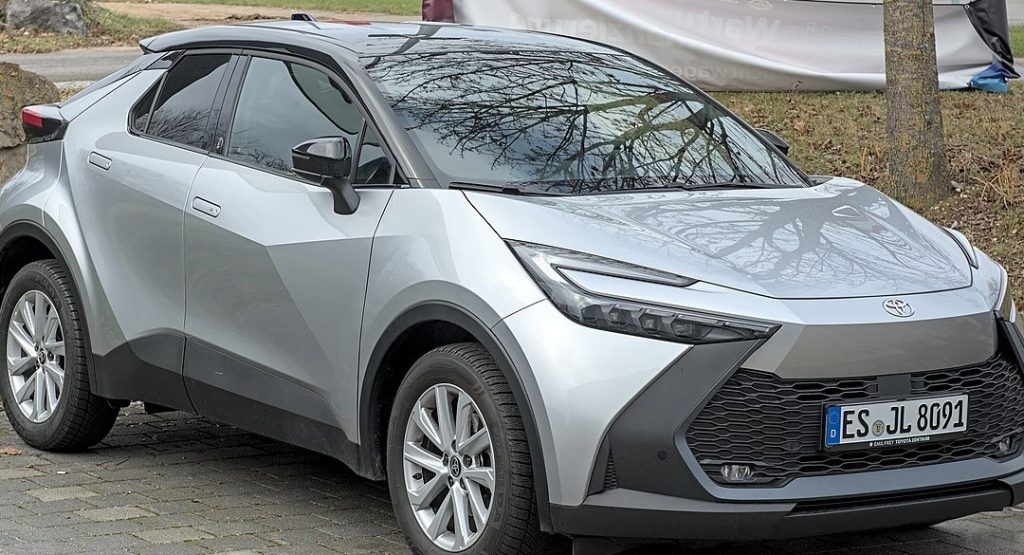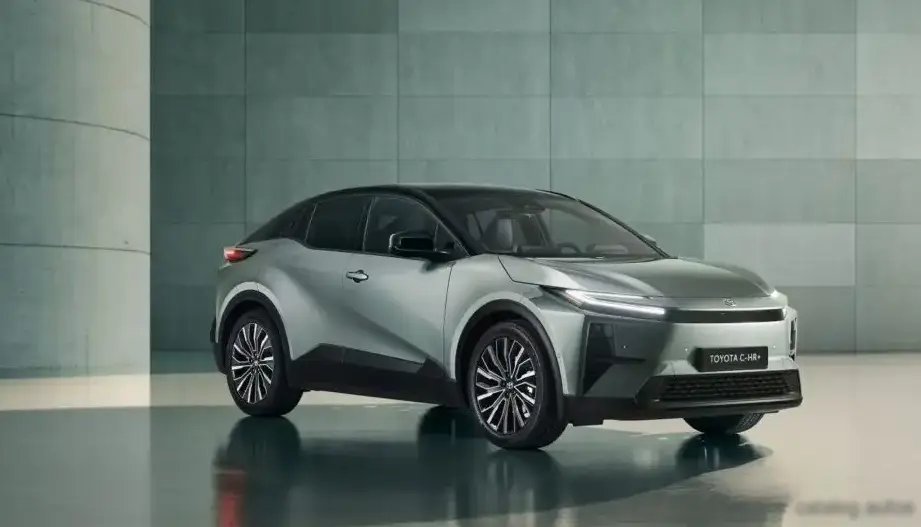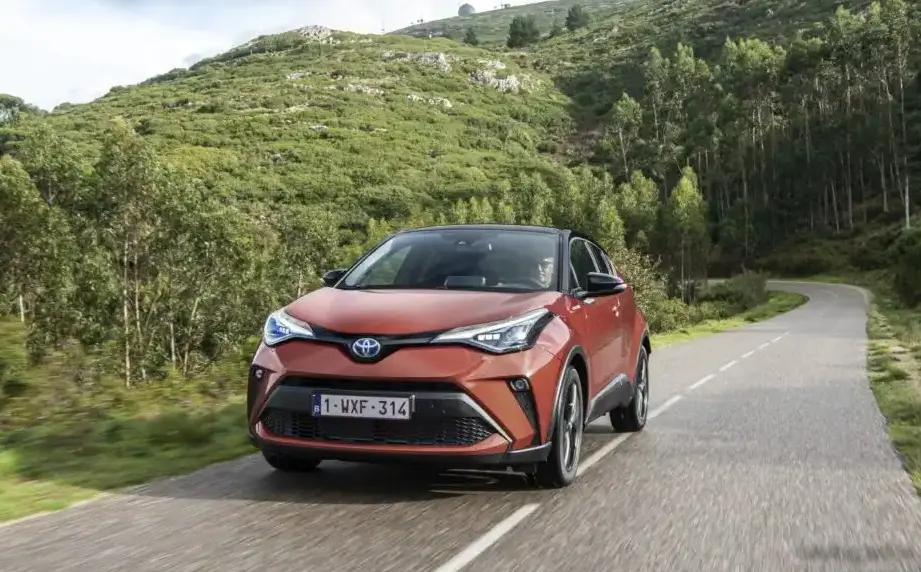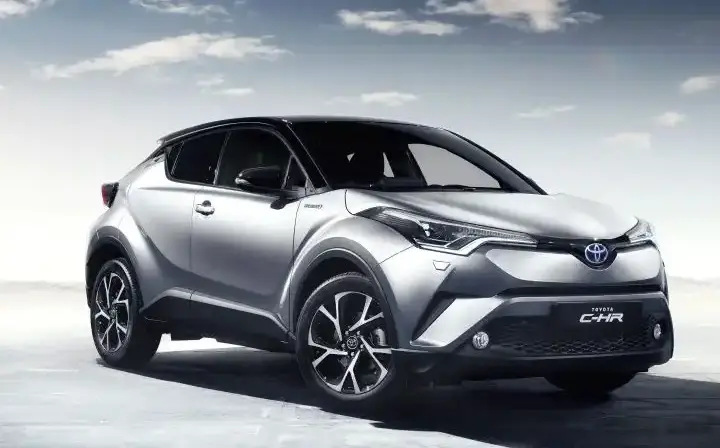
The Toyota C-HR 1.8 Hybrid, produced from 2016 to 2020, represents Toyota’s entry into the increasingly popular subcompact crossover segment. This variant, powered by a 1.8-liter gasoline engine paired with an electric motor and an e-CVT transmission, was a key component of the first-generation C-HR (NX50) lineup, built on the Toyota New Global Architecture (TNGA) platform. Positioned as the base model in many markets, it aimed to deliver fuel efficiency and affordability without sacrificing Toyota’s reputation for reliability. The C-HR, standing for “Compact High Rider,” was designed to appeal to a younger demographic seeking a stylish and practical urban vehicle.
Technical Specifications
| Brand | Toyota |
| Model | C-HR |
| Generation | C-HR I |
| Type (Engine) | 1.8 (122 Hp) Hybrid e-CVT |
| Start of production | 2016 |
| End of production | 2020 |
| Powertrain Architecture | FHEV (Full Hybrid Electric Vehicle) |
| Body type | SUV |
| Seats | 5 |
| Doors | 5 |
| Fuel consumption (urban) | 3.4 l/100 km (69.2 US mpg, 83.1 UK mpg, 29.4 km/l) |
| Fuel consumption (extra urban) | 4.1 l/100 km (57.4 US mpg, 68.9 UK mpg, 24.4 km/l) |
| Fuel consumption (combined) | 3.8 l/100 km (61.9 US mpg, 74.3 UK mpg, 26.3 km/l) |
| CO2 emissions | 86 g/km |
| Fuel Type | Petrol (Gasoline) |
| Acceleration 0 – 100 km/h | 11 sec |
| Acceleration 0 – 62 mph | 11 sec |
| Acceleration 0 – 60 mph | 10.5 sec |
| Maximum speed | 170 km/h (105.63 mph) |
| Emission standard | Euro 6 |
| Weight-to-power ratio | 11.3 kg/Hp, 88.4 Hp/tonne |
| Weight-to-torque ratio | 9.7 kg/Nm, 102.9 Nm/tonne |
| Battery voltage | 201.6 V |
| Battery technology | Nickel-metal hydride (NiMH) |
| Battery location | Under the rear seats |
| Electric motor power | 82 Hp |
| Electric motor Torque | 163 Nm (120.22 lb.-ft.) |
| Electric motor type | Synchronous |
| System power | 122 Hp |
| Internal combustion engine power | 99 Hp |
| Power per litre | 55.1 Hp/l |
| Torque | 142 Nm @ 3600 rpm (104.73 lb.-ft. @ 3600 rpm) |
| Engine layout | Front, Transverse |
| Engine Model/Code | 2ZR-FXE |
| Engine displacement | 1798 cm3 (109.72 cu. in.) |
| Number of cylinders | 4 |
| Engine configuration | Inline |
| Cylinder Bore | 80.5 mm (3.17 in.) |
| Piston Stroke | 88.3 mm (3.48 in.) |
| Compression ratio | 13.04:1 |
| Number of valves per cylinder | 4 |
| Fuel injection system | Multi-port manifold injection |
| Engine aspiration | Naturally aspirated engine |
| Valvetrain | DOHC |
| Engine oil capacity | 4.2 l (4.44 US qt | 3.7 UK qt) |
| Coolant | 5.4 l (5.71 US qt | 4.75 UK qt) |
| Kerb Weight | 1380-1460 kg (3042.38 – 3218.75 lbs.) |
| Max. weight | 1860 kg (4100.6 lbs.) |
| Max load | 400-480 kg (881.85 – 1058.22 lbs.) |
| Trunk (boot) space – minimum | 377 l (13.31 cu. ft.) |
| Fuel tank capacity | 43 l (11.36 US gal | 9.46 UK gal) |
| Permitted trailer load with brakes (12%) | 725 kg (1598.35 lbs.) |
| Permitted trailer load without brakes | 725 kg (1598.35 lbs.) |
| Length | 4360 mm (171.65 in.) |
| Width | 1795 mm (70.67 in.) |
| Height | 1555 mm (61.22 in.) |
| Wheelbase | 2640 mm (103.94 in.) |
| Front track | 1550 mm (61.02 in.) |
| Rear (Back) track | 1570 mm (61.81 in.) |
| Ride height (ground clearance) | 148 mm (5.83 in.) |
| Drag coefficient (Cd) | 0.32 |
| Minimum turning circle (turning diameter) | 10.4 m (34.12 ft.) |
| Approach angle | 14° |
| Drivetrain Architecture | The Internal combustion engine (ICE) and electric motor drive the front wheels of the car with the ability to work in full electric or mixed mode. |
| Drive wheel | Front wheel drive |
| Number of gears and type of gearbox | automatic transmission e-CVT |
| Front suspension | Independent type McPherson |
| Rear suspension | Double wishbone |
| Front brakes | Ventilated discs |
| Rear brakes | Disc |
| Assisting systems | ABS (Anti-lock braking system) |
| Steering type | Steering rack and pinion |
| Power steering | Electric Steering |
| Tires size | 215/65 R16; 215/60 R17; 225/50 R18 |
| Wheel rims size | 6.5J x 16; 6.5J x 17; 7J x 18 |
Powertrain & Engine Architecture
The heart of the C-HR 1.8 Hybrid is the 2ZR-FXE 1.8-liter inline-four cylinder gasoline engine. This engine utilizes Toyota’s Valvematic technology, a continuously variable valve lift system, to optimize efficiency and power delivery. It operates on the Atkinson cycle, which prioritizes fuel economy over outright power. The engine produces 99 horsepower and 142 Nm (104.73 lb-ft) of torque. Paired with this is an electric motor generating 82 horsepower and 163 Nm (120.22 lb-ft) of torque. The combined system output is 122 horsepower. The e-CVT (electronically controlled Continuously Variable Transmission) is not a traditional CVT with belts and pulleys. Instead, it’s a power-split device that seamlessly blends the output of the gasoline engine and electric motor, providing a smooth and linear driving experience. The Nickel-metal hydride (NiMH) battery pack is located under the rear seats, minimizing intrusion into passenger or cargo space.
Driving Characteristics
The C-HR 1.8 Hybrid e-CVT prioritizes fuel efficiency over sporty performance. Acceleration from 0-60 mph takes around 10.5 seconds, and 0-100 km/h in 11 seconds. The e-CVT transmission contributes to a very smooth, almost seamless acceleration feel, but it can sometimes feel less responsive than a traditional automatic or manual transmission, particularly during quick overtaking maneuvers. The electric motor provides instant torque, which helps to compensate for the relatively modest output of the gasoline engine, especially at lower speeds. The car excels in urban driving conditions, where the electric motor can frequently operate independently, resulting in near-silent and zero-emission driving. The gear ratios are optimized for efficiency, meaning the engine speed often remains relatively low during cruising, further enhancing fuel economy.
Equipment & Trim Levels
The C-HR 1.8 Hybrid typically came with a reasonable level of standard equipment. This included air conditioning, a touchscreen infotainment system with Bluetooth connectivity, a rearview camera, and Toyota Safety Sense, a suite of active safety features including pre-collision system, lane departure alert, and automatic high beams. Interior upholstery was typically cloth, with options for partial leather trim on higher trim levels. Optional extras included a panoramic sunroof, heated front seats, and upgraded audio systems. The dashboard layout was modern and driver-focused, with a distinctive central console design.
Chassis & Braking
The C-HR utilizes a McPherson strut front suspension and a double wishbone rear suspension, providing a comfortable and controlled ride. The front brakes are ventilated discs, while the rear brakes are solid discs. ABS (Anti-lock Braking System) is standard. The C-HR’s chassis was tuned to prioritize ride comfort and stability over outright handling prowess. Stabilizer bars were fitted to both the front and rear axles to reduce body roll during cornering. The relatively low curb weight (1380-1460 kg) helps to mitigate the effects of the modest engine output.
Market Reception & Comparison
The C-HR 1.8 Hybrid was generally well-received by critics for its fuel efficiency, stylish design, and comfortable ride. However, some reviewers criticized its relatively slow acceleration and lack of engaging driving dynamics. Compared to other trims in the C-HR lineup, such as the 1.2-liter turbocharged gasoline version, the hybrid offered superior fuel economy but less outright performance. Against competitors like the Nissan Qashqai and Kia Sportage, the C-HR stood out with its distinctive styling and hybrid powertrain, but often lagged behind in terms of interior space and practicality.
Legacy
The Toyota C-HR 1.8 Hybrid has proven to be a reliable and durable vehicle. The hybrid powertrain, in particular, has a strong reputation for longevity. On the used car market, these models continue to hold their value reasonably well, thanks to Toyota’s reputation for reliability and the increasing demand for fuel-efficient vehicles. While not a performance car, the C-HR 1.8 Hybrid remains a practical and economical choice for urban commuters and those seeking a stylish and well-equipped crossover.