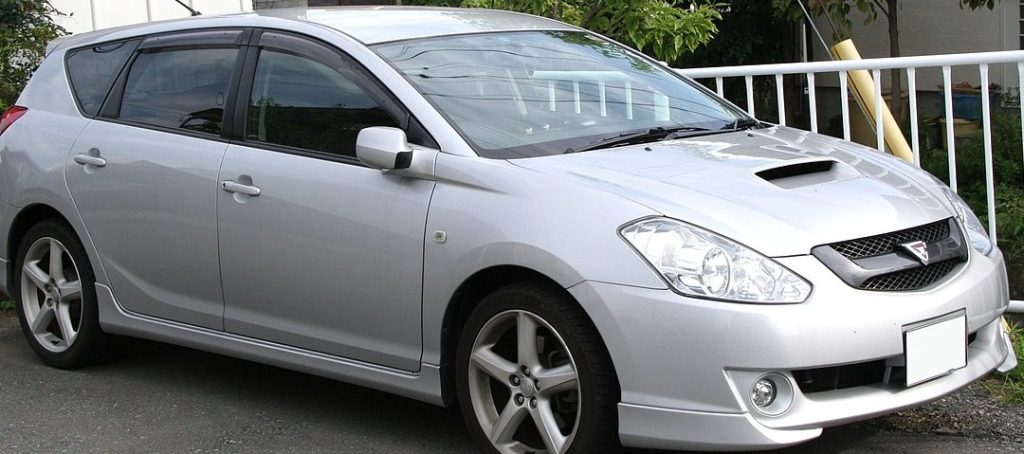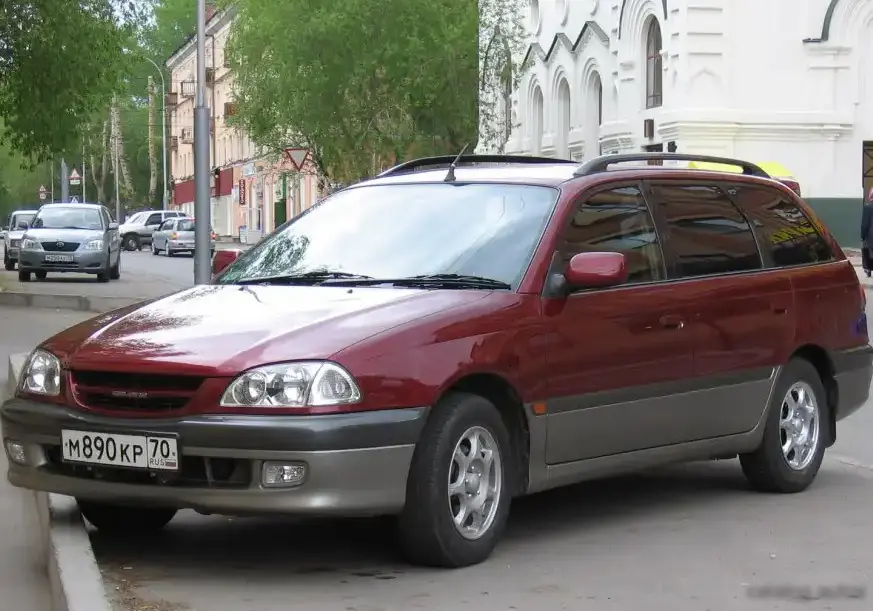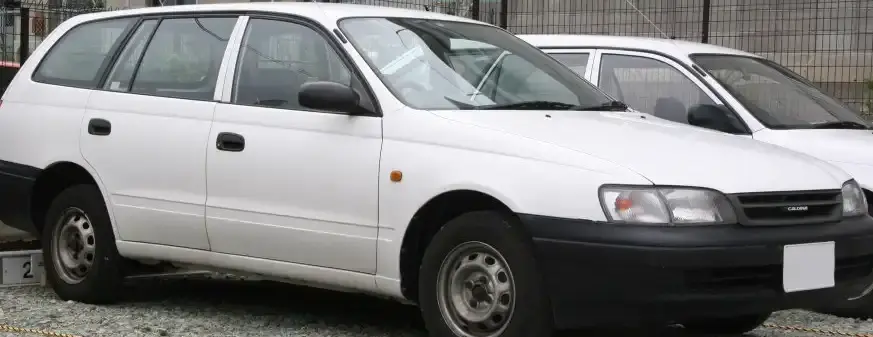
The Toyota Caldina (T19) 2.0 D Automatic, produced between 1992 and 1997, represents a practical and economical variant within the broader Caldina range. Positioned as an entry-level option, it catered to buyers seeking the spaciousness of a station wagon with the fuel efficiency of a diesel engine. The T19 generation Caldina, built on Toyota’s platform, was primarily marketed in Japan as a versatile vehicle suitable for families and commercial use, offering a blend of practicality and reliability. This particular 2.0 D Automatic model aimed for affordability and ease of use, distinguishing itself from the more performance-oriented gasoline variants.
Technical Specifications
| Brand | Toyota |
| Model | Caldina |
| Generation | Caldina (T19) |
| Type (Engine) | 2.0 D (73 Hp) Automatic |
| Start of production | 1992 |
| End of production | 1997 |
| Powertrain Architecture | Internal Combustion engine |
| Body type | Station wagon (estate) |
| Seats | 5 |
| Doors | 5 |
| Fuel Type | Diesel |
| Weight-to-power ratio | 16.7 kg/Hp |
| Hp/tonne | 59.8 Hp/tonne |
| Weight-to-torque ratio | 9.2 kg/Nm |
| Nm/tonne | 108.2 Nm/tonne |
| Power | 73 Hp @ 4600 rpm |
| Power per litre | 37 Hp/l |
| Torque | 132 Nm @ 2800 rpm (97.36 lb.-ft. @ 2800 rpm) |
| Engine layout | Front, Transverse |
| Engine Model/Code | 2C |
| Engine displacement | 1974 cm3 (120.46 cu. in.) |
| Number of cylinders | 4 |
| Engine configuration | Inline |
| Cylinder Bore | 86 mm (3.39 in.) |
| Piston Stroke | 85 mm (3.35 in.) |
| Compression ratio | 23:1 |
| Number of valves per cylinder | 2 |
| Fuel injection system | Precombustion chamber injection |
| Engine aspiration | Naturally aspirated engine |
| Valvetrain | OHC |
| Engine oil capacity | 4.3 l (4.54 US qt | 3.78 UK qt) |
| Coolant | 7 l (7.4 US qt | 6.16 UK qt) |
| Kerb Weight | 1220 kg (2689.64 lbs.) |
| Max. weight | 1495 kg (3295.91 lbs.) |
| Max load | 275 kg (606.27 lbs.) |
| Fuel tank capacity | 60 l (15.85 US gal | 13.2 UK gal) |
| Length | 4545 mm (178.94 in.) |
| Width | 1695 mm (66.73 in.) |
| Height | 1450 mm (57.09 in.) |
| Wheelbase | 2580 mm (101.57 in.) |
| Front track | 1465 mm (57.68 in.) |
| Rear track | 1450 mm (57.09 in.) |
| Drivetrain Architecture | The Internal combustion engine (ICE) drives the front wheels of the vehicle. |
| Drive wheel | Front wheel drive |
| Number of gears | 4 |
| Gearbox type | automatic transmission |
| Front suspension | Spring Strut |
| Rear suspension | Coil spring |
| Front brakes | Ventilated discs |
| Rear brakes | Drum |
| Assisting systems | ABS (Anti-lock braking system) |
| Steering type | Steering rack and pinion |
| Power steering | Hydraulic Steering |
| Tires size | 185/65 R14 S |
| Wheel rims size | 14 |
Powertrain & Engine Architecture
The heart of the Caldina 2.0 D Automatic is the 2C diesel engine, a 1.974-liter inline-four cylinder unit. This engine utilizes a precombustion chamber injection system, a common design for diesel engines of the era, which improves combustion efficiency and reduces noise compared to direct injection systems. The 2C engine is known for its robustness and relatively simple design, contributing to its longevity. The engine produces 73 horsepower at 4600 rpm and 132 Nm (97.36 lb-ft) of torque at 2800 rpm. The automatic transmission is a conventional 4-speed unit, chosen for its ease of use and suitability for urban driving. While not particularly sophisticated, it was a reliable unit designed to handle the engine’s torque output.
Driving Characteristics
The 2.0 D Automatic Caldina offered a comfortable, if not particularly exciting, driving experience. The 73 hp output and the characteristics of the automatic transmission meant acceleration was modest. The focus was on fuel economy and smooth, predictable power delivery. The automatic transmission, while convenient, did result in some power loss compared to the available manual transmission options. Gear ratios were optimized for everyday driving, prioritizing fuel efficiency over outright performance. Compared to the gasoline-powered Caldinas, the diesel model lacked the responsiveness and higher top speed, but it excelled in providing low-end torque, making it suitable for carrying loads or navigating hilly terrain.
Equipment & Trim Levels
The 2.0 D Automatic trim level typically included basic amenities such as power steering, a radio/cassette player, and cloth upholstery. Air conditioning was often an optional extra. Interior appointments were functional and durable, reflecting the vehicle’s practical focus. The dashboard layout was straightforward, with clearly labeled controls. Higher trim levels of the Caldina offered features like alloy wheels, upgraded audio systems, and more luxurious interior materials, but the 2.0 D Automatic remained the most affordable entry point into the Caldina range.
Chassis & Braking
The Caldina 2.0 D Automatic featured a front-engine, front-wheel-drive layout. Suspension consisted of a spring strut setup at the front and a coil spring arrangement at the rear. The braking system utilized ventilated discs on the front wheels and drum brakes on the rear, a common configuration for vehicles in this class during the 1990s. An Anti-lock Braking System (ABS) was included as a safety feature. The chassis was designed to provide a comfortable ride while maintaining reasonable handling characteristics. Stabilizer bars were present to reduce body roll during cornering.
Market Reception & Comparison
The Toyota Caldina 2.0 D Automatic was well-received in its primary market, Japan, as a practical and reliable family vehicle. Critics praised its fuel efficiency and spacious interior. Compared to other diesel station wagons available at the time, the Caldina offered a good balance of features and affordability. The diesel engine provided significantly better fuel economy than the gasoline alternatives, making it a popular choice for drivers covering long distances. However, the lower power output and slower acceleration were noted as drawbacks compared to the more powerful gasoline models. Maintenance costs were generally lower for the diesel variant due to the engine’s robust design and simpler mechanicals.
Legacy
The Toyota Caldina 2.0 D Automatic has proven to be a durable and reliable vehicle, with many examples still on the road today. The 2C diesel engine is known for its longevity, provided it receives regular maintenance. In the used car market, these Caldinas are often sought after for their practicality and affordability. While not a collector’s item, they represent a solid and dependable choice for buyers seeking a spacious and economical station wagon. The simplicity of the powertrain makes it relatively easy and inexpensive to repair, contributing to its continued popularity among those seeking a no-frills, reliable vehicle.