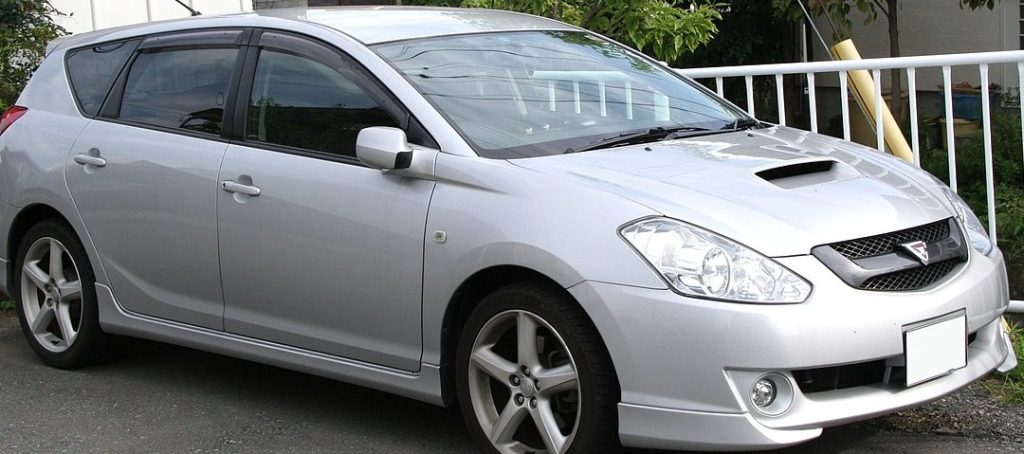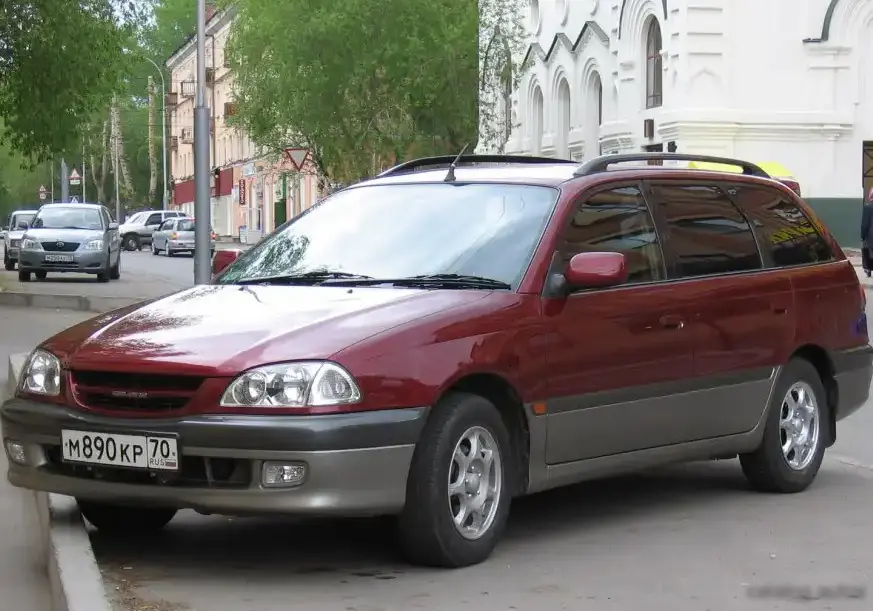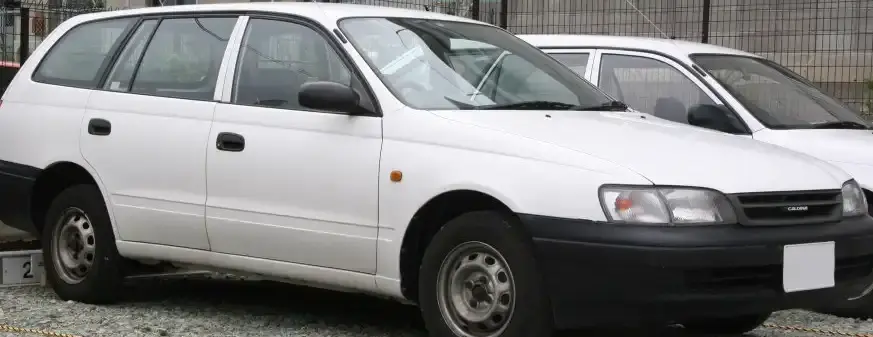
The Toyota Caldina, specifically the T19 generation produced between 1992 and 1997, was a station wagon designed primarily for the Japanese domestic market (JDM). Positioned as a practical and versatile vehicle, the Caldina aimed to offer a blend of passenger comfort, cargo space, and all-weather capability. The 2.0i 16V CZ variant, equipped with the 3S-FE engine and a four-wheel-drive system, represented a mid-range offering within the Caldina lineup, appealing to buyers seeking a balance between performance and fuel efficiency. This model was a popular choice for families and individuals needing a reliable and spacious vehicle for both daily commuting and recreational activities.
Technical Specifications
| Brand | Toyota |
| Model | Caldina |
| Generation | Caldina (T19) |
| Type | 2.0i 16V CZ (128 Hp) 4WD |
| Start of production | 1992 |
| End of production | 1997 |
| Powertrain Architecture | Internal Combustion engine |
| Body type | Station wagon (estate) |
| Seats | 5 |
| Doors | 5 |
| Fuel consumption (urban) | 13.5 l/100 km (17.4 US mpg, 20.9 UK mpg) |
| Fuel consumption (extra urban) | 10 l/100 km (23.5 US mpg, 28.2 UK mpg) |
| Fuel Type | Petrol (Gasoline) |
| Weight-to-power ratio | 10.2 kg/Hp |
| Weight-to-torque ratio | 7.3 kg/Nm |
| Power | 128 Hp @ 5600 rpm |
| Power per litre | 64.1 Hp/l |
| Torque | 179 Nm @ 4400 rpm (132.02 lb.-ft. @ 4400 rpm) |
| Engine layout | Front, Transverse |
| Engine Model/Code | 3S-FE |
| Engine displacement | 1998 cm3 (121.93 cu. in.) |
| Number of cylinders | 4 |
| Engine configuration | Inline |
| Cylinder Bore | 86 mm (3.39 in.) |
| Piston Stroke | 86 mm (3.39 in.) |
| Compression ratio | 9.8:1 |
| Number of valves per cylinder | 4 |
| Fuel injection system | Multi-port manifold injection |
| Engine aspiration | Naturally aspirated engine |
| Valvetrain | DOHC |
| Engine oil capacity | 3.9 l (4.12 US qt | 3.43 UK qt) |
| Coolant capacity | 6.5 l (6.87 US qt | 5.72 UK qt) |
| Kerb Weight | 1310 kg (2888.06 lbs.) |
| Max. weight | 1585 kg (3494.33 lbs.) |
| Max load | 275 kg (606.27 lbs.) |
| Fuel tank capacity | 60 l (15.85 US gal | 13.2 UK gal) |
| Length | 4545 mm (178.94 in.) |
| Width | 1695 mm (66.73 in.) |
| Height | 1470 mm (57.87 in.) |
| Wheelbase | 2580 mm (101.57 in.) |
| Front track | 1465 mm (57.68 in.) |
| Rear track | 1435 mm (56.5 in.) |
| Drive wheel | All wheel drive (4×4) |
| Number of gears | 5 |
| Gearbox type | Manual transmission |
| Front suspension | Spring Strut |
| Rear suspension | Coil spring |
| Front brakes | Ventilated discs |
| Rear brakes | Disc |
| Assisting systems | ABS (Anti-lock braking system) |
| Steering type | Steering rack and pinion |
| Power steering | Hydraulic Steering |
| Tires size | 185/65 R14 S |
Powertrain & Engine Architecture
The heart of the Caldina 2.0i CZ is the 3S-FE engine, a 2.0-liter inline-four cylinder gasoline engine. This engine is a naturally aspirated design, meaning it doesn’t utilize a turbocharger or supercharger. It features a double overhead camshaft (DOHC) valvetrain, operating 16 valves (four per cylinder), which contributes to its relatively good breathing and power output for its displacement. The 3S-FE employs multi-port fuel injection, delivering fuel directly into the intake ports for efficient combustion. The engine produces 128 horsepower at 5,600 rpm and 179 Nm (132 lb-ft) of torque at 4,400 rpm. The engine’s design prioritized reliability and ease of maintenance, making it a popular choice for long-term ownership. The transmission is a five-speed manual, offering drivers a direct connection to the engine and allowing for precise control over gear selection.
Driving Characteristics
The 2.0i 16V CZ Caldina offered a balanced driving experience. While not a performance-oriented model, the 128 hp engine provided adequate power for everyday driving and highway cruising. The five-speed manual transmission allowed drivers to keep the engine in its optimal power band, resulting in responsive acceleration. Compared to the higher-output variants, such as those with larger engines or turbocharging, the 2.0i felt less eager to accelerate, but it also offered better fuel economy. The all-wheel-drive system provided enhanced traction in various weather conditions, making it a practical choice for regions with snow or rain. The gear ratios were tuned for a blend of acceleration and fuel efficiency, with a relatively tall fifth gear for comfortable highway driving.
Equipment & Trim Levels
The Caldina 2.0i 16V CZ typically came equipped with a reasonable level of standard features. Interior appointments included cloth upholstery, a basic audio system, and power windows. Air conditioning was a common feature, and some models included power door locks and mirrors. The dashboard layout was functional and straightforward, prioritizing usability over luxury. Optional extras could include alloy wheels, upgraded audio systems, and a sunroof. The trim level of the 2.0i CZ positioned it as a mid-range offering, bridging the gap between the more basic models and the higher-specification variants.
Chassis & Braking
The Caldina’s chassis was designed for comfort and stability. The front suspension utilized a MacPherson strut setup, while the rear employed a coil spring arrangement. This combination provided a comfortable ride quality, absorbing bumps and irregularities in the road surface effectively. The braking system featured ventilated discs on the front wheels and solid discs on the rear, providing adequate stopping power for the vehicle’s weight and performance. An anti-lock braking system (ABS) was included as a standard safety feature, enhancing braking control in emergency situations. The all-wheel-drive system contributed to improved handling and stability, particularly on slippery surfaces.
Market Reception & Comparison
The Toyota Caldina 2.0i 16V CZ was generally well-received in the Japanese market. Critics praised its practicality, reliability, and all-weather capability. Compared to other station wagons in its class, the Caldina offered a competitive level of features and performance. The 2.0i variant was often seen as a sensible choice for buyers who didn’t require the extra power of the larger-engined models but still wanted a capable and versatile vehicle. Fuel economy was a strong point, making it an attractive option for daily commuting. Reliability was also a key factor, with the 3S-FE engine being known for its durability.
Legacy
The Toyota Caldina T19 generation, including the 2.0i 16V CZ variant, has developed a loyal following among enthusiasts. The 3S-FE engine is known for its robustness and relatively simple maintenance requirements. While not a high-performance engine, it is capable of providing years of reliable service with proper care. In the used car market, Caldinas in good condition are sought after for their practicality, durability, and classic JDM appeal. The all-wheel-drive system remains a valuable asset, particularly in regions with challenging weather conditions. The Caldina represents a well-engineered and thoughtfully designed station wagon that continues to offer a compelling blend of functionality and reliability.