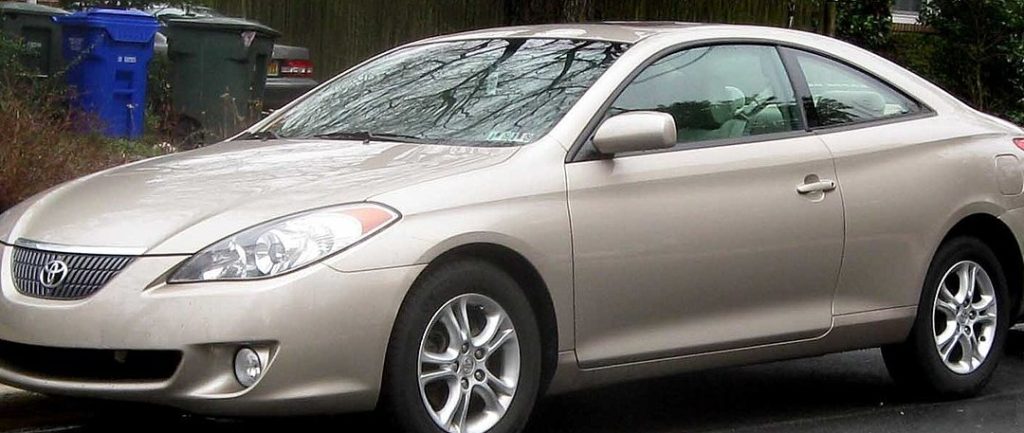
The Toyota Camry Solara, launched in 1998 as part of the fifth-generation Camry (XV20 platform), represented Toyota’s foray into the coupe market. Positioned as a more stylish and sporty alternative to the traditional Camry sedan, the Solara aimed to attract buyers seeking a personal luxury coupe without sacrificing Toyota’s renowned reliability. The 3.0i V6 24V variant, produced from 1998 to 2001, was the top-of-the-line offering, boasting a 200 horsepower V6 engine. It occupied the premium segment of the Solara lineup, offering a significant performance upgrade over the base 2.2-liter four-cylinder model. This generation Solara was exclusively sold in North America, primarily targeting the US and Canadian markets.
Technical Specifications
| Brand | Toyota |
| Model | Camry |
| Generation | Camry Solara I (Mark V) |
| Type (Engine) | 3.0i V6 24V (200 Hp) |
| Start of production | 1998 |
| End of production | 2001 |
| Powertrain Architecture | Internal Combustion engine |
| Body type | Coupe |
| Seats | 5 |
| Doors | 2 |
| Fuel consumption (urban) | 11.2 l/100 km (21 US mpg) |
| Fuel consumption (extra urban) | 8.4 l/100 km (28 US mpg) |
| Fuel Type | Petrol (Gasoline) |
| Weight-to-power ratio | 7.3 kg/Hp |
| Weight-to-torque ratio | 5.1 kg/Nm |
| Power | 200 Hp @ 5200 rpm |
| Power per litre | 66.8 Hp/l |
| Torque | 290 Nm @ 4400 rpm (213.89 lb.-ft. @ 4400 rpm) |
| Engine layout | Front, Transverse |
| Engine Model/Code | 1MZ-FE |
| Engine displacement | 2994 cm3 (182.71 cu. in.) |
| Number of cylinders | 6 |
| Engine configuration | V-engine |
| Cylinder Bore | 87.5 mm (3.44 in.) |
| Piston Stroke | 83 mm (3.27 in.) |
| Compression ratio | 10.5:1 |
| Number of valves per cylinder | 4 |
| Fuel injection system | Multi-port manifold injection |
| Engine aspiration | Naturally aspirated engine |
| Valvetrain | DOHC |
| Engine oil capacity | 4.7 l (4.97 US qt | 4.14 UK qt) |
| Coolant | 9.2 l (9.72 US qt | 8.09 UK qt) |
| Kerb Weight | 1465 kg (3229.77 lbs.) |
| Trunk (boot) space | 399 l (14.09 cu. ft.) |
| Fuel tank capacity | 70 l (18.49 US gal | 15.4 UK gal) |
| Length | 4826 mm (190 in.) |
| Width | 1806 mm (71.1 in.) |
| Height | 1400 mm (55.12 in.) |
| Wheelbase | 2670 mm (105.12 in.) |
| Front track | 1544 mm (60.79 in.) |
| Rear track | 1519 mm (59.8 in.) |
| Ride height (ground clearance) | 135 mm (5.31 in.) |
| Drag coefficient (Cd) | 0.31 |
| Minimum turning circle | 11.6 m (38.06 ft.) |
| Drivetrain Architecture | Front wheel drive |
| Number of gears | 5 |
| Gearbox type | Manual transmission |
| Front suspension | Independent, McPherson with coil spring and anti-roll bar |
| Rear suspension | Independent multi-link spring suspension with stabilizer |
| Front brakes | Ventilated discs |
| Rear brakes | Disc |
| Assisting systems | ABS (Anti-lock braking system) |
| Steering type | Steering rack and pinion |
| Power steering | Hydraulic |
| Tires size | 205/65 R15; 205/60 R16 |
| Wheel rims size | 15; 16 |
Powertrain & Engine Architecture
The heart of the 3.0i Solara was the 1MZ-FE engine, a 3.0-liter (2994 cc) DOHC 24-valve V6. This engine was a mainstay in Toyota’s lineup during the late 1990s and early 2000s, known for its smooth operation and reliability. The 1MZ-FE utilized a cast iron block with an aluminum cylinder head, a common configuration for balancing durability and weight. Fuel delivery was handled by a multi-port fuel injection system, providing precise fuel metering for optimal combustion. The engine featured a timing belt, requiring periodic replacement as part of scheduled maintenance. The five-speed manual transmission offered with this variant provided a direct connection to the engine, allowing for spirited driving. The transmission’s gear ratios were tuned to balance acceleration and fuel efficiency, with a relatively tall fifth gear for highway cruising.
Driving Characteristics
The 3.0i Solara with the five-speed manual transmission offered a noticeably more engaging driving experience than the base four-cylinder model. The 200 horsepower and 290 Nm (213.89 lb-ft) of torque provided ample power for both city driving and highway passing. While not a dedicated sports car, the Solara V6 delivered brisk acceleration and a responsive feel. The manual transmission allowed drivers to fully exploit the engine’s powerband, while the well-tuned suspension provided a comfortable yet controlled ride. Compared to the automatic transmission option, the manual offered better fuel economy and a more direct connection to the driving experience. The gear ratios were well-matched to the engine’s characteristics, providing strong pull throughout the rev range.
Equipment & Trim Levels
The 3.0i Solara typically came standard with features such as air conditioning, power windows and locks, a CD player, and alloy wheels. Higher trim levels added features like leather upholstery, a sunroof, upgraded audio systems, and automatic climate control. The interior design was focused on comfort and convenience, with supportive seats and a user-friendly layout. Optional extras included a premium sound system, heated seats, and a navigation system. The Solara aimed to provide a luxurious experience without the price tag of European grand tourers.
Chassis & Braking
The Solara utilized a front-wheel-drive chassis with an independent McPherson strut suspension in the front and an independent multi-link suspension in the rear. This setup provided a good balance of ride comfort and handling. The 3.0i model featured ventilated disc brakes in the front and solid disc brakes in the rear, providing adequate stopping power for its weight and performance. Anti-lock brakes (ABS) were standard, enhancing safety and control during emergency braking situations. The suspension was tuned for a comfortable ride, but also offered reasonable handling characteristics for a personal luxury coupe.
Market Reception & Comparison
The Toyota Camry Solara 3.0i V6 was generally well-received by automotive critics. It was praised for its smooth engine, comfortable ride, and Toyota’s reputation for reliability. However, some critics noted that it lacked the sporty handling of some of its competitors, such as the Honda Prelude or the Nissan Maxima. Compared to the base 2.2-liter Solara, the 3.0i offered a significant performance upgrade, but at a higher price point. Fuel economy was reasonable for a V6-powered coupe, but not class-leading. The Solara’s main appeal lay in its combination of style, comfort, and Toyota’s renowned dependability.
Legacy
The 1MZ-FE engine, found in the 3.0i Solara, is known for its longevity and relatively low maintenance requirements. With proper care, these engines can reliably exceed 200,000 miles. The Solara itself has become a popular choice among enthusiasts seeking an affordable and reliable coupe. On the used car market, the 3.0i V6 models command a premium over the base four-cylinder versions. While not a collector’s item, the Solara remains a well-regarded and practical coupe that offers a comfortable and enjoyable driving experience. The Solara’s design, while somewhat dated by today’s standards, still holds a certain appeal, and its reputation for reliability ensures its continued presence on roads today.