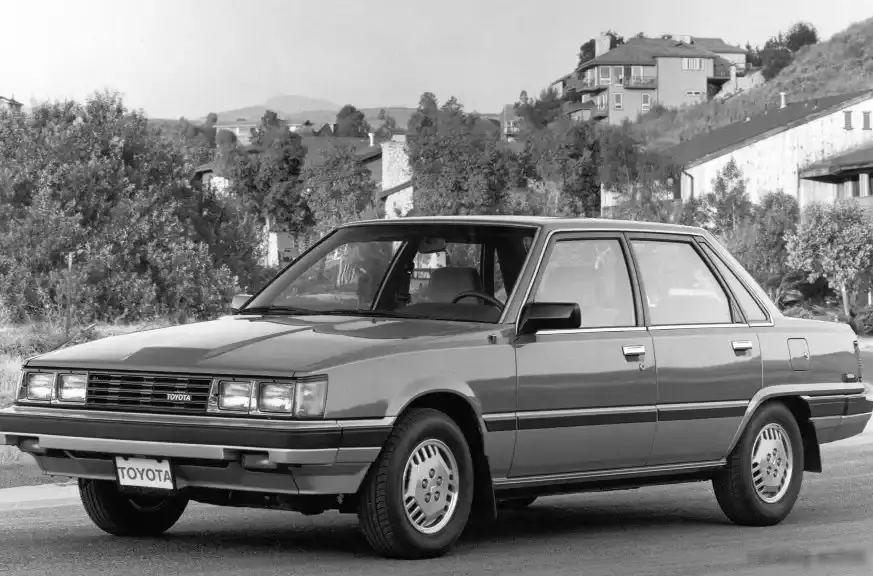
Technical Specifications
| Brand | Toyota |
| Model | Camry |
| Generation | Camry V (XV30) |
| Type (Engine) | 2.4 16V (157 Hp) Automatic |
| Start of production | 2001 |
| End of production | 2004 |
| Powertrain Architecture | Internal Combustion engine |
| Body type | Sedan |
| Seats | 5 |
| Doors | 4 |
| Fuel consumption (urban) | 10.2 l/100 km (23.1 US mpg) |
| Fuel consumption (extra urban) | 7.3 l/100 km (32.2 US mpg) |
| Fuel Type | Petrol (Gasoline) |
| Weight-to-power ratio | 9.1 kg/Hp |
| Weight-to-torque ratio | 6.5 kg/Nm |
| Power | 157 Hp @ 5600 rpm |
| Power per litre | 66.5 Hp/l |
| Torque | 218 Nm @ 3800 rpm (160.79 lb.-ft. @ 3800 rpm) |
| Engine layout | Front, Transverse |
| Engine Model/Code | 2AZ-FE |
| Engine displacement | 2362 cm3 (144.14 cu. in.) |
| Number of cylinders | 4 |
| Engine configuration | Inline |
| Cylinder Bore | 88.5 mm (3.48 in.) |
| Piston Stroke | 96 mm (3.78 in.) |
| Compression ratio | 9.6:1 |
| Number of valves per cylinder | 4 |
| Fuel injection system | Multi-port manifold injection |
| Engine aspiration | Naturally aspirated engine |
| Valvetrain | DOHC |
| Engine oil capacity | 3.8 l (4.02 US qt | 3.34 UK qt) |
| Coolant capacity | 6.2 l (6.55 US qt | 5.46 UK qt) |
| Kerb Weight | 1425 kg (3141.59 lbs.) |
| Trunk (boot) space | 472 l (16.67 cu. ft.) |
| Fuel tank capacity | 70 l (18.49 US gal | 15.4 UK gal) |
| Length | 4805 mm (189.17 in.) |
| Width | 1795 mm (70.67 in.) |
| Height | 1470 mm (57.87 in.) |
| Wheelbase | 2720 mm (107.09 in.) |
| Front track | 1544 mm (60.79 in.) |
| Rear track | 1534 mm (60.39 in.) |
| Ride height (ground clearance) | 137 mm (5.39 in.) |
| Drag coefficient (Cd) | 0.28 |
| Minimum turning circle | 11.1 m (36.42 ft.) |
| Drivetrain Architecture | Front wheel drive |
| Number of gears | 4 |
| Gearbox type | Automatic transmission ECT-i |
| Front suspension | Independent, type McPherson with coil spring and anti-roll bar |
| Rear suspension | Independent multi-link spring suspension with stabilizer |
| Front brakes | Ventilated discs |
| Rear brakes | Drum |
| Assisting systems | ABS (Anti-lock braking system) |
| Steering type | Steering rack and pinion |
| Power steering | Hydraulic Steering |
| Tires size | 205/65 R15 |
| Wheel rims size | 6.5J x 15 |
The 2001-2004 Toyota Camry XV30 with the 2.4-liter engine and automatic transmission was a cornerstone of Toyota’s sales success in North America and other markets. This generation Camry represented a move upmarket in terms of refinement and features, while retaining the core values of reliability and practicality that had made the Camry a household name. The 2.4L engine and automatic transmission combination was positioned as the mainstream offering, appealing to buyers who prioritized ease of use and fuel efficiency over outright performance. It sat below the more powerful 3.0-liter V6 option, and above the base 2.2-liter engine (available in some markets).
Powertrain & Engine Architecture
The heart of this Camry variant is the 2AZ-FE 2.4-liter inline-four cylinder engine. This engine utilizes a cast iron block with an aluminum cylinder head, a common configuration for balancing durability and weight. The 2AZ-FE features a double overhead camshaft (DOHC) valvetrain with four valves per cylinder, contributing to its relatively good power output for its displacement. Fuel delivery is handled by a multi-port fuel injection system, providing precise fuel metering for optimal combustion. The engine produces 157 horsepower at 5600 rpm and 218 Nm (160.79 lb-ft) of torque at 3800 rpm. The engine is transversely mounted, driving the front wheels. Paired with the 2AZ-FE is a four-speed automatic transmission, designated ECT-i (Electronically Controlled Transmission – intelligent). This transmission offers smooth shifts and is designed to optimize fuel efficiency. The ECT-i transmission also includes a “hold” function, allowing the driver to maintain a lower gear for more aggressive driving or engine braking.
Driving Characteristics
The Camry 2.4 Automatic delivers a comfortable and predictable driving experience. While not particularly sporty, it provides adequate acceleration for everyday driving situations. The four-speed automatic transmission is tuned for smooth shifts and fuel economy, rather than aggressive performance. Compared to the manual transmission versions of the 2.4L Camry, the automatic sacrifices some responsiveness, but gains in convenience. The gear ratios are optimized for cruising, making it a pleasant vehicle for highway driving. The 0-60 mph time is estimated to be around 9-10 seconds, which was competitive for its class at the time. Compared to the 3.0-liter V6 models, the 2.4L automatic is noticeably slower, but offers significantly better fuel economy.
Equipment & Trim Levels
The Camry 2.4 Automatic was typically offered in several trim levels, including CE, LE, and XLE. The base CE model included standard features such as air conditioning, power windows and locks, and an AM/FM stereo. The LE trim added features like upgraded upholstery, cruise control, and a CD player. The top-of-the-line XLE trim included leather upholstery, a power driver’s seat, and alloy wheels. Optional extras available on this variant included a sunroof, upgraded audio system, and side airbags. Interior upholstery was typically cloth on the CE and LE trims, with leather available on the XLE. The dashboard layout was functional and straightforward, prioritizing ease of use.
Chassis & Braking
The Camry XV30 utilizes an independent McPherson strut suspension in the front and an independent multi-link suspension in the rear. This suspension setup provides a comfortable ride and good handling characteristics. The front suspension incorporates a coil spring and anti-roll bar to reduce body roll during cornering. The rear suspension also features a stabilizer bar. Braking duties are handled by ventilated discs in the front and drum brakes in the rear. Anti-lock brakes (ABS) were standard equipment, enhancing safety. The steering system is a rack-and-pinion setup with hydraulic power assist, providing precise and responsive steering feel.
Market Reception & Comparison
The Camry 2.4 Automatic was well-received by critics and consumers alike. It was praised for its reliability, comfortable ride, and spacious interior. Fuel economy was also a strong point, with the 2.4L engine achieving around 23 mpg in the city and 32 mpg on the highway. Compared to competitors like the Honda Accord and Nissan Altima, the Camry was often seen as the more reliable and refined option. However, some critics noted that the Camry’s styling was somewhat conservative and that its driving dynamics were not as engaging as some of its rivals. The 2.4L engine offered a good balance between fuel efficiency and performance, making it a popular choice for buyers who didn’t need the extra power of the V6.
Legacy
The Toyota Camry XV30 2.4 Automatic has proven to be a remarkably durable and reliable vehicle. Many examples are still on the road today, often with high mileage. The 2AZ-FE engine is known for its longevity and relatively low maintenance costs. Common issues are typically related to age and wear, such as oil leaks and worn suspension components. In the used car market, this variant remains a popular choice for budget-conscious buyers seeking a dependable and practical sedan. Its reputation for reliability and affordability continues to make it a desirable option, even two decades after its production ended.