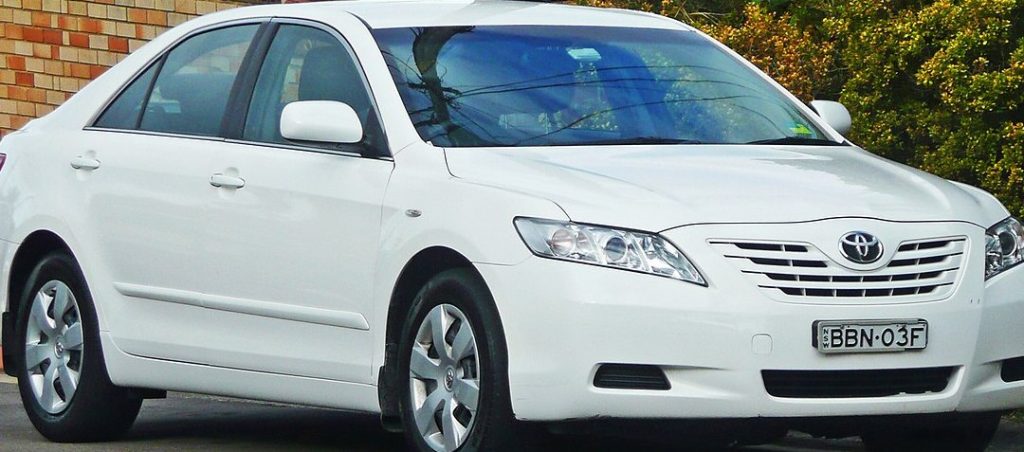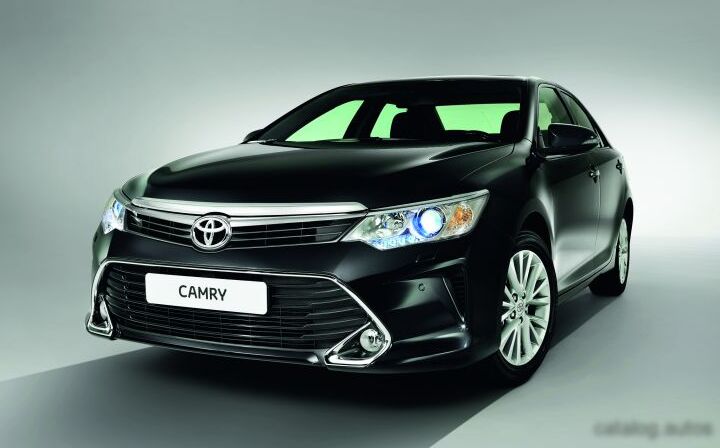
The Toyota Camry VII (XV50), specifically the facelifted model produced from 2014 to 2017, represented a significant evolution of Toyota’s best-selling mid-size sedan. Within the XV50 generation, the 2.5-liter (181 horsepower) variant paired with a 6-speed automatic transmission occupied a sweet spot in the lineup, offering a balance of performance, fuel efficiency, and comfort. This configuration was positioned as the mainstream offering, appealing to a broad customer base seeking a reliable and well-equipped family sedan. It sat above the base 2.5-liter model and below the hybrid variants in terms of price and features.
Technical Specifications
| Brand | Toyota |
| Model | Camry |
| Generation | Camry VII (XV50, facelift 2014) |
| Type (Engine) | 2.5 (181 Hp) Automatic |
| Start of production | 2014 |
| End of production | 2017 |
| Powertrain Architecture | Internal Combustion engine |
| Body type | Sedan |
| Seats | 5 |
| Doors | 4 |
| Fuel consumption (urban) | 11 l/100 km (21.4 US mpg) |
| Fuel consumption (extra urban) | 5.9 l/100 km (39.9 US mpg) |
| Fuel consumption (combined) | 7.8 l/100 km (30.2 US mpg) |
| CO2 emissions | 183 g/km |
| Fuel Type | Petrol (Gasoline) |
| Acceleration 0 – 100 km/h | 9 sec |
| Acceleration 0 – 62 mph | 9 sec |
| Acceleration 0 – 60 mph | 8.6 sec |
| Maximum speed | 210 km/h (130.49 mph) |
| Emission standard | Euro 4 |
| Weight-to-power ratio | 7.9 kg/Hp |
| Weight-to-torque ratio | 6.2 kg/Nm |
| Power | 181 Hp @ 6000 rpm |
| Torque | 231 Nm @ 4100 rpm (170.38 lb.-ft. @ 4100 rpm) |
| Engine layout | Front, Transverse |
| Engine Model/Code | 2AR-FE |
| Engine displacement | 2494 cm3 (152.19 cu. in.) |
| Number of cylinders | 4 |
| Engine configuration | Inline |
| Cylinder Bore | 90 mm (3.54 in.) |
| Piston Stroke | 98 mm (3.86 in.) |
| Compression ratio | 10.4:1 |
| Number of valves per cylinder | 4 |
| Fuel injection system | Multi-port manifold injection |
| Engine aspiration | Naturally aspirated engine |
| Valvetrain | DOHC, Dual VVT-i |
| Engine oil capacity | 4.4 l (4.65 US qt | 3.87 UK qt) |
| Coolant capacity | 6.9 l (7.29 US qt | 6.07 UK qt) |
| Kerb Weight | 1435-1465 kg (3163.63 – 3229.77 lbs.) |
| Max. weight | 2100 kg (4629.71 lbs.) |
| Max load | 635-665 kg (1399.94 – 1466.07 lbs.) |
| Trunk (boot) space | 506 l (17.87 cu. ft.) |
| Fuel tank capacity | 70 l (18.49 US gal | 15.4 UK gal) |
| Length | 4850 mm (190.94 in.) |
| Width | 1825 mm (71.85 in.) |
| Height | 1480 mm (58.27 in.) |
| Wheelbase | 2775 mm (109.25 in.) |
| Front track | 1575 mm (62.01 in.) |
| Rear track | 1565 mm (61.61 in.) |
| Front overhang | 990 mm (38.98 in.) |
| Rear overhang | 1085 mm (42.72 in.) |
| Drag coefficient (Cd) | 0.281 |
| Minimum turning circle | 11 m (36.09 ft.) |
| Drivetrain Architecture | Front wheel drive |
| Number of gears | 6 |
| Gearbox type | Automatic transmission |
| Front suspension | Independent, type McPherson with coil spring and anti-roll bar |
| Rear suspension | Independent multi-link spring suspension with stabilizer |
| Front brakes | Ventilated discs |
| Rear brakes | Disc |
| Assisting systems | ABS (Anti-lock braking system) |
| Steering type | Steering rack and pinion |
| Power steering | Electric Steering |
Powertrain & Engine Architecture
The heart of this Camry variant is the 2AR-FE engine, a 2.5-liter inline-four cylinder gasoline engine. This engine utilizes a multi-port fuel injection system and is equipped with Toyota’s Dual VVT-i (Variable Valve Timing-intelligence) technology, optimizing valve timing for both intake and exhaust to improve efficiency and power delivery across the rev range. The 2AR-FE is a naturally aspirated engine, meaning it doesn’t rely on turbocharging or supercharging for increased power. The 6-speed automatic transmission, a common choice for this generation Camry, provides smooth and responsive shifting. It’s designed for comfortable daily driving rather than aggressive performance. The transmission’s gear ratios are tuned to prioritize fuel economy and relaxed cruising, with a focus on minimizing engine RPM at highway speeds.
Driving Characteristics
The 2.5-liter, 181-horsepower Camry Automatic delivers adequate performance for most everyday driving situations. Acceleration from 0-60 mph takes around 8.6 seconds, which is competitive within its class but noticeably slower than the V6-powered Camry or even the earlier 2.4L four-cylinder with a manual transmission. The automatic transmission contributes to a smooth and effortless driving experience, particularly in city traffic. However, drivers seeking a more engaging driving experience might find the transmission a bit hesitant to downshift quickly for overtaking maneuvers. The suspension is tuned for comfort, providing a relatively soft ride that absorbs bumps and imperfections in the road. Steering feel is light and precise, making it easy to maneuver in tight spaces.
Equipment & Trim Levels
The 2.5-liter Automatic Camry typically came standard with features such as air conditioning, power windows and locks, a basic audio system with CD player, and standard safety equipment like ABS, traction control, and multiple airbags. Higher trim levels, such as the XLE, added features like leather upholstery, a sunroof, upgraded audio systems (often with touchscreen displays), and advanced safety features like blind-spot monitoring and rear cross-traffic alert. Optional extras included navigation systems, premium sound systems, and various appearance packages.
Chassis & Braking
The Camry XV50 utilizes a front-wheel-drive layout with an independent McPherson strut suspension in the front and an independent multi-link suspension in the rear. This suspension setup provides a good balance of ride comfort and handling. Braking duties are handled by ventilated discs in the front and solid discs in the rear. ABS (Anti-lock Braking System) is standard, enhancing braking performance and stability, especially in emergency situations. The brake system is adequate for the vehicle’s weight and performance capabilities, providing reliable stopping power.
Market Reception & Comparison
The 2.5-liter Camry Automatic was widely regarded as a sensible and practical choice for families and commuters. Critics praised its reliability, comfortable ride, and spacious interior. However, some reviewers noted that its acceleration was not particularly exciting compared to competitors or even higher-trim Camry models. Fuel economy was generally considered good for its class, averaging around 30 mpg in combined driving. Compared to the V6 Camry, the 2.5-liter model offered significantly better fuel economy but lacked the V6’s superior power and acceleration. Compared to the hybrid Camry, the 2.5-liter model was less fuel-efficient but offered a lower initial purchase price.
Legacy
The 2AR-FE engine, when paired with the 6-speed automatic transmission, has proven to be a remarkably reliable powertrain. Camry models equipped with this combination are known for their longevity and relatively low maintenance costs. In the used car market, these Camrys continue to be popular choices due to their reputation for dependability and affordability. While not a performance standout, the 2.5-liter Automatic Camry remains a practical and trustworthy option for buyers seeking a comfortable and reliable mid-size sedan.