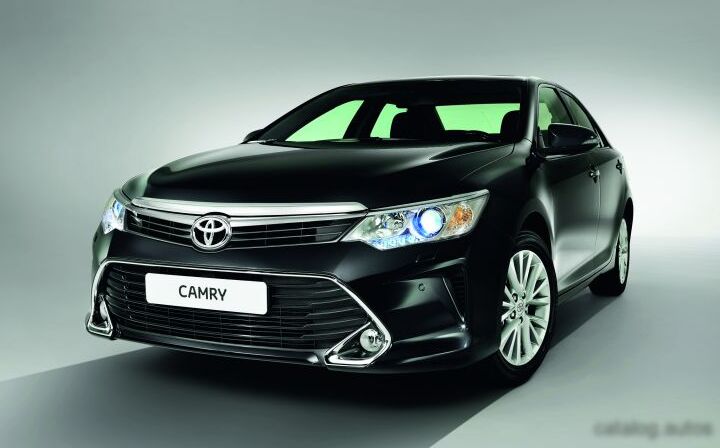
The Toyota Camry VII (XV50), specifically the facelifted model produced from 2014 to 2017, represented a significant evolution of Toyota’s best-selling mid-size sedan. Within the XV50 generation, the 3.5-liter V6 engine paired with a six-speed automatic transmission occupied the top performance tier. This variant was positioned as the premium offering, catering to buyers seeking a blend of comfort, refinement, and robust power. The facelift brought revised styling, enhanced interior materials, and updated technology, solidifying the Camry’s reputation for reliability and value in the North American market, where sedans remained dominant.
Technical Specifications
| Brand | Toyota |
| Model | Camry |
| Generation | Camry VII (XV50, facelift 2014) |
| Type (Engine) | 3.5 V6 (268 Hp) Automatic |
| Start of production | 2014 |
| End of production | 2017 |
| Powertrain Architecture | Internal Combustion engine |
| Body type | Sedan |
| Seats | 5 |
| Doors | 4 |
| Fuel consumption (urban) | 11.2 l/100 km (21 US mpg) |
| Fuel consumption (extra urban) | 7.5 l/100 km (31.4 US mpg) |
| Fuel consumption (combined) | 9.4 l/100 km (25 US mpg) |
| Fuel Type | Petrol (Gasoline) |
| Weight-to-power ratio | 5.9 kg/Hp |
| Weight-to-torque ratio | 4.7 kg/Nm |
| Power | 268 Hp @ 6000 rpm |
| Power per litre | 77.5 Hp/l |
| Torque | 336 Nm @ 4700 rpm (247.82 lb.-ft. @ 4700 rpm) |
| Engine layout | Front, Transverse |
| Engine Model/Code | 2GR-FE |
| Engine displacement | 3456 cm3 (210.9 cu. in.) |
| Number of cylinders | 6 |
| Engine configuration | V-engine |
| Cylinder Bore | 94 mm (3.7 in.) |
| Piston Stroke | 83 mm (3.27 in.) |
| Number of valves per cylinder | 4 |
| Fuel injection system | Multi-port manifold injection |
| Engine aspiration | Naturally aspirated engine |
| Valvetrain | DOHC, Dual VVT-i |
| Engine oil capacity | 6.1 l (6.45 US qt | 5.37 UK qt) |
| Coolant capacity | 8.8 l (9.3 US qt | 7.74 UK qt) |
| Kerb Weight | 1579 kg (3481.1 lbs.) |
| Trunk (boot) space | 436 l (15.4 cu. ft.) |
| Fuel tank capacity | 64 l (16.91 US gal | 14.08 UK gal) |
| Length | 4849 mm (190.91 in.) |
| Width | 1821 mm (71.69 in.) |
| Height | 1470 mm (57.87 in.) |
| Wheelbase | 2776 mm (109.29 in.) |
| Front track | 1595 mm (62.8 in.) |
| Rear track | 1585 mm (62.4 in.) |
| Ride height (ground clearance) | 155 mm (6.1 in.) |
| Drag coefficient (Cd) | 0.28 |
| Minimum turning circle | 11.1 m (36.42 ft.) |
| Drivetrain Architecture | Front wheel drive |
| Number of gears | 6 |
| Gearbox type | Automatic transmission ECT-i |
| Front suspension | Independent, type McPherson with coil spring and anti-roll bar |
| Rear suspension | Independent multi-link spring suspension with stabilizer |
| Front brakes | Ventilated discs |
| Rear brakes | Disc |
| Assisting systems | ABS (Anti-lock braking system) |
| Steering type | Steering rack and pinion |
| Power steering | Electric Steering |
| Tires size | P205/65 R16; 215/55 R17; 225/45 R18 |
| Wheel rims size | 16; 17; 18 |
Powertrain & Engine Architecture
The heart of this Camry variant is the 2GR-FE 3.5-liter V6 engine. This engine is a naturally aspirated, 60-degree V6 featuring a cast aluminum alloy block and cylinder heads. It utilizes a dual overhead camshaft (DOHC) design with Toyota’s Variable Valve Timing-intelligent (VVT-i) system on both intake and exhaust valves, optimizing performance and fuel efficiency across the rev range. Fuel delivery is managed by a multi-port fuel injection system. The 2GR-FE is known for its smooth operation and relatively high output for its displacement. Paired with the engine is a six-speed automatic transmission, designated ECT-i (Electronically Controlled Transmission – intelligent). This transmission features sequential shift capabilities and adapts to driving conditions for optimal gear selection. The transmission was designed to provide smooth shifts and contribute to the overall refined driving experience.
Driving Characteristics
The 3.5L V6 Camry delivers a noticeably more spirited driving experience compared to the four-cylinder models. With 268 horsepower and 248 lb-ft of torque, acceleration is brisk, and highway passing maneuvers are executed with ease. The six-speed automatic transmission is well-tuned, providing smooth and responsive shifts. While not a sports sedan, the V6 Camry offers a level of performance that many competitors in its class couldn’t match. The automatic transmission’s gear ratios are optimized for both acceleration and fuel economy, though the combined fuel economy of 25 mpg is lower than the four-cylinder variants. The suspension is tuned for comfort, providing a smooth ride over most road surfaces, but it doesn’t offer the same level of handling precision as some sportier sedans.
Equipment & Trim Levels
The 3.5L V6 Camry typically came equipped with a higher level of standard features than the base models. These often included leather upholstery, a premium audio system, automatic climate control, power-adjustable front seats, and alloy wheels. Optional extras could include a sunroof, navigation system, and advanced safety features like blind-spot monitoring and rear cross-traffic alert. Trim levels varied slightly depending on the year and region, but the V6 model consistently represented the most luxurious and well-equipped version of the Camry.
Chassis & Braking
The Camry XV50 utilizes a front-wheel-drive layout with an independent McPherson strut suspension in the front and an independent multi-link suspension in the rear. This suspension setup provides a comfortable ride and decent handling characteristics. Braking duties are handled by ventilated disc brakes in the front and solid disc brakes in the rear. Anti-lock braking system (ABS) is standard. The chassis is designed to balance ride comfort with handling stability, prioritizing a smooth and predictable driving experience over outright sportiness.
Market Reception & Comparison
The 3.5L V6 Camry was generally well-received by automotive critics. It was praised for its smooth and powerful engine, comfortable ride, and spacious interior. However, some reviewers noted that the fuel economy was lower than that of the four-cylinder models. Compared to competitors like the Honda Accord V6 and Nissan Maxima, the Camry V6 offered a similar level of performance and refinement, but often at a slightly lower price point. The Camry’s reputation for reliability also gave it an edge in the eyes of many buyers.
Legacy
The 2GR-FE engine, in general, has proven to be a remarkably durable and reliable powerplant. The Camry V6 variants from the XV50 generation continue to be sought after in the used car market, particularly by buyers who prioritize reliability and a smooth driving experience. While maintenance costs are slightly higher than those of the four-cylinder models due to the more complex engine, the 2GR-FE is known for its longevity and relatively few major issues. The combination of performance, comfort, and reliability has cemented the Camry V6’s place as a popular and respected mid-size sedan.