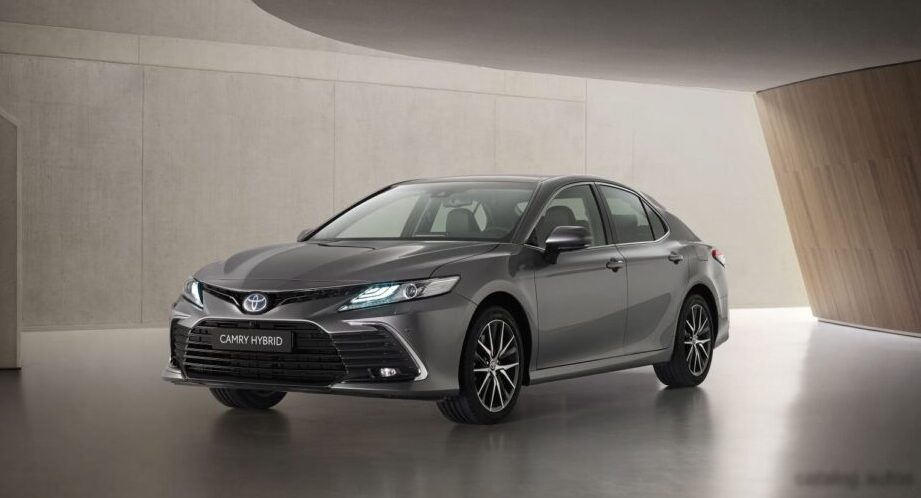
The Toyota Camry VIII (XV70), particularly the facelifted model produced from 2020 to 2024, represents a significant evolution in Toyota’s mid-size sedan offering. The 2.5-liter Hybrid variant, producing 218 horsepower and utilizing an e-CVT transmission, was a cornerstone of the lineup, aimed at buyers prioritizing fuel efficiency and refined driving experience. This model year saw updates to styling, technology, and safety features, solidifying the Camry’s position as a leading contender in the highly competitive North American and global mid-size sedan segments. The XV70 generation Camry, built on the TNGA (Toyota New Global Architecture) platform, emphasized improved handling, a more comfortable ride, and enhanced interior quality compared to its predecessors.
Technical Specifications
| Brand | Toyota |
| Model | Camry |
| Generation | Camry VIII (XV70, facelift 2020) |
| Type (Engine) | 2.5 (218 Hp) Hybrid e-CVT |
| Start of production | 2020 |
| End of production | 2024 |
| Powertrain Architecture | FHEV (Full Hybrid Electric Vehicle) |
| Body type | Sedan |
| Seats | 5 |
| Doors | 4 |
| Combined fuel consumption (WLTP) | 5.3-5.5 l/100 km (44.4 – 42.8 US mpg, 53.3 – 51.4 UK mpg, 18.9 – 18.2 km/l) |
| CO2 emissions (WLTP) | 120-126 g/km |
| Fuel Type | Petrol (Gasoline) |
| Acceleration 0 – 100 km/h | 8.3 sec |
| Acceleration 0 – 62 mph | 8.3 sec |
| Acceleration 0 – 60 mph | 7.9 sec |
| Maximum speed | 180 km/h (111.85 mph) |
| Emission standard | Euro 6D-Temp Evap-ISC |
| Weight-to-power ratio | 7 kg/Hp, 143.4 Hp/tonne |
| Weight-to-torque ratio | 6.9 kg/Nm, 145.4 Nm/tonne |
| Gross battery capacity | 1.6 kWh |
| Battery voltage | 244.8 V |
| Battery technology | Nickel-metal hydride (NiMH) |
| Battery location | Under the rear seats |
| All-electric range | 2 km (1.24 mi) |
| Electric motor power | 120 Hp |
| Electric motor Torque | 202 Nm (148.99 lb.-ft.) |
| Electric motor location | Integrated into the transmission |
| Electric motor type | Synchronous |
| System power | 218 Hp |
| Internal combustion engine power | 178 Hp |
| Power per litre | 71.6 Hp/l |
| Torque | 221 Nm @ 3600-5200 rpm (163 lb.-ft. @ 3600-5200 rpm) |
| Engine layout | Front, Transverse |
| Engine Model/Code | A25A-FXS |
| Engine displacement | 2487 cm3 (151.77 cu. in.) |
| Number of cylinders | 4 |
| Engine configuration | Inline |
| Cylinder Bore | 87.5 mm (3.44 in.) |
| Piston Stroke | 103.4 mm (4.07 in.) |
| Number of valves per cylinder | 4 |
| Fuel injection system | Multi-port manifold injection |
| Engine aspiration | Naturally aspirated engine |
| Valvetrain | DOHC, VVTi |
| Engine oil capacity | 4.5 l (4.76 US qt | 3.96 UK qt) |
| Coolant | 6.1 l (6.45 US qt | 5.37 UK qt) |
| Kerb Weight | 1520-1585 kg (3351.03 – 3494.33 lbs.) |
| Max. weight | 2100 kg (4629.71 lbs.) |
| Max load | 515-580 kg (1135.38 – 1278.68 lbs.) |
| Trunk (boot) space – minimum | 524 l (18.5 cu. ft.) |
| Fuel tank capacity | 50 l (13.21 US gal | 11 UK gal) |
| Length | 4885 mm (192.32 in.) |
| Width | 1840 mm (72.44 in.) |
| Height | 1445 mm (56.89 in.) |
| Wheelbase | 2825 mm (111.22 in.) |
| Front track | 1580-1600 mm (62.2 – 62.99 in.) |
| Rear (Back) track | 1590-1605 mm (62.6 – 63.19 in.) |
| Drivetrain Architecture | The Internal combustion engine (ICE) and electric motor drive the front wheels of the car with the ability to work in full electric or mixed mode. |
| Drive wheel | Front wheel drive |
| Number of gears and type of gearbox | automatic transmission e-CVT |
| Front suspension | Independent type McPherson |
| Rear suspension | Double wishbone |
| Front brakes | Ventilated discs |
| Rear brakes | Disc |
| Assisting systems | ABS (Anti-lock braking system) |
| Steering type | Steering rack and pinion |
| Power steering | Electric Steering |
| Tires size | 205/65 R16; 215/55 R17; 235/45 R18 |
| Wheel rims size | 6.5J x 16; 7.5J x 17; 8J x 18 |
INTRODUCTION
The 2020-2024 Toyota Camry 2.5 Hybrid, designated as part of the XV70 facelift, represents a significant step forward in Toyota’s hybrid technology. Positioned as a mid-range offering within the Camry lineup, it bridged the gap between the base 2.5-liter gasoline model and the more premium trims. Built upon the TNGA platform, the XV70 Camry aimed to deliver a more engaging driving experience alongside Toyota’s renowned reliability and fuel efficiency. The facelift brought revised styling, upgraded safety features, and enhanced infotainment systems, further solidifying the Camry’s appeal in a competitive segment. This variant was primarily targeted towards families and commuters seeking a comfortable, economical, and dependable vehicle.
Powertrain & Engine Architecture
At the heart of the Camry Hybrid lies the A25A-FXS 2.5-liter inline-four cylinder engine. This engine utilizes Toyota’s D-4S fuel injection system, combining direct injection and port injection for optimal efficiency and power delivery. The engine features a dual overhead camshaft (DOHC) valvetrain with Variable Valve Timing with intelligence (VVTi) on both intake and exhaust valves. The engine produces 178 horsepower and 163 lb-ft of torque. Coupled with the electric motor, the total system output reaches 218 horsepower. The electric motor itself is a synchronous type, generating 120 horsepower and 148.99 lb-ft of torque. The e-CVT (electronically controlled continuously variable transmission) is a key component of the hybrid system, seamlessly blending power from the gasoline engine and electric motor. Unlike traditional CVTs with belts, Toyota’s e-CVT uses a power split device to achieve a continuously variable gear ratio, resulting in smooth acceleration and optimized fuel economy. The nickel-metal hydride (NiMH) battery pack, located under the rear seats, provides 1.6 kWh of gross capacity.
Driving Characteristics
The 2.5-liter Hybrid with e-CVT delivers a smooth and refined driving experience. Acceleration to 60 mph takes approximately 7.9 seconds, which is competitive for the segment. The e-CVT prioritizes fuel efficiency, and while it doesn’t offer the sporty feel of a traditional automatic transmission, it provides seamless power delivery. The electric motor provides instant torque, enhancing responsiveness during initial acceleration. The hybrid system automatically switches between electric-only, gasoline-only, and combined modes, optimizing efficiency based on driving conditions. Compared to the standard 2.5-liter Camry, the hybrid variant offers noticeably improved fuel economy. Compared to higher-output Camry trims (like those with the optional V6), the hybrid sacrifices some outright performance but gains significant advantages in fuel efficiency and everyday drivability.
Equipment & Trim Levels
The 2.5-liter Hybrid Camry typically came standard with features such as Toyota Safety Sense 2.5+, which includes pre-collision system with pedestrian detection, lane departure alert with steering assist, lane tracing assist, automatic high beams, and dynamic radar cruise control. Interior features included comfortable cloth upholstery, a 7-inch touchscreen infotainment system with Apple CarPlay and Android Auto compatibility, and a rearview camera. Higher trim levels offered upgrades such as leather upholstery, a larger touchscreen display (9-inch), premium audio systems, and a panoramic glass roof. Optional extras included blind spot monitoring with rear cross-traffic alert, and a head-up display.
Chassis & Braking
The Camry Hybrid utilizes an independent MacPherson strut front suspension and a double wishbone rear suspension, tuned for a balance of comfort and handling. The suspension setup is optimized for the added weight of the hybrid components. All four wheels feature ventilated disc brakes, providing ample stopping power. The electronic brake force distribution (EBD) and brake assist systems enhance safety and control. The steering is an electric power steering system, offering light and precise steering feel.
Market Reception & Comparison
The 2020-2024 Camry Hybrid was well-received by critics and consumers alike. It was praised for its fuel efficiency, comfortable ride, and Toyota’s reputation for reliability. Compared to other hybrid sedans in its class, such as the Honda Accord Hybrid, the Camry Hybrid offered a competitive combination of features, fuel economy, and price. The Camry Hybrid generally achieved fuel economy figures of 53.3 – 51.4 UK mpg, making it a compelling choice for environmentally conscious buyers. Reliability ratings were consistently high, with few reported issues regarding the hybrid powertrain.
Legacy
The Toyota Camry Hybrid, particularly the XV70 generation, has established itself as a benchmark in the mid-size hybrid sedan segment. The A25A-FXS engine and e-CVT transmission have proven to be durable and reliable, contributing to the Camry’s strong resale value. On the used car market, these models continue to be sought after for their fuel efficiency and dependability. The XV70 Camry Hybrid represents a significant step in Toyota’s commitment to hybrid technology and its ongoing efforts to reduce emissions and improve fuel economy.