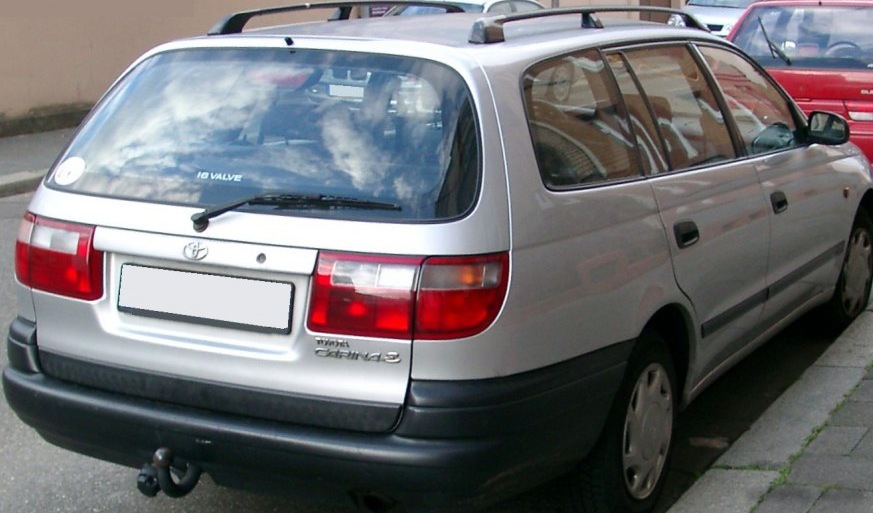
Technical Specifications
| Brand | Toyota |
| Model | Carina |
| Generation | Carina E Wagon (T19) |
| Type (Engine) | 1.6 i 16V XLi (107 Hp) |
| Start of production | 1994 |
| End of production | 1998 |
| Powertrain Architecture | Internal Combustion engine |
| Body type | Station wagon (estate) |
| Seats | 5 |
| Doors | 5 |
| Fuel consumption (combined) | 7.7 l/100 km (30.5 US mpg, 36.7 UK mpg, 13 km/l) |
| Fuel Type | Petrol (Gasoline) |
| Acceleration 0 – 100 km/h | 11.4 sec |
| Acceleration 0 – 62 mph | 11.4 sec |
| Acceleration 0 – 60 mph | 10.8 sec |
| Maximum speed | 185 km/h (114.95 mph) |
| Weight-to-power ratio | 10.8 kg/Hp, 92.6 Hp/tonne |
| Weight-to-torque ratio | 8.4 kg/Nm, 118.6 Nm/tonne |
| Power | 107 Hp @ 6000 rpm |
| Power per litre | 67.4 Hp/l |
| Torque | 137 Nm @ 4600 rpm (101.05 lb.-ft. @ 4600 rpm) |
| Engine layout | Front, Transverse |
| Engine Model/Code | 4A-FE |
| Engine displacement | 1587 cm3 (96.84 cu. in.) |
| Number of cylinders | 4 |
| Engine configuration | Inline |
| Cylinder Bore | 81 mm (3.19 in.) |
| Piston Stroke | 77 mm (3.03 in.) |
| Compression ratio | 9.5:1 |
| Number of valves per cylinder | 4 |
| Fuel injection system | Multi-port manifold injection |
| Engine aspiration | Naturally aspirated engine |
| Valvetrain | DOHC |
| Engine oil capacity | 3.3 l (3.49 US qt | 2.9 UK qt) |
| Coolant capacity | 5.4 l (5.71 US qt | 4.75 UK qt) |
| Kerb Weight | 1155 kg (2546.34 lbs.) |
| Max. weight | 1650 kg (3637.63 lbs.) |
| Max load | 495 kg (1091.29 lbs.) |
| Trunk (boot) space – minimum | 485 l (17.13 cu. ft.) |
| Trunk (boot) space – maximum | 860 l (30.37 cu. ft.) |
| Fuel tank capacity | 60 l (15.85 US gal | 13.2 UK gal) |
| Length | 4545 mm (178.94 in.) |
| Width | 1695 mm (66.73 in.) |
| Height | 1470 mm (57.87 in.) |
| Wheelbase | 2580 mm (101.57 in.) |
| Front track | 1465 mm (57.68 in.) |
| Rear (Back) track | 1445 mm (56.89 in.) |
| Drivetrain Architecture | Front wheel drive |
| Number of gears and type of gearbox | 5 gears, manual transmission |
| Front suspension | Spring Strut |
| Rear suspension | Coil spring |
| Front brakes | Ventilated discs |
| Rear brakes | Drum |
| Steering type | Steering rack and pinion |
| Power steering | Hydraulic Steering |
| Tires size | 175/70 R14 H |
The Toyota Carina E Wagon 1.6 i 16V XLi, launched in 1994, was a key model in Toyota’s strategy to capture a larger share of the European family car market. Building on the success of the Carina E sedan, the wagon variant offered increased practicality without sacrificing the brand’s reputation for reliability. The “1.6 i 16V” designation refers to the engine – a 1.6-liter inline-four cylinder engine with sixteen valves and fuel injection. The “XLi” trim level denoted a mid-range specification, offering a good balance of features and affordability. This model competed with other European station wagons like the Ford Mondeo Estate, Vauxhall/Opel Vectra Estate, and Volkswagen Passat Variant.
Powertrain & Engine Architecture
The heart of the Carina E Wagon 1.6 i 16V XLi is the 4A-FE engine. This 1.6-liter (1587cc) inline-four cylinder engine is a naturally aspirated unit featuring a double overhead camshaft (DOHC) valvetrain and multi-port fuel injection. The 4A-FE engine is known for its durability and relatively simple design, contributing to its longevity. It produces 107 horsepower at 6000 rpm and 137 Nm (101 lb-ft) of torque at 4600 rpm. The engine’s compression ratio is 9.5:1. The XLi trim was typically paired with a five-speed manual transmission, although a four-speed automatic transmission was also available. The automatic transmission, while offering convenience, slightly impacted acceleration and fuel economy compared to the manual version. The engine is transversely mounted, driving the front wheels.
Driving Characteristics
The 1.6-liter engine in the Carina E Wagon, while not particularly powerful, provided adequate performance for everyday driving. Acceleration from 0-60 mph took around 10.8 seconds, and the top speed was approximately 115 mph. The five-speed manual transmission allowed drivers to make the most of the engine’s powerband, while the optional automatic offered a smoother, more relaxed driving experience. The gear ratios were tuned for fuel efficiency rather than outright performance. Compared to higher-spec Carina E Wagons equipped with larger engines (like the 2.0-liter), the 1.6 felt less responsive, especially when fully loaded with passengers and luggage. However, the lighter engine weight contributed to better handling and a more nimble feel in urban environments.
Equipment & Trim Levels
The XLi trim level offered a reasonable level of equipment for the time. Standard features typically included power steering, central locking, electric front windows, and an adjustable steering column. The interior was generally finished in durable cloth upholstery. Optional extras available on the XLi included air conditioning, a sunroof, and upgraded audio systems. The dashboard layout was functional and straightforward, prioritizing ease of use over stylistic flair. Safety features were relatively basic by modern standards, typically including a driver’s airbag and seatbelts.
Chassis & Braking
The Carina E Wagon utilized a front-engine, front-wheel-drive layout. The front suspension consisted of MacPherson strut coil springs, while the rear suspension employed a coil spring setup. This configuration provided a comfortable ride quality, although it wasn’t particularly sporty. The braking system featured ventilated discs on the front wheels and drum brakes on the rear. Power-assisted steering was standard, making maneuvering easy. The tires were typically 175/70 R14, providing a good balance of grip and ride comfort.
Market Reception & Comparison
The Toyota Carina E Wagon 1.6 i 16V XLi was generally well-received by automotive critics as a practical and reliable family car. It was praised for its spacious interior, comfortable ride, and Toyota’s renowned build quality. However, some critics noted that the 1.6-liter engine lacked the power and refinement of some of its competitors. Compared to the higher-spec 2.0-liter Carina E Wagon, the 1.6 offered better fuel economy but less performance. The 1.6 XLi was positioned as a more affordable alternative to the more luxurious trims, appealing to budget-conscious buyers.
Legacy
The Toyota Carina E Wagon, and particularly the 1.6 i 16V XLi variant, has proven to be a durable and reliable vehicle. The 4A-FE engine is known for its longevity, and many examples are still on the road today. In the used car market, these wagons are often sought after for their practicality, affordability, and Toyota’s reputation for dependability. While not a particularly collectible model, well-maintained examples are appreciated by enthusiasts who value classic Japanese engineering. The Carina E Wagon represents a significant chapter in Toyota’s history, demonstrating the brand’s commitment to building practical, reliable, and affordable vehicles for the European market.