
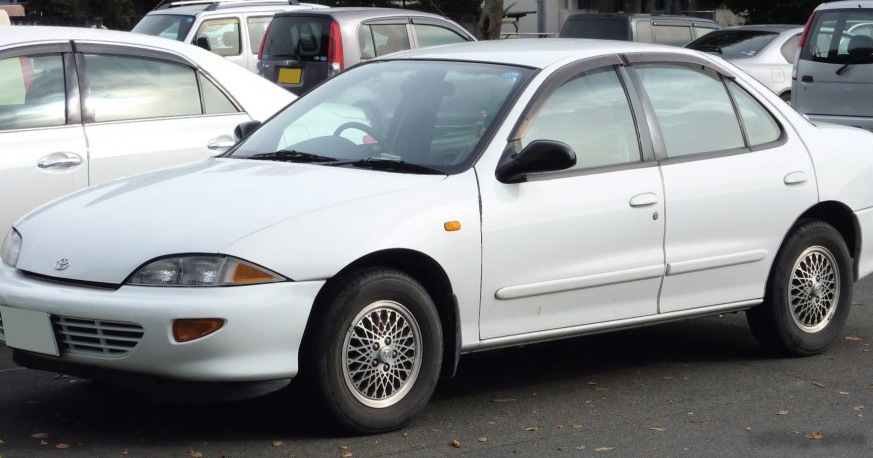
The Toyota Cavalier 2.4i Automatic, produced between 1995 and 2000, represented a mid-range offering within the broader Cavalier lineup. Positioned above the base 1.8L models, it aimed to provide a balance of performance and affordability for the North American market. While the Cavalier nameplate had a long history in other regions, this generation was specifically tailored for the US and Canadian consumer, focusing on practicality and value. It competed directly with vehicles like the Honda Accord, Nissan Sentra, and Ford Contour. This variant, with its 2.4-liter engine and automatic transmission, was a popular choice for buyers seeking a comfortable and reliable daily driver.
Technical Specifications
| Brand | Toyota |
| Model | Cavalier |
| Generation | Cavalier |
| Type (Engine) | 2.4i (150 Hp) Automatic |
| Start of production | 1995 |
| End of production | 2000 |
| Powertrain Architecture | Internal Combustion engine |
| Body type | Sedan |
| Seats | 5 |
| Doors | 4 |
| Fuel Type | Petrol (Gasoline) |
| Weight-to-power ratio | 8.7 kg/Hp, 115.4 Hp/tonne |
| Weight-to-torque ratio | 6 kg/Nm, 166.9 Nm/tonne |
| Power | 150 Hp @ 6000 rpm |
| Power per litre | 62.7 Hp/l |
| Torque | 217 Nm @ 4400 rpm, 160.05 lb.-ft. @ 4400 rpm |
| Engine layout | Front, Transverse |
| Engine Model/Code | T2 |
| Engine displacement | 2392 cm3, 145.97 cu. in. |
| Number of cylinders | 4 |
| Engine configuration | Inline |
| Cylinder Bore | 90 mm, 3.54 in. |
| Piston Stroke | 94 mm, 3.7 in. |
| Compression ratio | 9.5:1 |
| Number of valves per cylinder | 4 |
| Fuel injection system | Multi-port manifold injection |
| Engine aspiration | Naturally aspirated engine |
| Valvetrain | DOHC |
| Kerb Weight | 1300 kg, 2866.01 lbs |
| Fuel tank capacity | 58 l, 15.32 US gal | 12.76 UK gal |
| Length | 4595 mm, 180.91 in. |
| Width | 1735 mm, 68.31 in. |
| Height | 1395 mm, 54.92 in. |
| Wheelbase | 2645 mm, 104.13 in. |
| Front track | 1460 mm, 57.48 in. |
| Rear (Back) track | 1440 mm, 56.69 in. |
| Minimum turning circle (turning diameter) | 11 m, 36.09 ft. |
| Drivetrain Architecture | The Internal combustion engine (ICE) drives the front wheels of the vehicle. |
| Drive wheel | Front wheel drive |
| Number of gears and type of gearbox | 4 gears, automatic transmission |
| Front brakes | Ventilated discs |
| Rear brakes | Drum |
| Tires size | 195/70 R14 |
Powertrain & Engine Architecture
The heart of the Cavalier 2.4i Automatic is the 2.4-liter (2392 cc) inline-four cylinder engine, designated as the T2 code. This engine featured a double overhead camshaft (DOHC) valvetrain with four valves per cylinder, contributing to its relatively high output for its displacement. The engine utilized a multi-port fuel injection system, delivering fuel directly to each intake port for improved efficiency and responsiveness. The 9.5:1 compression ratio was a standard figure for naturally aspirated engines of the era, balancing performance and fuel economy. Paired with this engine was a four-speed automatic transmission. While not the most advanced transmission available at the time, it provided smooth and convenient shifting for everyday driving. The transmission was tuned for comfort rather than outright performance, with gear ratios optimized for fuel efficiency and relaxed cruising.
Driving Characteristics
The 150 horsepower and 217 Nm (160 lb-ft) of torque delivered by the 2.4i engine provided adequate, though not exhilarating, performance. Acceleration from 0 to 60 mph was typically in the 9-10 second range. Compared to the base 1.8L engine, the 2.4i offered a noticeable improvement in both acceleration and passing power. However, it wasn’t as sporty as some of its competitors with manual transmissions or more powerful engine options. The automatic transmission, while convenient, did result in some power loss compared to a manual gearbox. The gear ratios were spaced to prioritize fuel economy, meaning the engine often felt slightly strained during aggressive acceleration. Overall, the driving experience was comfortable and predictable, making it well-suited for daily commuting and long highway drives.
Equipment & Trim Levels
The 2.4i Automatic trim typically included features such as air conditioning, power windows and locks, and an AM/FM stereo. Higher trim levels, often denoted with additional packages, could add features like cruise control, upgraded upholstery, and a sunroof. Interior upholstery was generally cloth, with optional leather available on some models. The dashboard layout was functional and straightforward, prioritizing ease of use over stylistic flair. Optional extras included alloy wheels, a premium sound system, and anti-lock brakes (ABS), which were not standard on all models.
Chassis & Braking
The Cavalier utilized a front-wheel-drive platform with independent front suspension and a twist-beam rear suspension. The front suspension featured MacPherson struts, while the rear suspension was a simpler, more cost-effective design. Braking consisted of ventilated discs on the front wheels and drum brakes on the rear. This configuration was typical for vehicles in this price range during the 1990s. The braking performance was adequate for normal driving conditions, but lacked the stopping power of vehicles with four-wheel disc brakes. Stabilizer bars were included on both the front and rear axles to reduce body roll during cornering.
Market Reception & Comparison
The Toyota Cavalier 2.4i Automatic was generally well-received by critics as a practical and reliable family sedan. It was praised for its comfortable ride, spacious interior, and Toyota’s reputation for dependability. However, it was often criticized for its somewhat bland styling and lack of sporty handling. Compared to the base 1.8L models, the 2.4i offered a significant improvement in performance, but at a slightly higher price point. Fuel economy was comparable to other vehicles in its class, averaging around 22-28 mpg in combined driving. The 2.4i Automatic was often seen as a good value for buyers who prioritized comfort and reliability over sporty performance.
Legacy
The Toyota Cavalier 2.4i Automatic has proven to be a relatively reliable vehicle over the long term. The 2.4-liter engine is known for its durability, and the automatic transmission, while not particularly sophisticated, has generally held up well with proper maintenance. Today, these vehicles can be found in the used car market at affordable prices. Common issues include minor oil leaks, worn suspension components, and corrosion in areas prone to rust. Despite its age, the Cavalier 2.4i Automatic remains a viable option for budget-conscious buyers seeking a dependable and practical transportation solution. Its simplicity and relatively low maintenance costs contribute to its continued appeal in the used car market.
