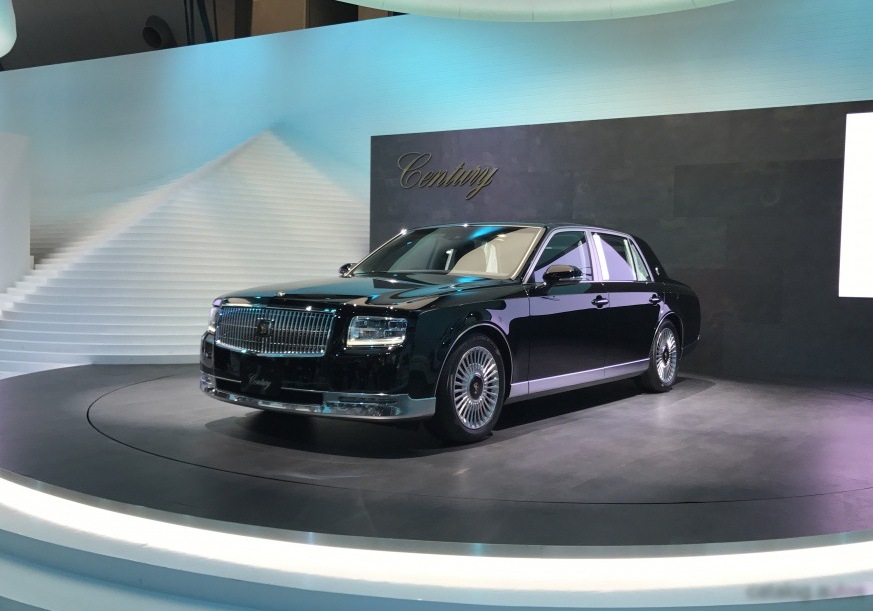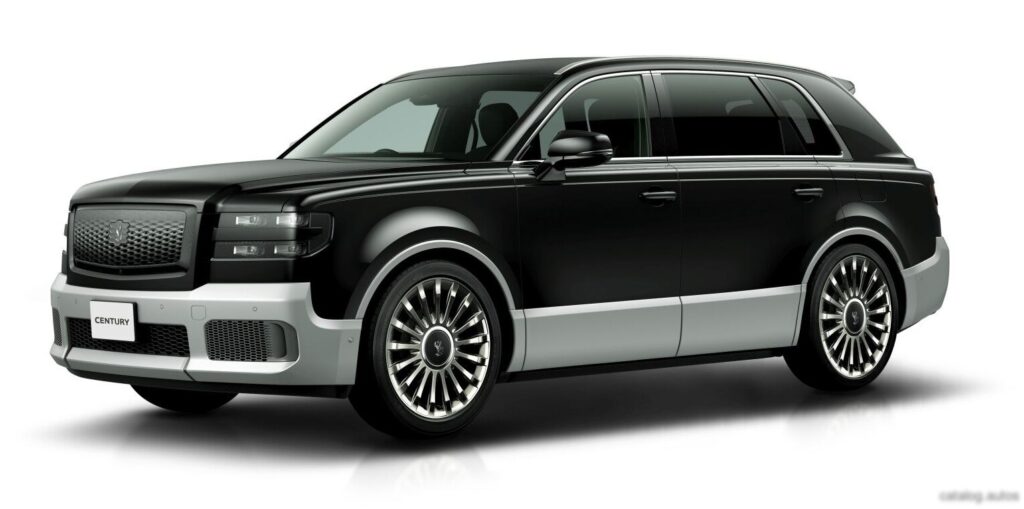
The Toyota Century SUV (GRG75), launched in September 2023, represents a significant departure for Toyota’s flagship Century line. Traditionally a conservative, chauffeur-driven sedan, the Century transitioned to a more contemporary SUV format, aiming to appeal to a broader, yet still discerning, clientele. This variant, equipped with a 3.5-liter V6 plug-in hybrid powertrain producing a combined 412 horsepower, sits at the top of the Century SUV range, offering a blend of luxury, performance, and advanced technology. It is built upon a reinforced version of the TNGA-K platform, shared with other Toyota and Lexus models, but extensively modified to meet the Century’s elevated standards of refinement and capability.
Technical Specifications
| Brand | Toyota |
| Model | Century |
| Generation | Century III SUV (GRG75) |
| Type (Engine) | 3.5 V6 (412 Hp) Plug-in Hybrid E-Four Advanced e-CVT |
| Start of production | September, 2023 |
| Powertrain Architecture | PHEV (Plug-in Hybrid Electric Vehicle) |
| Body type | SUV |
| Seats | 4 |
| Doors | 5 |
| Fuel consumption (economy) – urban (WLTC) | 7 l/100 km (33.6 US mpg, 40.4 UK mpg, 14.3 km/l) |
| Fuel consumption (economy) – extra urban (WLTC) | 6.2 l/100 km (37.9 US mpg, 45.6 UK mpg, 16.1 km/l) |
| Fuel consumption (economy) – combined (WLTC) | 6.6 l/100 km (35.6 US mpg, 42.8 UK mpg, 15.2 km/l) |
| CO2 emissions (WLTC) | 163 g/km |
| Fuel Type | Petrol / electricity |
| Weight-to-power ratio | 6.2 kg/Hp, 160.3 Hp/tonne |
| Weight-to-torque ratio | 7.7 kg/Nm, 130.4 Nm/tonne |
| Battery technology | Lithium-ion (Li-Ion) |
| Battery location | Below the floor |
| All-electric range (WLTC) | 69 km (42.87 mi) |
| Average Energy consumption (WLTC) | 21.3 kWh/100 km (34.28 kWh/100 mi, 98 MPGe, 4.7 km/kWh, 2.9 mi/kWh) |
| Electric motor power (1) | 182 Hp |
| Electric motor Torque (1) | 270 Nm (199.14 lb.-ft.) |
| Electric motor model/code (1) | 5NM |
| Electric motor location (1) | Integrated into the transmission |
| Electric motor type (1) | Synchronous |
| Electric motor power (2) | 109 Hp |
| Electric motor Torque (2) | 169 Nm (124.65 lb.-ft.) |
| Electric motor model/code (2) | 1YM |
| Electric motor location (2) | Rear axle, Transverse |
| Electric motor type (2) | Synchronous |
| System power | 412 Hp |
| Power | 262 Hp @ 6000 rpm |
| Torque | 335 Nm @ 4600 rpm (247.08 lb.-ft. @ 4600 rpm) |
| Engine layout | Front, Transverse |
| Engine Model/Code | 2GR-FXS |
| Engine displacement | 3456 cm3 (210.9 cu. in.) |
| Number of cylinders | 6 |
| Engine configuration | V-engine |
| Cylinder Bore | 94 mm (3.7 in.) |
| Piston Stroke | 83 mm (3.27 in.) |
| Number of valves per cylinder | 4 |
| Fuel injection system | Direct injection and Multi-port manifold injection |
| Engine aspiration | Naturally aspirated engine |
| Valvetrain | DOHC, VVT |
| Engine oil capacity | 5.5 l (5.81 US qt | 4.84 UK qt) |
| Coolant | 12.4 l (13.1 US qt | 10.91 UK qt) |
| Kerb Weight | 2570-2600 kg (5665.88 – 5732.02 lbs.) |
| Max. weight | 2790-2820 kg (6150.9 – 6217.04 lbs.) |
| Max load | 220 kg (485.02 lbs.) |
| Trunk (boot) space – minimum | 340 l (12.01 cu. ft.) |
| Fuel tank capacity | 55 l (14.53 US gal | 12.1 UK gal) |
| Length | 5205 mm (204.92 in.) |
| Width | 1990 mm (78.35 in.) |
| Height | 1805 mm (71.06 in.) |
| Wheelbase | 2950 mm (116.14 in.) |
| Front track | 1705-1715 mm (67.13 – 67.52 in.) |
| Rear (Back) track | 1715-1725 mm (67.52 – 67.91 in.) |
| Ride height (ground clearance) | 185 mm (7.28 in.) |
| Minimum turning circle (turning diameter) | 11 m (36.09 ft.) |
| Drivetrain Architecture | An Internal combustion engine (ICE) drives the front wheels, one electric motor drives the front wheels, one electric motor drives the rear wheels. There is an ability for running in full electric or mixed mode. |
| Drive wheel | All wheel drive (4×4) |
| Number of gears and type of gearbox | automatic transmission e-CVT |
| Front suspension | Independent, type McPherson with coil spring and anti-roll bar |
| Rear suspension | Independent multi-link spring suspension with stabilizer |
| Front brakes | Ventilated discs |
| Rear brakes | Ventilated discs |
Powertrain & Engine Architecture
The Century SUV’s powertrain centers around Toyota’s 2GR-FXS 3.5-liter V6 engine, paired with a sophisticated plug-in hybrid system. The engine itself utilizes both direct injection and multi-port fuel injection, optimizing combustion efficiency and reducing emissions. It produces 262 horsepower at 6000 rpm and 247 lb-ft of torque at 4600 rpm. The hybrid component consists of two electric motors: a 182 hp motor integrated with the e-CVT transmission driving the front wheels, and a 109 hp motor powering the rear axle. This configuration enables a full-time all-wheel-drive system and allows for operation in electric-only mode for up to 69 kilometers (42.87 miles) on the WLTC cycle. The e-CVT (electronically controlled continuously variable transmission) is crucial to the system’s efficiency, seamlessly blending power from the engine and electric motors. The battery pack, a lithium-ion unit, is positioned under the floor, contributing to a low center of gravity and preserving interior space.
Driving Characteristics
The 3.5L V6 plug-in hybrid Century SUV delivers a remarkably smooth and refined driving experience. The electric motors provide instant torque, resulting in brisk acceleration, especially in the initial stages. The combined system output of 412 horsepower allows for confident highway passing and merging. The e-CVT, while prioritizing efficiency, is programmed to simulate traditional gear changes under hard acceleration, providing a more engaging feel. Compared to a hypothetical non-hybrid Century SUV, this variant offers significantly improved fuel economy and reduced emissions. The all-wheel-drive system provides enhanced traction and stability in various weather conditions. While not a sports SUV, the Century prioritizes a comfortable and composed ride, absorbing bumps and imperfections with ease.
Equipment & Trim Levels
The Century SUV is positioned as a luxury vehicle, and the equipment levels reflect this. Standard features include premium leather upholstery, wood trim, a large touchscreen infotainment system with navigation, a comprehensive suite of advanced driver-assistance systems (ADAS), and a high-end audio system. The interior is designed with a focus on rear passenger comfort, featuring spacious seating and individual climate control. Optional extras include a rear-seat entertainment system, upgraded leather options, and a panoramic sunroof. The overall aesthetic is one of understated elegance, avoiding ostentatious displays of wealth.
Chassis & Braking
The Century SUV utilizes an independent suspension system at all four corners, with McPherson struts at the front and a multi-link setup at the rear. This configuration provides a comfortable ride and good handling characteristics. Stabilizer bars are fitted to both axles to minimize body roll during cornering. The braking system consists of ventilated discs on all four wheels, providing ample stopping power. Anti-lock brakes (ABS) and other electronic stability control systems are standard, enhancing safety. The steering is an electric power-assisted rack and pinion system, offering precise and responsive control.
Market Reception & Comparison
The Century SUV has been generally well-received by critics, who praise its luxurious interior, smooth ride, and advanced technology. The plug-in hybrid powertrain is seen as a significant step forward for the Century line, offering improved fuel economy and reduced emissions. Compared to other luxury SUVs in its class, the Century SUV stands out for its unique blend of Japanese craftsmanship and understated elegance. While its price point places it in competition with established European brands, the Century offers a distinctive alternative for buyers seeking a more refined and technologically advanced vehicle.
Legacy
The Century SUV represents a bold move for Toyota, expanding the Century brand into a new segment. The 3.5L V6 plug-in hybrid powertrain is expected to be reliable and durable, building upon Toyota’s reputation for engineering excellence. As a relatively new model, its long-term reliability is still being assessed, but early indications are positive. On the used car market, the Century SUV is likely to hold its value well, appealing to collectors and enthusiasts who appreciate its unique character and luxurious features. It marks a significant evolution for a traditionally conservative brand, embracing new technologies and appealing to a wider audience.