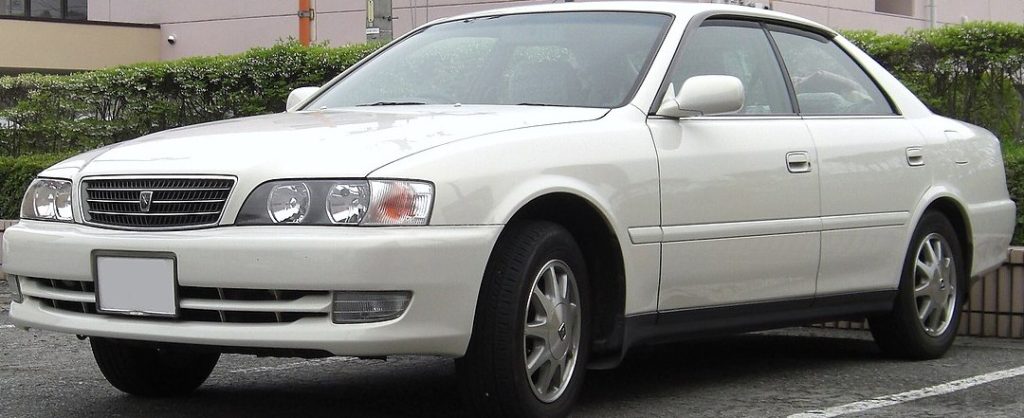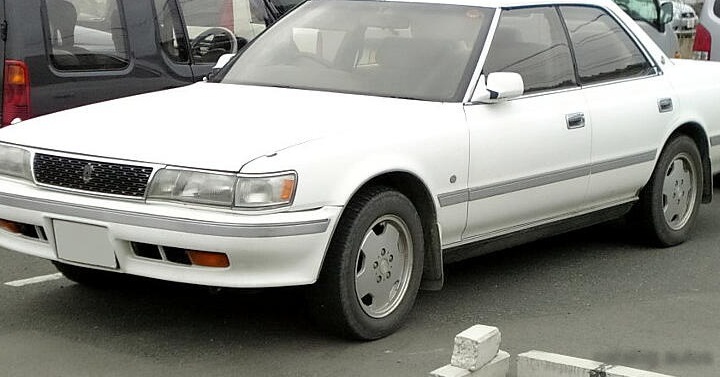
The Toyota Chaser 1.8i, producing 115 horsepower, was a variant of the JX81 series Chaser produced between 1988 and 1992. Positioned as an entry-level model within the Chaser lineup, it offered a more affordable and fuel-efficient alternative to the higher-performance 2.0-liter and 2.4-liter versions. The Chaser, in its various iterations, was primarily a Japan-market vehicle, designed to appeal to buyers seeking a sporty, yet practical, mid-size sedan. It competed with models like the Nissan Skyline and Mazda Savanna, offering a rear-wheel-drive experience increasingly rare in the Japanese automotive landscape of the late 1980s and early 1990s.
Technical Specifications
| Brand | Toyota |
| Model | Chaser |
| Generation | Chaser (JX81) |
| Type (Engine) | 1.8i (115 Hp) |
| Start of production | 1988 |
| End of production | 1992 |
| Powertrain Architecture | Internal Combustion Engine |
| Body type | Sedan |
| Seats | 5 |
| Doors | 4 |
| Fuel consumption (urban) | 9.8 l/100 km (24 US mpg) |
| Fuel consumption (extra urban) | 5.3 l/100 km (44.4 US mpg) |
| Fuel Type | Petrol (Gasoline) |
| Power | 115 Hp @ 5400 rpm |
| Torque | 155 Nm @ 2800 rpm (114.32 lb.-ft. @ 2800 rpm) |
| Engine layout | Front, Longitudinal |
| Engine Model/Code | 4S-FE |
| Engine displacement | 1762 cm3 (107.52 cu. in.) |
| Number of cylinders | 4 |
| Engine configuration | Inline |
| Cylinder Bore | 81 mm (3.19 in.) |
| Piston Stroke | 85.5 mm (3.37 in.) |
| Compression ratio | 9.5:1 |
| Number of valves per cylinder | 4 |
| Fuel injection system | Multi-port manifold injection |
| Engine aspiration | Naturally aspirated |
| Engine oil capacity | 3.6 l (3.8 US qt | 3.17 UK qt) |
| Coolant capacity | 6.8 l (7.19 US qt | 5.98 UK qt) |
| Fuel tank capacity | 65 l (17.17 US gal | 14.3 UK gal) |
| Length | 4690 mm (184.65 in.) |
| Width | 1695 mm (66.73 in.) |
| Height | 1375 mm (54.13 in.) |
| Wheelbase | 2680 mm (105.51 in.) |
| Drivetrain | Rear wheel drive |
| Number of gears | 5 |
| Gearbox type | Manual transmission |
| Front brakes | Ventilated discs |
| Rear brakes | Drum |
| Assisting systems | ABS (Anti-lock braking system) |
| Tires size | 185/70 R14 |
| Wheel rims size | 14 |
Powertrain & Engine Architecture
The 1.8i Chaser was powered by the 4S-FE engine, a 1.8-liter (1762 cc) inline-four cylinder gasoline engine. This engine was part of Toyota’s ‘S’ series, known for its reliability and relatively simple design. The 4S-FE featured multi-port fuel injection, a double overhead camshaft (DOHC) valvetrain with four valves per cylinder, and a compression ratio of 9.5:1. These features contributed to its respectable power output for its displacement. The engine’s longitudinal mounting allowed for a rear-wheel-drive configuration, a key characteristic of the Chaser. The standard transmission was a 5-speed manual, providing drivers with direct control over the engine’s power.
Driving Characteristics
The 115 hp and 155 Nm (114 lb-ft) of torque produced by the 4S-FE engine in the 1.8i Chaser provided adequate, but not exhilarating, performance. Acceleration was modest, and the car was geared more towards fuel efficiency than outright speed. The 5-speed manual transmission allowed drivers to keep the engine in its optimal power band, but it wasn’t a particularly sporty setup. Compared to the 2.0-liter (1G-FE) and 2.4-liter (2S-EL) Chaser variants, the 1.8i felt noticeably less powerful, especially during overtaking maneuvers or uphill climbs. However, the lighter weight of the 1.8i, due to the smaller engine, did contribute to slightly better handling and responsiveness in corners. The rear-wheel-drive layout provided a balanced feel, although it lacked the sophistication of more advanced suspension systems found in higher-end sports sedans.
Equipment & Trim Levels
The 1.8i Chaser typically came with a fairly basic level of equipment, reflecting its position as the entry-level model. Standard features generally included power steering, a basic audio system, and cloth upholstery. Air conditioning was often an optional extra. Interior trim was functional and durable, prioritizing practicality over luxury. The dashboard layout was typical of Japanese cars of the era, with a clear and straightforward instrument cluster. Optional extras could include upgraded audio systems, electric windows, and central locking. The trim level was generally denoted by a simple designation, with the 1.8i being the most basic offering.
Chassis & Braking
The Chaser 1.8i utilized a conventional suspension setup for a rear-wheel-drive sedan of its time. It featured MacPherson struts in the front and a solid axle with leaf springs in the rear. This setup provided a comfortable ride, but it wasn’t particularly sophisticated in terms of handling. The braking system consisted of ventilated discs on the front wheels and drum brakes on the rear. Anti-lock brakes (ABS) were often included as standard equipment, enhancing safety. The 185/70 R14 tires provided adequate grip for everyday driving conditions. The chassis was designed to be robust and durable, prioritizing reliability over outright performance.
Market Reception & Comparison
The Toyota Chaser 1.8i was generally well-received in the Japanese market as a practical and affordable sedan. Critics praised its fuel efficiency and reliability, but noted its lack of performance compared to the higher-spec models. It was seen as a sensible choice for buyers who prioritized economy and dependability over sporty driving dynamics. Compared to the 2.0-liter and 2.4-liter Chaser variants, the 1.8i offered significantly better fuel economy, but at the cost of performance. The 1.8i also had a lower purchase price, making it accessible to a wider range of buyers. Its main competitors, such as the Nissan Skyline and Mazda Savanna, offered similar levels of performance and features, but the Chaser’s reputation for reliability gave it an edge.
Legacy
The Toyota Chaser 1.8i, while not the most sought-after variant of the JX81 series, remains a relatively common sight on the used car market in Japan. The 4S-FE engine is known for its durability and relatively low maintenance costs. However, like any older vehicle, it is susceptible to age-related issues such as rust and wear and tear on suspension components. The 1.8i Chaser is often seen as a good entry point for enthusiasts interested in experiencing a classic Japanese rear-wheel-drive sedan. Its affordability and simplicity make it a popular choice for restoration projects and casual driving. While it may not offer the same level of performance as its more powerful siblings, the 1.8i Chaser represents a significant piece of Japanese automotive history.