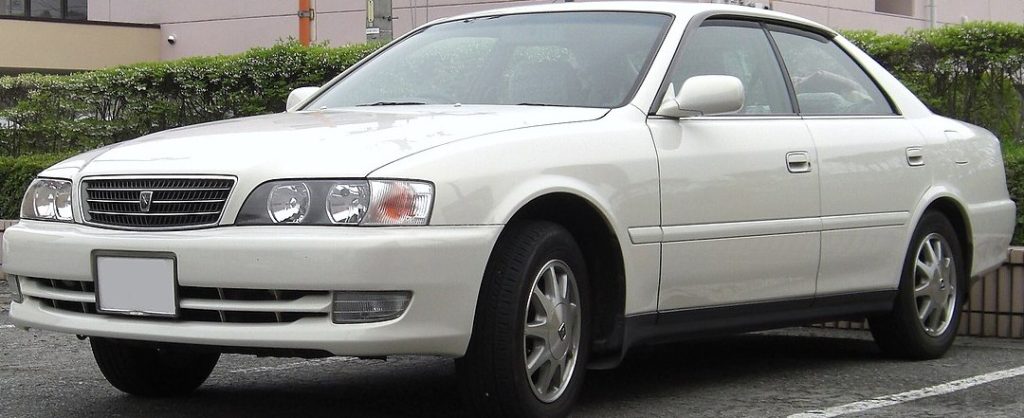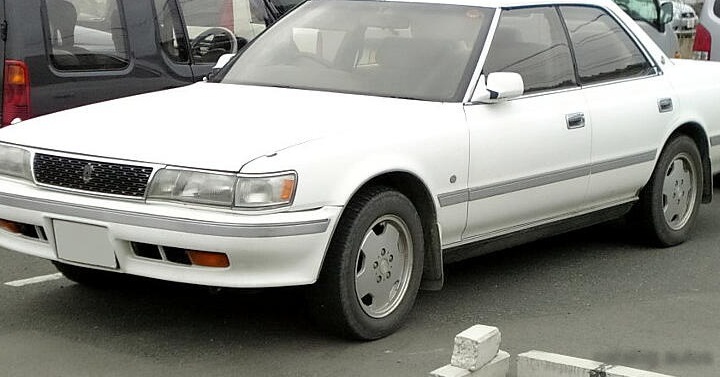
The Toyota Chaser (ZX100), specifically the 2.5i 24V Twin-turbo variant with an automatic transmission, represents a significant offering from Toyota’s JDM (Japanese Domestic Market) lineup during the 1996-2001 production years. Positioned as a sporty, mid-size sedan, the Chaser competed with rivals like the Nissan Skyline and Mazda RX-7, offering a blend of performance, comfort, and technology. This particular iteration, powered by the 1JZ-GTE engine, was a step up from the naturally aspirated models and the smaller turbocharged engines, targeting enthusiasts seeking a powerful and refined driving experience. The ZX100 series, built on the J platform, was the third generation of the Chaser, known for its more aggressive styling and improved mechanicals compared to its predecessors.
Technical Specifications
| Brand | Toyota |
| Model | Chaser |
| Generation | Chaser (ZX 100) |
| Type | 2.5i 24V Twin-turbo (280 Hp) Automatic |
| Start of production | 1996 |
| End of production | 2001 |
| Powertrain Architecture | Internal Combustion engine |
| Body type | Sedan |
| Seats | 5 |
| Doors | 4 |
| Fuel consumption (combined) | 8.5 l/100 km (27.7 US mpg, 33.2 UK mpg, 11.8 km/l) |
| Fuel Type | Petrol (Gasoline) |
| Weight-to-power ratio | 5.2 kg/Hp, 193.1 Hp/tonne |
| Weight-to-torque ratio | 3.8 kg/Nm, 260.7 Nm/tonne |
| Power | 280 Hp @ 6200 rpm |
| Power per litre | 112.4 Hp/l |
| Torque | 378 Nm @ 2400 rpm (278.8 lb.-ft. @ 2400 rpm) |
| Engine layout | Front, Longitudinal |
| Engine Model/Code | 1JZ-GTE |
| Engine displacement | 2492 cm3 (152.07 cu. in.) |
| Number of cylinders | 6 |
| Engine configuration | Inline |
| Cylinder Bore | 86 mm (3.39 in.) |
| Piston Stroke | 71.5 mm (2.81 in.) |
| Compression ratio | 9:1 |
| Number of valves per cylinder | 4 |
| Fuel injection system | Multi-port manifold injection |
| Engine aspiration | Turbocharger |
| Valvetrain | DOHC |
| Engine oil capacity | 5.4 l (5.71 US qt | 4.75 UK qt) |
| Coolant capacity | 8.4 l (8.88 US qt | 7.39 UK qt) |
| Kerb Weight | 1450 kg (3196.7 lbs.) |
| Max. weight | 1725 kg (3802.97 lbs.) |
| Max load | 275 kg (606.27 lbs.) |
| Fuel tank capacity | 70 l (18.49 US gal | 15.4 UK gal) |
| Length | 4750 mm (187.01 in.) |
| Width | 1750 mm (68.9 in.) |
| Height | 1390 mm (54.72 in.) |
| Wheelbase | 2730 mm (107.48 in.) |
| Front track | 1485 mm (58.46 in.) |
| Rear track | 1495 mm (58.86 in.) |
| Drivetrain | Rear wheel drive |
| Number of gears | 4 |
| Gearbox type | Automatic transmission |
| Front suspension | Spring Strut |
| Rear suspension | Coil spring |
| Front brakes | Ventilated discs |
| Rear brakes | Disc |
| Assisting systems | ABS (Anti-lock braking system) |
| Steering type | Steering rack and pinion |
| Power steering | Hydraulic Steering |
| Tires size | 205/55 R16 |
| Wheel rims size | 16 |
Powertrain & Engine Architecture
The heart of the Chaser 2.5i Twin-turbo is the 1JZ-GTE engine, a 2.5-liter inline-six cylinder powerplant. This engine is renowned for its robust construction and tuning potential. The “GTE” designation signifies Toyota’s performance variant, featuring twin turbochargers and an intercooler to boost power output. The 1JZ-GTE utilizes a sequential turbo system, where a smaller turbocharger provides boost at lower RPMs for improved responsiveness, while a larger turbocharger takes over at higher RPMs for maximum power. Fuel delivery is managed by a multi-port fuel injection system, ensuring precise fuel metering for optimal combustion. The engine features a double overhead camshaft (DOHC) valvetrain with four valves per cylinder, contributing to its high volumetric efficiency. The automatic transmission paired with this engine is a four-speed unit, designed to handle the substantial torque produced by the turbocharged engine. While not as sporty as a manual transmission, it offered a more comfortable and convenient driving experience for many buyers.
Driving Characteristics
The 280 horsepower and 278.8 lb.-ft. of torque delivered by the 1JZ-GTE engine, coupled with the rear-wheel-drive configuration, provided the Chaser 2.5i Twin-turbo with impressive acceleration and handling. While the automatic transmission did introduce some power loss compared to the manual versions, it still offered brisk performance. The turbo lag was noticeable, but the sequential turbo system minimized it compared to single-turbo setups. The car felt planted and stable at highway speeds, with the rear-wheel-drive layout providing a balanced feel. The automatic transmission’s gear ratios were tuned for a balance between acceleration and fuel efficiency, making it suitable for both city driving and long-distance cruising. Compared to the naturally aspirated Chaser variants, the twin-turbo model offered a significantly more engaging and exhilarating driving experience.
Equipment & Trim Levels
The Chaser 2.5i Twin-turbo typically came equipped with a range of features aimed at enhancing comfort and convenience. Standard equipment often included power windows, power locks, air conditioning, and a decent audio system. Higher trim levels offered upgrades such as leather upholstery, power-adjustable seats, and a sunroof. The interior design was functional and well-built, reflecting Toyota’s reputation for quality. Optional extras included upgraded audio systems, navigation systems (a rarity for the time), and various cosmetic enhancements. The dashboard layout was straightforward and easy to use, with clearly labeled controls.
Chassis & Braking
The Chaser ZX100 featured a robust chassis designed to handle the power of the 1JZ-GTE engine. The front suspension utilized a MacPherson strut setup, while the rear employed a coil spring arrangement. The suspension was tuned for a balance between comfort and handling, providing a relatively smooth ride without sacrificing stability. Braking duties were handled by ventilated disc brakes at the front and solid disc brakes at the rear. An Anti-lock Braking System (ABS) was standard, enhancing safety by preventing wheel lockup during hard braking. The steering system was a rack-and-pinion setup with hydraulic power assistance, providing precise and responsive steering feel.
Market Reception & Comparison
The Toyota Chaser 2.5i Twin-turbo was well-received in the Japanese market, praised for its performance, refinement, and reliability. Critics noted the engine’s impressive power output and the car’s overall driving dynamics. However, some reviewers pointed out the automatic transmission’s slight impact on performance compared to the manual versions. Compared to other trims in the Chaser lineup, the 2.5i Twin-turbo was positioned as the performance flagship, offering a significant upgrade in power and handling. It was more expensive than the naturally aspirated models and the smaller turbocharged variants, but it provided a more rewarding driving experience for enthusiasts. Fuel economy was reasonable for a car of its performance, averaging around 27.7 US mpg.
Legacy
The Toyota Chaser 2.5i Twin-turbo, and the 1JZ-GTE engine in particular, has gained a strong following among car enthusiasts. The engine is known for its durability and potential for modification, making it a popular choice for engine swaps and performance upgrades. The Chaser ZX100 remains a sought-after JDM classic, with well-maintained examples commanding high prices in the used car market. The car’s combination of performance, reliability, and style has cemented its place as a significant vehicle in Toyota’s history. While finding parts can sometimes be a challenge due to its age and limited production outside of Japan, the Chaser 2.5i Twin-turbo continues to be appreciated by those who value a unique and capable sports sedan.