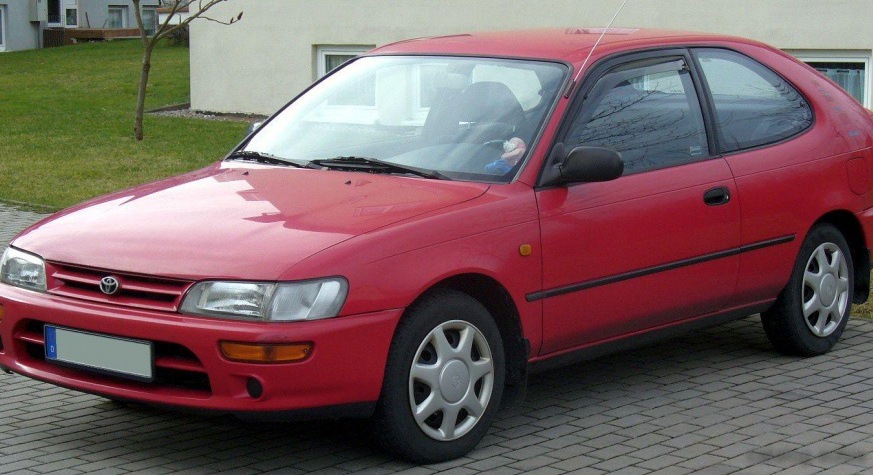
The Toyota Corolla E100, produced from 1992 to 1995, represented the seventh generation of Toyota’s globally successful Corolla line. Available in a variety of body styles including sedan, liftback, and wagon, the E100 was a significant model for Toyota, particularly in Europe and Asia, where compact hatchbacks were highly popular. The 1.3 i 16V XLi variant, powered by the 2E-E engine producing 88 horsepower, occupied an important position as an entry-level offering, balancing affordability with Toyota’s reputation for reliability. This trim level aimed to provide a practical and economical choice for buyers seeking a dependable daily driver.
Technical Specifications
| Brand | Toyota |
| Model | Corolla |
| Generation | Corolla Compact VII (E100) |
| Type (Engine) | 1.3 i 16V XLi (88 Hp) |
| Start of production | 1992 |
| End of production | 1995 |
| Powertrain Architecture | Internal Combustion engine |
| Body type | Hatchback |
| Seats | 5 |
| Doors | 3-5 |
| Fuel consumption (combined) | 6.7 l/100 km (35.1 US mpg, 42.2 UK mpg, 14.9 km/l) |
| Fuel Type | Petrol (Gasoline) |
| Acceleration 0 – 100 km/h | 11.5 sec |
| Acceleration 0 – 62 mph | 11.5 sec |
| Acceleration 0 – 60 mph | 10.9 sec |
| Maximum speed | 175 km/h (108.74 mph) |
| Weight-to-power ratio | 11.5 kg/Hp, 87.1 Hp/tonne |
| Weight-to-torque ratio | 8.2 kg/Nm, 121.8 Nm/tonne |
| Power | 88 Hp @ 6000 rpm |
| Power per litre | 67.7 Hp/l |
| Torque | 123 Nm @ 4400 rpm (90.72 lb.-ft. @ 4400 rpm) |
| Engine layout | Front, Transverse |
| Engine Model/Code | 2E-E |
| Engine displacement | 1299 cm3 (79.27 cu. in.) |
| Number of cylinders | 4 |
| Engine configuration | Inline |
| Cylinder Bore | 75 mm (2.95 in.) |
| Piston Stroke | 73.5 mm (2.89 in.) |
| Compression ratio | 10.5:1 |
| Number of valves per cylinder | 4 |
| Fuel injection system | Multi-port manifold injection |
| Engine aspiration | Naturally aspirated engine |
| Valvetrain | DOHC |
| Engine oil capacity | 3.2 l (3.38 US qt | 2.82 UK qt) |
| Coolant capacity | 5 l (5.28 US qt | 4.4 UK qt) |
| Kerb Weight | 1010 kg (2226.67 lbs.) |
| Max. weight | 1555 kg (3428.19 lbs.) |
| Max load | 545 kg (1201.52 lbs.) |
| Trunk (boot) space – minimum | 309 l (10.91 cu. ft.) |
| Trunk (boot) space – maximum | 748 l (26.42 cu. ft.) |
| Fuel tank capacity | 50 l (13.21 US gal | 11 UK gal) |
| Length | 4059 mm (159.8 in.) |
| Width | 1685 mm (66.34 in.) |
| Height | 1380 mm (54.33 in.) |
| Wheelbase | 2465 mm (97.05 in.) |
| Front track | 1460 mm (57.48 in.) |
| Rear (Back) track | 1450 mm (57.09 in.) |
| Drivetrain Architecture | Front wheel drive |
| Number of gears and type of gearbox | 5 gears, manual transmission |
| Front suspension | Spring Strut |
| Rear suspension | Spring Strut |
| Front brakes | Ventilated discs |
| Rear brakes | Drum |
| Assisting systems | ABS (Anti-lock braking system) |
| Steering type | Steering rack and pinion |
| Tires size | 165/70 R14 T |
INTRODUCTION
The Toyota Corolla E100 1.3 i 16V XLi was a key component of Toyota’s strategy to offer a versatile and affordable compact car. Produced between 1992 and 1995, it was part of the seventh generation Corolla, known internally as the E100 series. This generation saw a move towards more rounded styling and improved interior space compared to its predecessor. The XLi trim, positioned as a mid-range offering, provided a balance between basic transportation and desirable features. It was primarily sold in European and Asian markets, where the demand for fuel-efficient and compact hatchbacks was strong. The E100 platform was also used for other Toyota models, demonstrating its adaptability and cost-effectiveness.
Powertrain & Engine Architecture
The heart of the 1.3 i 16V XLi was the 2E-E engine, a 1.3-liter inline-four cylinder gasoline engine. This engine featured a double overhead camshaft (DOHC) valvetrain operating 16 valves, contributing to its relatively efficient power output. The 2E-E utilized multi-port fuel injection, a significant advancement over earlier carburetor-based systems, improving fuel economy and reducing emissions. The engine produced 88 horsepower at 6000 rpm and 123 Nm (90.72 lb-ft) of torque at 4400 rpm. The engine’s relatively simple design and robust construction contributed to its reputation for reliability. The XLi was typically paired with a 5-speed manual transmission, although a 3-speed automatic transmission was also available, albeit less common. The automatic transmission, while offering convenience, did impact acceleration and fuel economy compared to the manual version.
Driving Characteristics
The 1.3 i 16V XLi, with its 88 horsepower, wasn’t designed for outright performance. Acceleration from 0 to 60 mph took around 10.9 seconds, and its top speed was approximately 108.74 mph. The engine felt somewhat strained at higher speeds, particularly when fully loaded. However, in typical urban and highway driving conditions, it provided adequate power for everyday commuting. The 5-speed manual transmission allowed drivers to keep the engine in its optimal power band, resulting in a more responsive driving experience. The automatic transmission, while smooth, resulted in noticeable power loss and required more frequent downshifts for overtaking maneuvers. The E100’s suspension provided a comfortable ride, absorbing bumps and imperfections in the road reasonably well. Steering was light and precise, making it easy to maneuver in tight spaces.
Equipment & Trim Levels
The XLi trim level offered a step up in features compared to the base Corolla models. Standard equipment typically included power steering, central locking, electric windows, and a basic audio system. Interior upholstery was usually cloth, with a relatively simple dashboard layout. Optional extras available for the XLi included air conditioning, alloy wheels, and a more advanced audio system. The XLi aimed to provide a comfortable and practical interior without excessive luxury. The overall design was functional and focused on durability rather than aesthetic flair.
Chassis & Braking
The Corolla E100 utilized a front-engine, front-wheel-drive layout. Suspension consisted of MacPherson strut coil springs in the front and a torsion beam setup in the rear. The front brakes were ventilated discs, providing adequate stopping power, while the rear brakes were drums, a cost-saving measure common in this class of vehicle. The XLi typically featured ABS (Anti-lock Braking System) as standard equipment, enhancing safety by preventing wheel lockup during hard braking. The chassis was relatively lightweight, contributing to the car’s fuel efficiency and handling. Stabilizer bars were fitted to both the front and rear axles to reduce body roll during cornering.
Market Reception & Comparison
The Corolla E100 1.3 i 16V XLi was generally well-received by automotive critics as a practical and reliable compact car. It was praised for its fuel efficiency, comfortable ride, and Toyota’s renowned build quality. However, some critics noted its lack of outright performance and somewhat bland styling. Compared to other trims in the Corolla lineup, such as the 1.6L versions, the 1.3L XLi offered lower running costs but sacrificed performance. The 1.6L models provided a more engaging driving experience but came at a higher price point. Against competitors like the Volkswagen Golf and Ford Escort, the Corolla E100 offered a compelling combination of reliability, fuel economy, and affordability.
Legacy
The Toyota Corolla E100 1.3 i 16V XLi has proven to be a remarkably durable and reliable vehicle. Many examples are still on the road today, testament to Toyota’s engineering and build quality. The 2E-E engine is known for its longevity and relatively low maintenance costs. In the used car market, these Corollas are often sought after as affordable and dependable transportation. While not a collector’s item, the E100 holds a significant place in automotive history as a representative of Toyota’s commitment to producing high-quality, mass-market vehicles. Its simple design and robust construction have ensured its continued relevance for decades.