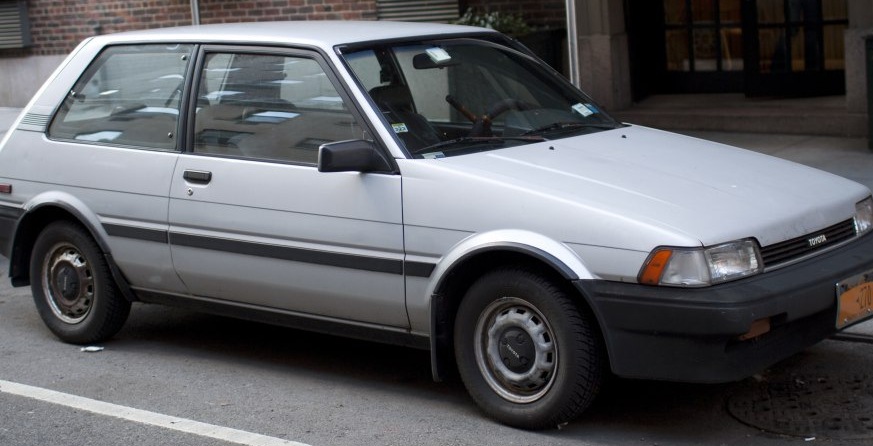
The Toyota Corolla FX Compact V (E80) 1.3, produced between 1985 and 1987, represented a youthful and sporty iteration of Toyota’s ubiquitous Corolla line. Positioned as an entry-level offering within the E80 generation – which also included more traditionally styled sedans and wagons – the FX Compact V, with its distinctive hatchback body style and smaller displacement engine, aimed to attract a different demographic. It was a key model in Toyota’s strategy to broaden the Corolla’s appeal, particularly in markets where compact, fuel-efficient vehicles were highly valued. The “V” designation denoted a slightly more equipped version compared to the base FX models. This variant was primarily sold in Japan and Europe, offering a more affordable and nimble alternative to larger family cars.
Technical Specifications
| Brand | Toyota |
| Model | Corolla |
| Generation | Corolla FX Compact V (E80) |
| Type (Engine) | 1.3 (75 Hp) |
| Start of production | 1985 |
| End of production | 1987 |
| Powertrain Architecture | Internal Combustion engine |
| Body type | Hatchback |
| Seats | 5 |
| Doors | 3 |
| Fuel consumption (urban) | 7.4 l/100 km (31.8 US mpg) |
| Fuel consumption (extra urban) | 5.1 l/100 km (46.1 US mpg) |
| Fuel Type | Petrol (Gasoline) |
| Acceleration 0 – 100 km/h | 14.1 sec |
| Acceleration 0 – 62 mph | 14.1 sec |
| Acceleration 0 – 60 mph | 13.4 sec |
| Maximum speed | 160 km/h (99.42 mph) |
| Weight-to-power ratio | 11.4 kg/Hp |
| Weight-to-torque ratio | 8.3 kg/Nm |
| Power | 75 Hp @ 6200 rpm |
| Power per litre | 57.9 Hp/l |
| Torque | 103 Nm @ 4200 rpm (75.97 lb.-ft. @ 4200 rpm) |
| Engine layout | Front, Transverse |
| Engine Model/Code | 2E-LU |
| Engine displacement | 1295 cm3 (79.03 cu. in.) |
| Number of cylinders | 4 |
| Engine configuration | Inline |
| Cylinder Bore | 73 mm (2.87 in.) |
| Piston Stroke | 77.4 mm (3.05 in.) |
| Number of valves per cylinder | 3 |
| Fuel injection system | Carburettor |
| Engine aspiration | Naturally aspirated |
| Engine oil capacity | 3.2 l (3.38 US qt | 2.82 UK qt) |
| Coolant capacity | 4.9 l (5.18 US qt | 4.31 UK qt) |
| Kerb Weight | 855 kg (1884.95 lbs.) |
| Max. weight | 1385 kg (3053.4 lbs.) |
| Max load | 530 kg (1168.45 lbs.) |
| Trunk (boot) space – minimum | 246 l (8.69 cu. ft.) |
| Trunk (boot) space – maximum | 366 l (12.93 cu. ft.) |
| Fuel tank capacity | 50 l (13.21 US gal | 11 UK gal) |
| Max. roof load | 50 kg (110.23 lbs.) |
| Permitted trailer load with brakes (12%) | 1000 kg (2204.62 lbs.) |
| Permitted trailer load without brakes | 400 kg (881.85 lbs.) |
| Permitted towbar download | 75 kg (165.35 lbs.) |
| Length | 3970 mm (156.3 in.) |
| Height | 1385 mm (54.53 in.) |
| Wheelbase | 2430 mm (95.67 in.) |
| Front overhang | 805 mm (31.69 in.) |
| Rear overhang | 735 mm (28.94 in.) |
| Minimum turning circle | 9.4 m (30.84 ft.) |
| Drivetrain Architecture | Front wheel drive |
| Number of gears | 5 |
| Gearbox type | Manual transmission |
| Front suspension | Independent, McPherson with coil spring and anti-roll bar |
| Rear suspension | Trailing arm, Transverse stabilizer |
| Wheel rims size | 5J x 13 |
Powertrain & Engine Architecture
The heart of the Corolla FX Compact V 1.3 was the 2E-LU engine, a 1.3-liter (1295 cc) inline-four cylinder gasoline engine. This engine was a relatively simple design, utilizing a single overhead camshaft (SOHC) valvetrain with three valves per cylinder. Crucially, it employed a carburetor for fuel delivery, a technology becoming less common in the mid-1980s as fuel injection gained prominence. The carburetor setup contributed to the engine’s affordability but also limited its overall efficiency and responsiveness compared to fuel-injected counterparts. The 2E-LU produced 75 horsepower at 6200 rpm and 103 Nm (76 lb-ft) of torque at 4200 rpm. This power was transmitted to the front wheels through a five-speed manual transmission, the only gearbox option available for this variant. The transverse engine layout, common for front-wheel-drive vehicles, helped maximize interior space.
Driving Characteristics
The 1.3-liter engine and five-speed manual transmission combination provided adequate, though not exhilarating, performance. Acceleration from 0 to 60 mph took around 13.4 seconds, and the top speed was approximately 99 mph. The car felt nimble and easy to maneuver, particularly in urban environments. The five-speed gearbox allowed drivers to keep the engine in its optimal power band, but the relatively low horsepower meant that overtaking maneuvers required careful planning. Compared to the later 1.6-liter versions of the FX, the 1.3 felt noticeably slower, but it offered better fuel economy. The manual transmission provided a more engaging driving experience than an automatic would have, and the light weight of the vehicle contributed to its responsive handling.
Equipment & Trim Levels
The Corolla FX Compact V 1.3 was positioned as a relatively basic, yet functional, vehicle. Standard equipment typically included cloth upholstery, a basic instrument cluster, and manual windows and door locks. The “V” designation indicated some additional features over the base model, such as upgraded interior trim and potentially a more comprehensive radio. Optional extras included a sunroof, upgraded audio systems, and alloy wheels. The interior design was functional and straightforward, prioritizing practicality over luxury. The hatchback body style offered good cargo versatility, with a usable trunk space of around 8.69 to 12.93 cubic feet depending on the rear seats’ position.
Chassis & Braking
The FX Compact V utilized a McPherson strut front suspension with coil springs and an anti-roll bar, providing a comfortable and controlled ride. The rear suspension employed a trailing arm setup with a transverse stabilizer. Braking was accomplished via disc brakes on the front wheels and drum brakes on the rear. This configuration was typical for vehicles in this price range during the mid-1980s. The steering was manual, contributing to the car’s direct feel. The relatively lightweight construction of the vehicle – around 1885 lbs – helped to compensate for the less sophisticated braking system.
Market Reception & Comparison
The Corolla FX Compact V 1.3 was generally well-received as an affordable and reliable entry-level hatchback. Critics praised its fuel efficiency and nimble handling, but noted its lack of outright performance. Compared to other small hatchbacks of the era, such as the Volkswagen Polo or the Ford Fiesta, the Corolla offered a good balance of practicality, reliability, and value. The 1.6-liter versions of the FX offered significantly more power, but at a higher price point. The 1.3-liter model appealed to buyers who prioritized fuel economy and affordability over performance.
Legacy
The Toyota Corolla FX Compact V 1.3, while not a particularly high-performance variant, played an important role in expanding the Corolla’s appeal to a younger and more diverse audience. The 2E-LU engine, while simple, proved to be remarkably durable and reliable. Today, these cars are relatively rare, but well-maintained examples are sought after by collectors and enthusiasts. The FX Compact V represents a charming and practical piece of automotive history, embodying the spirit of the 1980s compact car market. Its simplicity and robust construction contribute to its continued viability as a classic vehicle, though finding parts can be increasingly challenging.