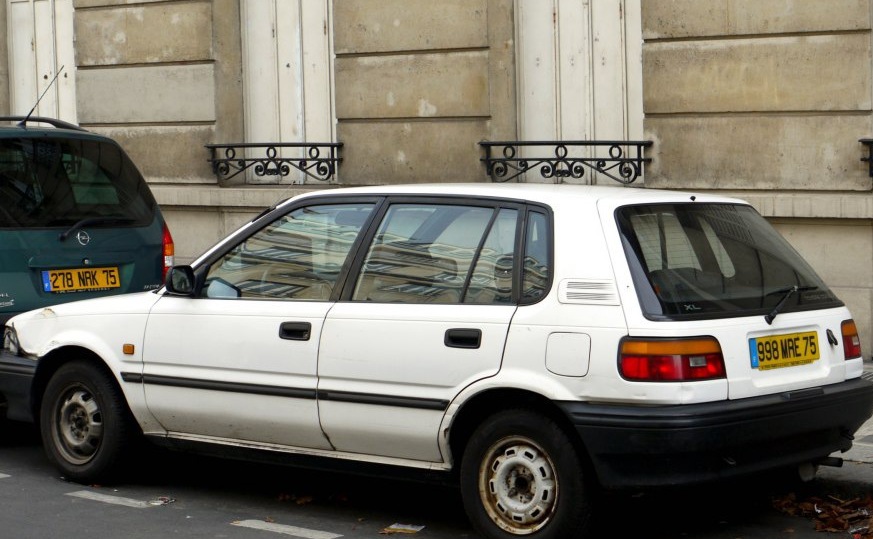
The Toyota Corolla E90, produced between 1987 and 1990, represented the sixth generation of Toyota’s globally successful Corolla line. Within this generation, the 1.3-liter (EE90) variant, producing 75 horsepower, served as the entry point into the Corolla hatchback range, primarily aimed at budget-conscious buyers and those prioritizing fuel efficiency. This model was particularly significant in European and Asian markets where smaller, economical hatchbacks were highly sought after. It offered a practical and reliable transportation solution, building upon the Corolla’s established reputation for dependability.
Technical Specifications
| Brand | Toyota |
| Model | Corolla |
| Generation | Corolla Hatch VI (E90) |
| Type (Engine) | 1.3 (EE90) (75 Hp) |
| Start of production | 1987 |
| End of production | 1990 |
| Powertrain Architecture | Internal Combustion engine |
| Body type | Hatchback |
| Seats | 5 |
| Doors | 5 |
| Fuel Type | Petrol (Gasoline) |
| Power | 75 Hp |
| Engine Model/Code | 2E-E |
| Engine aspiration | Naturally aspirated engine |
| Engine oil capacity | 3.2 l (3.38 US qt | 2.82 UK qt) |
| Coolant capacity | 4.9 l (5.18 US qt | 4.31 UK qt) |
Powertrain & Engine Architecture
The heart of the Corolla EE90 was the 2E-E engine, a 1.3-liter, inline-four cylinder gasoline engine. This engine was a relatively simple design, featuring a single overhead camshaft (SOHC) operating two valves per cylinder. Fuel delivery was managed by a carburetor in many markets, though some later versions incorporated electronic fuel injection (EFI) for improved efficiency and emissions control. The 2E-E was known for its robustness and ease of maintenance, characteristics that contributed to the Corolla’s overall reliability. The engine’s modest 75 horsepower output was achieved at 6,000 rpm, with peak torque of approximately 88 lb-ft at 3,600 rpm. The transmission paired with this engine was typically a four-speed automatic, designed to provide smooth and comfortable operation for everyday driving. This automatic transmission wasn’t known for its sportiness, prioritizing fuel economy and ease of use over rapid acceleration.
Driving Characteristics
The 1.3L automatic Corolla E90 offered a decidedly unhurried driving experience. Acceleration was adequate for city driving and highway merging, but it wasn’t a particularly quick car. The four-speed automatic transmission, while smooth, had relatively widely spaced gear ratios, which meant the engine often felt strained during overtaking maneuvers. Compared to the 1.6-liter versions of the E90, or those equipped with a manual transmission, the 1.3 automatic was noticeably slower. However, the trade-off was improved fuel economy. The suspension was tuned for comfort, providing a reasonably compliant ride over most road surfaces. Steering was light and easy, making it well-suited for urban environments. The overall driving experience was geared towards practicality and ease of use, rather than performance.
Equipment & Trim Levels
The 1.3-liter Corolla E90 typically represented the base trim level. Standard equipment generally included cloth upholstery, a basic AM/FM radio, and manual windows and door locks. Power steering was often optional, and air conditioning was frequently an extra-cost option. Interior plastics were durable but relatively basic in appearance. The dashboard layout was functional and straightforward, with clearly labeled controls. Higher trim levels, such as the 1.6-liter models, offered features like upgraded upholstery, a more sophisticated stereo system, and additional convenience items like central locking and electric windows. The EE90’s interior was designed for practicality and durability, prioritizing function over luxury.
Chassis & Braking
The Corolla E90 utilized a front-engine, front-wheel-drive layout. The suspension consisted of MacPherson struts at the front and a torsion beam axle at the rear. This setup provided a good balance between ride comfort and handling. Braking was typically accomplished with disc brakes at the front and drum brakes at the rear. The braking system was adequate for the car’s weight and performance, but it lacked the stopping power of more modern vehicles. Stabilizer bars were often omitted on the base 1.3-liter model to keep costs down, further contributing to the car’s softer handling characteristics. The chassis was designed to be lightweight and durable, contributing to the Corolla’s overall reliability and fuel efficiency.
Market Reception & Comparison
The 1.3-liter Corolla E90 was generally well-received as an affordable and reliable hatchback. Critics praised its fuel efficiency and ease of maintenance, but noted its lack of performance. Compared to other hatchbacks in its class, such as the Volkswagen Golf or Ford Escort, the Corolla offered a more conservative driving experience but a stronger reputation for long-term dependability. The automatic transmission version, while convenient, was often criticized for its sluggishness compared to the manual transmission options. Fuel economy was a key selling point, with the 1.3-liter engine achieving around 35-40 mpg in real-world driving conditions. The Corolla’s strong resale value also contributed to its popularity.
Legacy
The Toyota Corolla E90 1.3 (EE90) has proven to be a remarkably durable and long-lasting vehicle. Many examples are still on the road today, a testament to Toyota’s engineering and build quality. The 2E-E engine is known for its ability to withstand high mileage with proper maintenance. While not a particularly collectible model, the E90 holds a nostalgic appeal for many drivers who remember its practicality and reliability. In the used car market, these Corollas are often sought after as inexpensive and dependable transportation, particularly by first-time car buyers or those needing a reliable commuter vehicle. The 1.3 automatic variant, while not the most exciting version of the E90, remains a viable option for those prioritizing affordability and fuel efficiency over performance.