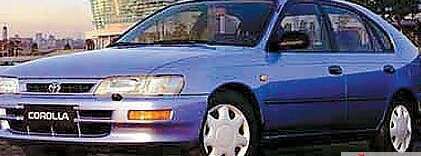
The Toyota Corolla E100, produced between 1992 and 1997, represented the seventh generation of Toyota’s globally successful Corolla. Within this generation, the 1.6 i 16V GLi hatchback, available from 1995 to 1997, occupied a mid-range position in the lineup, offering a balance between performance, fuel efficiency, and equipment. This variant was primarily aimed at the European market, where compact hatchbacks were – and continue to be – immensely popular. It served as a step up from the base models, providing a more refined driving experience and a higher level of standard features.
POWERTRAIN & ENGINE ARCHITECTURE
The heart of the 1.6 i 16V GLi is the 4A-FE engine, a 1.6-liter (1587 cc) inline-four cylinder gasoline engine. This engine is characterized by its multi-port fuel injection system and a double overhead camshaft (DOHC) valvetrain, contributing to its relatively high output for its displacement. The 4A-FE engine produced 114 horsepower at 6000 rpm and 145 Nm (106.95 lb-ft) of torque at 4800 rpm. The engine’s design prioritized reliability and fuel economy, typical of Toyota engineering philosophy. The 4A-FE was known for its durability and relatively simple maintenance requirements. This particular GLi trim was equipped with a five-speed manual transmission, offering drivers full control over the engine’s power delivery. The transmission was chosen to complement the engine’s characteristics, providing crisp shifts and a responsive feel.
DRIVING CHARACTERISTICS
The 1.6 i 16V GLi offered a reasonably spirited driving experience for its class. Acceleration from 0 to 62 mph (0-100 km/h) took approximately 10 seconds, making it competitive with other hatchbacks of the era. The five-speed manual transmission allowed drivers to keep the engine in its optimal power band, resulting in decent acceleration and responsiveness. Compared to the base 1.3L models, the 1.6L offered a noticeable improvement in performance, particularly when carrying passengers or cargo. While not a sports car, the 1.6 i 16V GLi provided enough power for everyday driving and occasional highway trips. The gear ratios were well-matched to the engine’s torque curve, providing good in-gear acceleration. The front-wheel-drive configuration offered predictable handling, although it wasn’t particularly engaging for enthusiastic drivers.
EQUIPMENT & TRIM LEVELS
The GLi trim level signified a step up in features compared to the more basic Corolla models. Standard equipment typically included power steering, central locking, electric windows, and a basic audio system. Interior upholstery was usually cloth, with a relatively simple but functional dashboard layout. Optional extras could include air conditioning, alloy wheels, and an upgraded audio system. The GLi trim aimed to provide a comfortable and well-equipped package for buyers seeking a practical and reliable hatchback. The interior design prioritized functionality and durability over luxury, reflecting the car’s overall value proposition.
CHASSIS & BRAKING
The Corolla E100 utilized a relatively conventional chassis design, featuring a MacPherson strut front suspension and a torsion beam rear suspension. This setup provided a comfortable ride quality, although it wasn’t particularly sporty. The front brakes were ventilated discs, offering good stopping power, while the rear brakes were drums. Anti-lock Braking System (ABS) was available as an option, enhancing safety. The steering was a rack and pinion system with hydraulic power assistance, providing light and precise steering feel. The car’s relatively light curb weight of 1097 kg (2418.47 lbs) contributed to its nimble handling.
MARKET RECEPTION & COMPARISON
The Toyota Corolla E100 1.6 i 16V GLi was generally well-received by automotive critics. It was praised for its reliability, fuel efficiency (around 32.2 US mpg combined), and comfortable ride. Compared to other hatchbacks in its class, such as the Volkswagen Golf or Ford Escort, the Corolla offered a strong value proposition, combining practicality with Toyota’s renowned build quality. The 1.6L engine provided a good balance between performance and economy, making it a popular choice for buyers who didn’t require the extra power of larger engines. Some critics noted that the interior design was somewhat bland, but this was often overlooked in light of the car’s overall strengths.
LEGACY
The 4A-FE engine, found in the 1.6 i 16V GLi, is known for its exceptional longevity and reliability. Many examples of this engine are still running smoothly today, even with high mileage. The E100 Corolla, in general, has earned a reputation as a dependable and affordable used car. Parts availability remains good, and maintenance costs are relatively low. While not a collector’s item, the 1.6 i 16V GLi is a well-regarded variant within the E100 range, appreciated by owners for its practicality, reliability, and fuel efficiency. It represents a solid example of Toyota’s commitment to building durable and dependable vehicles.
| Brand | Toyota |
| Model | Corolla |
| Generation | Corolla Hatch VII (E100) |
| Type (Engine) | 1.6 i 16V GLi (114 Hp) |
| Start of production | 1995 year |
| End of production | 1997 year |
| Powertrain Architecture | Internal Combustion engine |
| Body type | Hatchback |
| Seats | 5 |
| Doors | 5 |
| Fuel consumption (economy) – combined | 7.3 l/100 km |
| Fuel consumption (economy) – combined | 32.2 US mpg |
| Fuel consumption (economy) – combined | 38.7 UK mpg |
| Fuel Type | Petrol (Gasoline) |
| Acceleration 0 – 100 km/h | 10 sec |
| Acceleration 0 – 62 mph | 10 sec |
| Acceleration 0 – 60 mph | 9.5 sec |
| Maximum speed | 195 km/h |
| Maximum speed | 121.17 mph |
| Weight-to-power ratio | 9.6 kg/Hp |
| Weight-to-power ratio | 103.9 Hp/tonne |
| Weight-to-torque ratio | 7.6 kg/Nm |
| Weight-to-torque ratio | 132.2 Nm/tonne |
| Power | 114 Hp @ 6000 rpm |
| Power per litre | 71.8 Hp/l |
| Torque | 145 Nm @ 4800 rpm |
| Torque | 106.95 lb.-ft. @ 4800 rpm |
| Engine layout | Front, Transverse |
| Engine Model/Code | 4A-FE |
| Engine displacement | 1587 cm3 |
| Engine displacement | 96.84 cu. in. |
| Number of cylinders | 4 |
| Engine configuration | Inline |
| Cylinder Bore | 81 mm |
| Cylinder Bore | 3.19 in. |
| Piston Stroke | 77 mm |
| Piston Stroke | 3.03 in. |
| Compression ratio | 9.5:1 |
| Number of valves per cylinder | 4 |
| Fuel injection system | Multi-port manifold injection |
| Engine aspiration | Naturally aspirated engine |
| Valvetrain | DOHC |
| Engine oil capacity | 3.3 l |
| Engine oil capacity | 3.49 US qt | 2.9 UK qt |
| Coolant | 5 l |
| Coolant | 5.28 US qt | 4.4 UK qt |
| Kerb Weight | 1097 kg |
| Kerb Weight | 2418.47 lbs. |
| Max. weight | 1595 kg |
| Max. weight | 3516.37 lbs. |
| Max load | 498 kg |
| Max load | 1097.9 lbs. |
| Trunk (boot) space – minimum | 400 l |
| Trunk (boot) space – minimum | 14.13 cu. ft. |
| Trunk (boot) space – maximum | 845 l |
| Trunk (boot) space – maximum | 29.84 cu. ft. |
| Fuel tank capacity | 50 l |
| Fuel tank capacity | 13.21 US gal | 11 UK gal |
| Length | 4295 mm |
| Length | 169.09 in. |
| Width | 1685 mm |
| Width | 66.34 in. |
| Height | 1375 mm |
| Height | 54.13 in. |
| Wheelbase | 2465 mm |
| Wheelbase | 97.05 in. |
| Front track | 1460 mm |
| Front track | 57.48 in. |
| Rear (Back) track | 1450 mm |
| Rear (Back) track | 57.09 in. |
| Drivetrain Architecture | The Internal combustion engine (ICE) drives the front wheels of the vehicle. |
| Drive wheel | Front wheel drive |
| Number of gears and type of gearbox | 5 gears, manual transmission |
| Front suspension | Spring Strut |
| Rear suspension | Spring Strut |
| Front brakes | Ventilated discs |
| Rear brakes | Drum |
| Assisting systems | ABS (Anti-lock braking system) |
| Steering type | Steering rack and pinion |
| Power steering | Hydraulic Steering |
| Tires size | 175/65 R14 H |