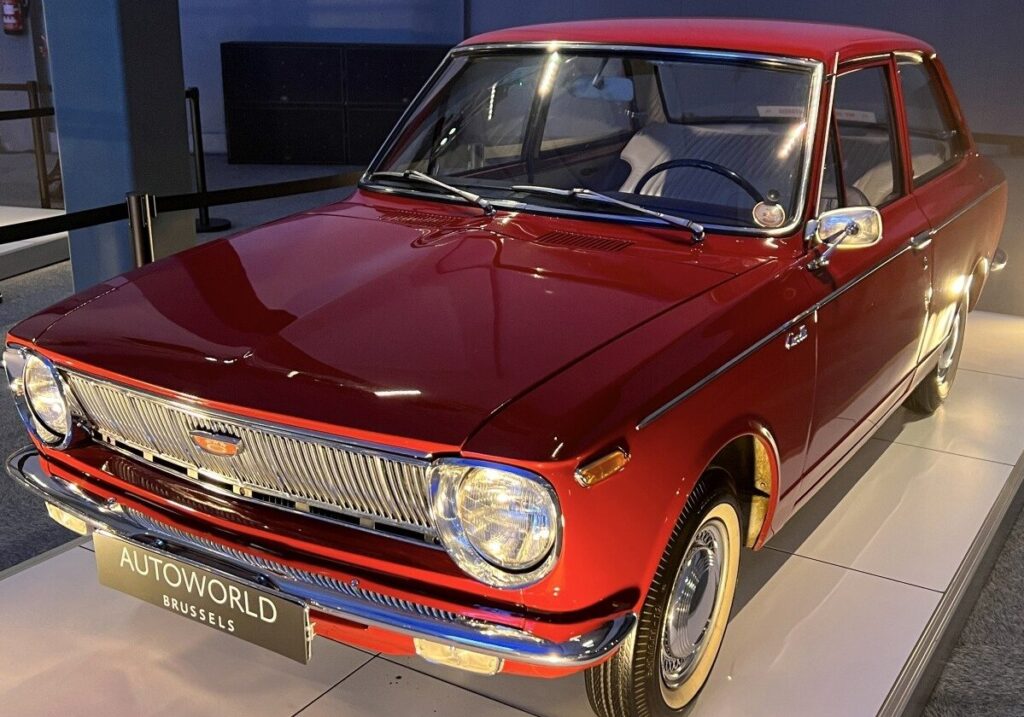
The Toyota Corolla E10, introduced in 1966, marked a significant step forward for Toyota, representing their second foray into the compact car market. The 2-door sedan variant, specifically equipped with the 1.1-liter (1077 cc) ‘K’ engine producing 60 horsepower, served as the entry point into the Corolla lineup during its 1966-1970 production run. This model was crucial in establishing the Corolla’s reputation for reliability and affordability, and it played a key role in Toyota’s growing international presence. The E10 series, built on the A10 platform, offered a more modern and comfortable alternative to the smaller Toyota Publica, targeting a broader customer base.
The 1.1L ‘K’ Engine and its Positioning
The 1.1L Corolla represented the base model within the E10 range. Higher trim levels featured larger 1.2L and 1.5L engines offering increased performance. The 60 hp version was specifically designed for economy and practicality, appealing to buyers prioritizing fuel efficiency and low running costs over outright speed. It was often chosen by first-time car buyers, families needing a dependable second vehicle, and those in markets where smaller, more economical cars were preferred. Compared to the larger-engined Corollas, the 1.1L offered a more accessible price point, making it a popular choice despite its modest power output.
Powertrain & Engine Architecture
The heart of the 1.1L Corolla was the Toyota ‘K’ engine, a 1077 cc inline-four cylinder engine. This engine featured a relatively simple overhead valve (OHV) valvetrain with two valves per cylinder. The engine’s bore and stroke measured 75 mm (2.95 in) and 61 mm (2.4 in) respectively, resulting in a compression ratio of 9:1. Fuel delivery was managed by a single carburetor, a common setup for the time, prioritizing simplicity and cost-effectiveness. The engine produced 60 hp at 6000 rpm and 83 Nm (61.22 lb-ft) of torque at 3800 rpm. The engine was longitudinally mounted in the front of the vehicle, driving the rear wheels.
The standard transmission for the 1.1L Corolla was a 4-speed manual gearbox. While an automatic transmission was not initially offered on this base model, some markets later saw the availability of a 3-speed automatic, though it was less common and often paired with the larger 1.2L engine. The manual transmission was chosen for its efficiency and simplicity, contributing to the car’s overall fuel economy.
Driving Characteristics
The 1.1L Corolla was not designed for spirited performance. With 60 horsepower propelling a vehicle weighing approximately 690 kg (1521 lbs), acceleration was modest. The car’s strength lay in its usability and fuel efficiency. The 4-speed manual transmission allowed drivers to keep the engine in its optimal power band, but overtaking required careful planning. The rear-wheel-drive configuration provided predictable handling, typical of cars of that era. The gear ratios were optimized for economy, with a relatively tall final drive. Compared to the 1.2L and 1.5L models, the 1.1L felt noticeably slower, particularly when fully loaded or climbing hills. However, its lighter weight and simpler engine contributed to a more nimble feel in city driving.
Equipment & Trim Levels
The base 1.1L Corolla was fairly spartan in terms of equipment, reflecting its position as the entry-level model. Standard features typically included basic vinyl upholstery, a simple dashboard with minimal instrumentation (speedometer, fuel gauge, and temperature gauge), and basic exterior trim. Optional extras included a radio, heater, and upgraded interior trim. The interior was functional and durable, prioritizing practicality over luxury. The 2-door sedan body style offered reasonable space for four passengers, although rear seat legroom was limited. The steering wheel was a simple two-spoke design, and the door panels featured basic handles and armrests.
Chassis & Braking
The Corolla E10 utilized a body-on-frame construction, common for cars of that period. The front suspension consisted of independent coil springs with a transverse stabilizer bar, providing a reasonable level of ride comfort. The rear suspension employed a rigid axle with leaf springs, a simpler and more cost-effective design. Braking was handled by drum brakes on all four wheels, measuring 200.66 mm in diameter. The steering system was a cone worm with recirculation balls, offering relatively precise steering feel for the time. The car’s relatively light weight helped to compensate for the limitations of the drum brakes.
Market Reception & Comparison
The 1.1L Corolla was generally well-received by critics and consumers alike. It was praised for its reliability, fuel economy, and affordability. While its performance was not exceptional, it was considered adequate for its intended purpose. Compared to other cars in its class, such as the Volkswagen Beetle and the Ford Cortina, the Corolla offered a more modern design and a reputation for exceptional durability. The 1.1L version was particularly popular in markets where fuel costs were high and driving conditions were primarily urban. Its fuel consumption of 5 l/100 km (47 US mpg) was a significant selling point. However, some critics noted the car’s lack of power and its relatively basic interior.
Technical Specifications
| Brand | Toyota |
| Model | Corolla |
| Generation | Corolla I 2-door sedan (E10) |
| Type (Engine) | 1100 (60 Hp) |
| Start of production | 1966 |
| End of production | 1970 |
| Powertrain Architecture | Internal Combustion engine |
| Body type | Sedan |
| Seats | 5 |
| Doors | 2 |
| Fuel consumption (combined) | 5 l/100 km (47 US mpg, 56.5 UK mpg, 20 km/l) |
| Maximum speed | 140 km/h (86.99 mph) |
| Weight-to-power ratio | 11.5 kg/Hp |
| Weight-to-torque ratio | 8.3 kg/Nm |
| Power | 60 Hp @ 6000 rpm |
| Power per litre | 55.7 Hp/l |
| Torque | 83 Nm @ 3800 rpm (61.22 lb.-ft. @ 3800 rpm) |
| Engine layout | Front, Longitudinal |
| Engine Model/Code | K |
| Engine displacement | 1077 cm3 (65.72 cu. in.) |
| Number of cylinders | 4 |
| Engine configuration | Inline |
| Cylinder Bore | 75 mm (2.95 in.) |
| Piston Stroke | 61 mm (2.4 in.) |
| Compression ratio | 9:1 |
| Number of valves per cylinder | 2 |
| Fuel injection system | Carburettor |
| Engine aspiration | Naturally aspirated |
| Engine oil capacity | 2.7 l (2.85 US qt | 2.38 UK qt) |
| Coolant capacity | 4.7 l (4.97 US qt | 4.14 UK qt) |
| Kerb Weight | 690 kg (1521.19 lbs.) |
| Fuel tank capacity | 36 l (9.51 US gal | 7.92 UK gal) |
| Length | 3845 mm (151.38 in.) |
| Width | 1485 mm (58.46 in.) |
| Height | 1380 mm (54.33 in.) |
| Wheelbase | 2285 mm (89.96 in.) |
| Front track | 1230 mm (48.43 in.) |
| Rear track | 1220 mm (48.03 in.) |
| Ride height (ground clearance) | 170 mm (6.69 in.) |
| Minimum turning circle | 9.1 m (29.86 ft.) |
| Drivetrain Architecture | Rear wheel drive |
| Number of gears | 4 |
| Type of gearbox | Manual transmission |
| Front suspension | Independent coil spring, Transverse stabilizer |
| Rear suspension | Rigid axle suspension, Leaf spring |
| Front brakes | Drum, 200.66 mm |
| Rear brakes | Drum, 200.66 mm |
| Steering type | Cone worm with recirculation balls |
Legacy
The 1.1L Corolla E10, while the least powerful variant, remains a significant vehicle in Toyota’s history. Its robust engine and simple design contributed to its long-term reliability. Today, well-maintained examples are sought after by classic car enthusiasts, particularly those interested in experiencing a piece of automotive history. The ‘K’ engine, while not known for its high performance, is relatively easy to maintain and parts availability remains reasonable. The 1.1L Corolla’s enduring appeal lies in its simplicity, affordability, and the reputation for dependability that helped establish the Corolla as one of the world’s most popular cars.