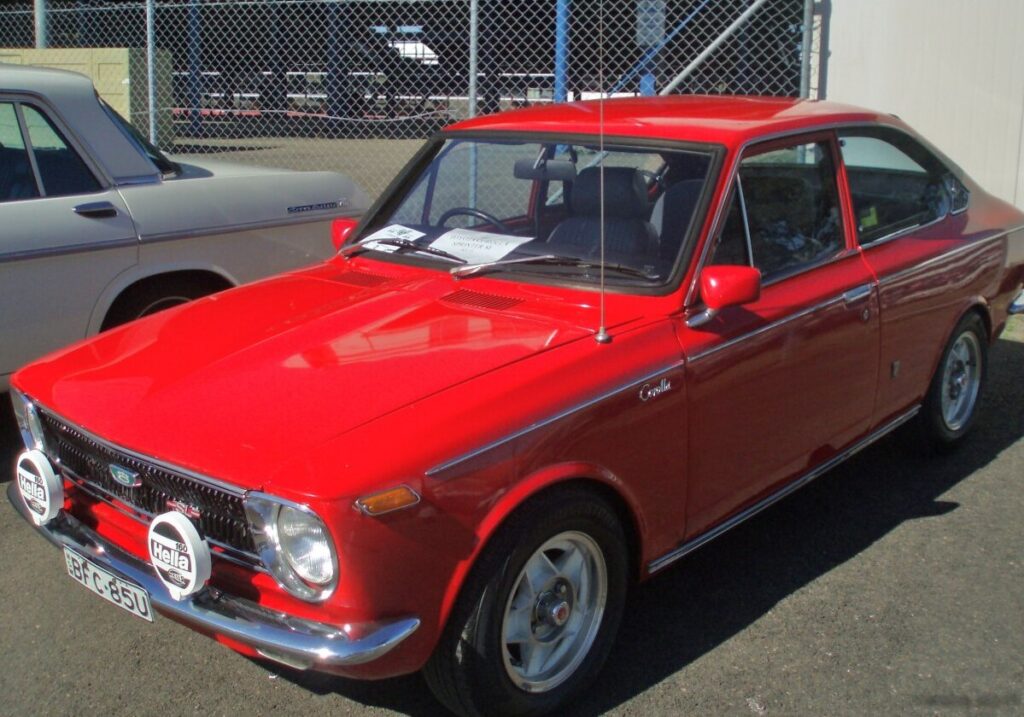
The Toyota Corolla I Sprinter (E10) 1100, produced between 1968 and 1970, represented an early iteration of Toyota’s globally successful Corolla line. This specific variant, powered by a 1.1-liter engine producing 60 horsepower, occupied the entry-level position within the E10 range, primarily marketed as an affordable and economical coupe. The Sprinter designation denoted a slightly more upscale trim level compared to the base Corolla, offering minor cosmetic and equipment differences. It was built on the E10 platform, the first generation Corolla, and served as a key model in establishing Toyota’s presence in international markets.
The 1.1L “K” Engine and Powertrain
The heart of the Corolla I Sprinter 1100 was the Toyota K engine, a 1077cc (65.72 cubic inches) inline-four cylinder gasoline engine. This engine, designated as the ‘K’ series, was a relatively simple design featuring a two-valve per cylinder OHV (Overhead Valve) valvetrain. It utilized a single carburetor for fuel delivery, a common practice for engines of this era aiming for cost-effectiveness. The engine produced 60 hp at 6000 rpm and 83 Nm (61.22 lb-ft) of torque at 3800 rpm. The compression ratio was set at 9:1. Engine oil capacity was 2.7 liters (2.85 US quarts), and the cooling system held 4.7 liters (4.97 US quarts).
Power was delivered to the rear wheels via a four-speed manual transmission. The longitudinal engine layout was typical for rear-wheel-drive vehicles of the time. While an automatic transmission wasn’t offered on this specific 1100 variant, the manual gearbox provided a direct and engaging driving experience, albeit one limited by the engine’s modest power output. The K engine was known for its durability and relative simplicity, making it a reliable, if not particularly exciting, powerplant.
Comparison to Other E10 Variants
The 1100 Sprinter sat at the bottom of the E10 lineup. Higher trim levels included the 1200 and 1600 models, which featured larger displacement engines offering significantly more power. The 1600, in particular, was considered the performance-oriented version of the first-generation Corolla. Compared to these larger engines, the 1100 prioritized fuel economy and affordability. Maintenance costs for the 1100 were generally lower due to its simpler design and smaller engine size. The target audience for the 1100 was primarily first-time car buyers, students, or those seeking a basic, reliable form of transportation.
Driving Characteristics
The Corolla I Sprinter 1100 offered modest performance. With 60 horsepower propelling a relatively lightweight vehicle (705 kg or 1554.26 lbs), acceleration was leisurely. Top speed was recorded at 145 km/h (90.1 mph). The four-speed manual transmission required frequent shifting to maintain momentum, especially when climbing hills or overtaking. The weight-to-power ratio of 11.8 kg/hp and weight-to-torque ratio of 8.5 kg/Nm reflected the engine’s limitations. However, the car’s light weight and nimble handling made it enjoyable to drive on winding roads. The rear-wheel-drive configuration provided a balanced feel, although it lacked the stability of more modern front-wheel-drive systems.
Equipment and Trim Levels
The Sprinter trim level offered a slightly more refined interior compared to the base Corolla. Standard features included basic cloth upholstery, a simple dashboard layout with analog gauges, and minimal exterior brightwork. The coupe body style, with its two doors and five-seat capacity, was a defining characteristic of this variant. Optional extras were limited, reflecting the car’s entry-level positioning. These might have included a radio, upgraded seat materials, or a different paint color. The focus was on providing essential transportation at an affordable price point.
Chassis and Braking
The Corolla I Sprinter 1100 utilized a relatively conventional chassis design for the late 1960s. The front suspension consisted of independent coil springs with a transverse stabilizer bar, providing a reasonable level of ride comfort and handling. The rear suspension employed a rigid axle with leaf springs, a cost-effective solution that prioritized durability over sophistication. Braking was handled by drum brakes on all four wheels, with a diameter of 200.66 mm. The steering system was a cone worm with recirculation balls, offering a direct but somewhat heavy steering feel. The ride height (ground clearance) was 170 mm (6.69 inches).
Market Reception and Comparison
The Corolla I Sprinter 1100 was generally well-received by critics as a practical and reliable vehicle. Its fuel economy, rated at 4.7 l/100 km (50 US mpg, 60.1 UK mpg, 21.3 km/l), was a significant selling point, particularly during a period of rising fuel prices. While its performance was not exceptional, it was considered adequate for everyday driving. Compared to other small cars of the era, such as the Volkswagen Beetle or the Ford Cortina, the Corolla offered a good balance of affordability, reliability, and comfort. However, it lacked the sporting pretensions of some of its European rivals.
Technical Specifications
| Brand | Toyota |
| Model | Corolla I Sprinter (E10) |
| Type (Engine) | 1100 (60 Hp) |
| Start of production | 1968 |
| End of production | 1970 |
| Engine Model/Code | K |
| Engine displacement | 1077 cm3 (65.72 cu. in.) |
| Number of cylinders | 4 |
| Engine configuration | Inline |
| Cylinder Bore | 75 mm (2.95 in.) |
| Piston Stroke | 61 mm (2.4 in.) |
| Compression ratio | 9:1 |
| Number of valves per cylinder | 2 |
| Fuel injection system | Carburettor |
| Engine aspiration | Naturally aspirated |
| Power | 60 Hp @ 6000 rpm |
| Torque | 83 Nm @ 3800 rpm (61.22 lb.-ft. @ 3800 rpm) |
| Kerb Weight | 705 kg (1554.26 lbs.) |
| Max. weight | 980 kg (2160.53 lbs.) |
| Max load | 275 kg (606.27 lbs.) |
| Fuel tank capacity | 36 l (9.51 US gal | 7.92 UK gal) |
| Length | 3845 mm (151.38 in.) |
| Width | 1485 mm (58.46 in.) |
| Height | 1345 mm (52.95 in.) |
| Wheelbase | 2285 mm (89.96 in.) |
| Drive wheel | Rear wheel drive |
| Number of gears and type of gearbox | 4 gears, manual transmission |
Legacy
The Toyota Corolla I Sprinter 1100, while not the most powerful or technologically advanced vehicle of its time, played a crucial role in establishing the Corolla as a global automotive icon. The ‘K’ engine proved to be remarkably durable, and many examples of this engine are still running today. In the used car market, these early Corollas are increasingly sought after by collectors and enthusiasts, particularly those interested in preserving automotive history. The 1100 variant, due to its affordability and simplicity, remains a relatively accessible entry point into the world of classic Toyota ownership. Its enduring appeal lies in its honest design, reliable mechanics, and the nostalgic charm of a bygone era.