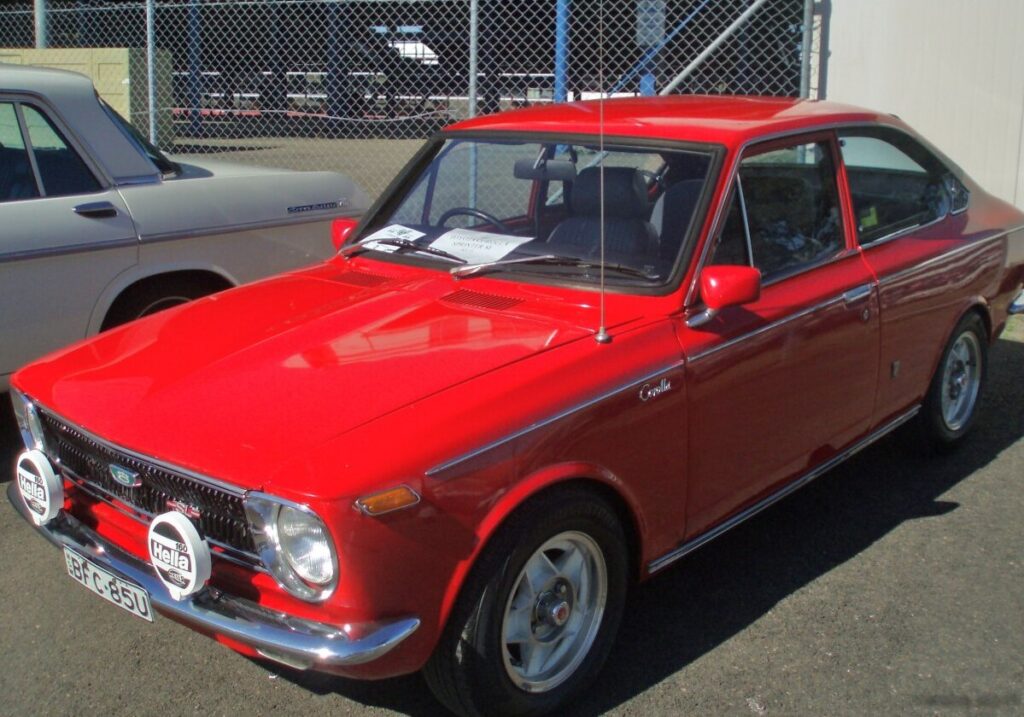
The Toyota Corolla I Sprinter (E10) 1100 Automatic, produced between 1968 and 1970, represented an entry-level offering within the first generation Corolla lineup. Positioned as a more stylish and slightly more upscale variant of the standard Corolla, the Sprinter was a two-door coupe aimed at buyers seeking a compact, economical, and relatively sporty vehicle. This particular configuration, featuring a 1.1-liter engine paired with a two-speed automatic transmission, was designed for ease of use and accessibility, prioritizing comfort over outright performance. The E10 chassis underpinned all first-generation Corollas and Sprinters, representing Toyota’s initial foray into front-engine, rear-wheel-drive compact cars designed for a global market.
Powertrain & Engine Architecture
The heart of the Corolla I Sprinter 1100 Automatic was the Toyota K engine, a 1077cc (65.72 cubic inch) inline-four cylinder gasoline engine. This engine, designated as the ‘K’ series, was a relatively simple design featuring a cast iron block and cylinder head. It utilized an overhead valve (OHV) valvetrain with two valves per cylinder. Fuel delivery was managed by a single carburetor, a common practice for engines of this era. The engine produced 60 horsepower at 6000 rpm and 83 Nm (61.22 lb-ft) of torque at 3800 rpm. The compression ratio was set at 9:1. Engine oil capacity was 2.7 liters (2.85 US quarts / 2.38 UK quarts) and the cooling system held 4.7 liters (4.97 US quarts / 4.14 UK quarts).
The automatic transmission was a two-speed unit, a relatively uncommon feature in 1968-1970 for vehicles in this class. This transmission was chosen to provide a smooth and effortless driving experience, appealing to a broader range of drivers, particularly those unfamiliar or uninterested in manual transmissions. The two-speed design prioritized fuel efficiency and ease of driving in urban environments over rapid acceleration. The engine was mounted longitudinally in the front of the vehicle, driving the rear wheels.
Engine Code & Characteristics
The ‘K’ engine, while simple, was known for its durability and relatively low maintenance requirements. The carburetor system, while not as efficient as later fuel injection systems, was reliable and easy to service. The OHV valvetrain, while less sophisticated than overhead camshaft designs, contributed to the engine’s robustness. The 1.1-liter displacement provided adequate power for the Sprinter’s light weight, but performance was modest by modern standards.
Driving Characteristics
The Corolla I Sprinter 1100 Automatic offered a comfortable, albeit unhurried, driving experience. The two-speed automatic transmission resulted in relatively slow acceleration, with a focus on smooth shifts and ease of operation. The limited number of gears meant that the engine often operated at higher rpm during highway cruising, potentially impacting fuel economy and noise levels. The maximum speed was approximately 135 km/h (83.89 mph). The weight-to-power ratio of 12 kg/hp and weight-to-torque ratio of 8.7 kg/Nm reflected the car’s modest performance capabilities.
Compared to the manual transmission versions of the Corolla and Sprinter, the automatic variant sacrificed some responsiveness and fuel efficiency. The manual transmission allowed drivers to better control engine speed and maximize power output. However, the automatic provided a significantly more relaxed driving experience, particularly in stop-and-go traffic. Compared to later, more powerful Corolla variants (like those with larger engines), the 1100 Automatic was clearly positioned as an entry-level model, prioritizing affordability and ease of use over performance.
Equipment & Trim Levels
The Corolla I Sprinter 1100 Automatic, while positioned as a more stylish version of the standard Corolla, was still a relatively basic vehicle by modern standards. Standard features typically included cloth upholstery, basic instrumentation (speedometer, fuel gauge, temperature gauge), and a two-spoke steering wheel. The interior was functional and designed for durability rather than luxury. The Sprinter’s coupe body style offered seating for five passengers, although rear seat space was limited.
Optional extras were available, though their prevalence varied depending on the market. These could include upgraded audio systems, a heater, and different exterior color options. The Sprinter often featured more chrome trim and a slightly more refined interior finish compared to the base Corolla models. Trim levels were relatively simple, with the Automatic variant typically representing a mid-range offering within the Sprinter lineup.
Chassis & Braking
The Corolla I Sprinter 1100 Automatic utilized a relatively simple chassis design. The front suspension consisted of independent coil springs with a transverse stabilizer bar, providing a reasonable level of ride comfort. The rear suspension employed a rigid axle with leaf springs, a common setup for rear-wheel-drive vehicles of this era. The kerb weight of the vehicle was 720 kg (1587.33 lbs), while the maximum weight was 995 kg (2193.6 lbs).
The braking system consisted of drum brakes on all four wheels, with a diameter of 200.66 mm. While adequate for the vehicle’s weight and performance, the drum brakes lacked the stopping power and fade resistance of disc brakes. The steering system was a cone worm with recirculation balls, providing a relatively indirect steering feel. The minimum turning circle was 9.1 meters (29.86 ft).
Market Reception & Comparison
The Corolla I Sprinter 1100 Automatic was generally well-received by critics and consumers as a practical and economical compact car. Its stylish coupe body and available automatic transmission appealed to buyers seeking a comfortable and easy-to-drive vehicle. However, its modest performance and basic features were often noted. Fuel economy was a strong point, with combined fuel consumption rated at 5.1 l/100 km (46.1 US mpg / 55.4 UK mpg / 19.6 km/l).
Compared to other trims in the Corolla lineup, the 1100 Automatic offered a balance between affordability and convenience. The larger-engined Corollas provided more power and performance, but at a higher price point. The manual transmission versions offered better fuel economy and a more engaging driving experience, but required more driver involvement. The Sprinter’s main competitors included other compact coupes from Japanese manufacturers, such as the Datsun Sports 1200.
Technical Specifications
| Brand | Toyota |
| Model | Corolla I Sprinter (E10) |
| Type | 1100 (60 Hp) Automatic |
| Start of production | 1968 |
| End of production | 1970 |
| Engine Displacement | 1077 cm3 (65.72 cu. in.) |
| Engine Model/Code | K |
| Number of Cylinders | 4 |
| Engine Configuration | Inline |
| Power | 60 Hp @ 6000 rpm |
| Torque | 83 Nm @ 3800 rpm (61.22 lb.-ft. @ 3800 rpm) |
| Fuel Type | Petrol (Gasoline) |
| Fuel Consumption (Combined) | 5.1 l/100 km (46.1 US mpg / 55.4 UK mpg / 19.6 km/l) |
| Maximum Speed | 135 km/h (83.89 mph) |
| Kerb Weight | 720 kg (1587.33 lbs) |
| Max. Weight | 995 kg (2193.6 lbs) |
| Transmission | 2-speed Automatic |
| Drive Wheels | Rear Wheel Drive |
| Length | 3845 mm (151.38 in) |
| Width | 1485 mm (58.46 in) |
| Height | 1345 mm (52.95 in) |
Legacy
The Toyota Corolla I Sprinter 1100 Automatic, while not a particularly rare or highly sought-after classic today, represents an important milestone in Toyota’s history. It was one of the first Corollas to be offered with an automatic transmission, broadening the car’s appeal to a wider audience. The ‘K’ engine proved to be a durable and reliable powerplant, and many examples of these cars continue to operate today.
In the used car market, these Sprinters are typically valued for their originality and historical significance. While parts availability can be a challenge, the relatively simple mechanical design makes them relatively easy to maintain for experienced mechanics. The two-speed automatic transmission, while not particularly efficient, is generally reliable. The Sprinter 1100 Automatic remains a charming and affordable entry point into the world of classic Japanese automobiles.